

The UK immigration system is entering one of its biggest periods of reform since Brexit. Throughout 2025 and into 2026, the UK Government has announced major policy changes affecting skilled workers, students, employers, families, settlement routes, and permanent residency pathways.
For migrants already living in Britain, employers sponsoring overseas talent, and future applicants planning their move, understanding these reforms has become more important than ever.
Many people are asking:
- What are the new changes in UK immigration rules?
- Are UK immigration rules changing?
- When will UK immigration rules change?
- When do new UK immigration rules change?
- How will these reforms affect permanent residency and citizenship?
The short answer is yes. Significant UK immigration changes are already underway, while several additional reforms are expected to be introduced throughout 2026.
This guide explains the latest UK immigration rules changes, what has already happened, what proposals are still under consultation, and what migrants should expect in the future.
Why Is the UK Changing Its Immigration System?
The UK Government published a major policy document called “Restoring Control over the Immigration System“ in May 2025. The white paper outlined a long-term strategy aimed at reducing net migration while creating a more skills-focused immigration system.
Government ministers argued that migration levels had reached historically high levels in recent years and that the immigration system needed reform to encourage domestic workforce development and reduce reliance on overseas labour.
The proposed reforms focus on:
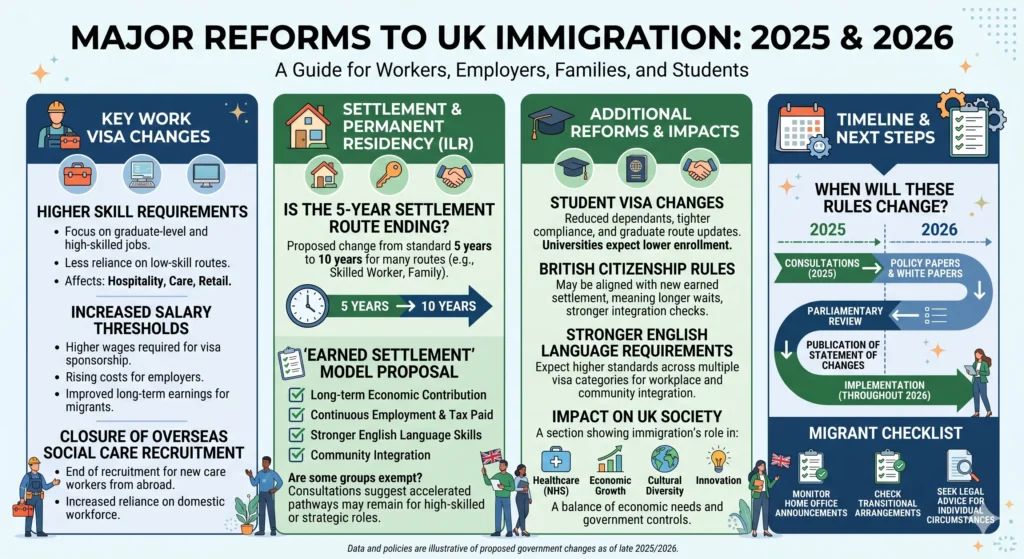
- Raising skill requirements
- Increasing salary thresholds
- Tightening settlement rules
- Strengthening English language standards
- Reducing lower-skilled migration routes
- Creating an “earned settlement” framework
These proposals form the foundation of the latest UK immigration changes 2026 discussions.
UK Immigration Changes 2025: Key Reforms Already Announced
Several major reforms were introduced or proposed during 2025.
1. Higher Skill Requirements for Work Visas
One of the biggest UK immigration rule changes involves the Skilled Worker route.
The Government plans to increase the skills threshold for sponsored jobs, focusing on graduate-level occupations and higher-skilled positions.
The objective is to ensure employers recruit internationally only when genuine skill shortages exist.
For many industries that traditionally relied on overseas recruitment, this represents a major shift.
Affected sectors may include:
- Hospitality
- Social care
- Retail support roles
- Entry-level administrative jobs
The Government believes employers should invest more heavily in domestic workforce training before seeking international recruitment.
2. Increased Salary Thresholds
Another major element of the UK immigration changes is the planned increase in salary requirements.
The Government confirmed its intention to raise salary thresholds across multiple visa categories.
This means future applicants may need significantly higher salaries to qualify for sponsorship.
For employers, this could increase recruitment costs while encouraging hiring of higher-skilled professionals.
For migrants, higher salaries may improve long-term earnings but could reduce opportunities for lower-paid workers.
3. Closure of Overseas Social Care Recruitment
One of the most discussed UK immigration rules changes affects the care sector.
The Government announced plans to end overseas recruitment for new care workers.
Officials argue that the UK should focus on training domestic workers rather than relying on international recruitment for social care roles.
However, care providers have raised concerns about labour shortages and staffing pressures. Industry organisations warn that recruitment challenges could worsen if alternative workforce solutions are not introduced quickly.
The UK Is Changing Permanent Residency Requirements for Immigrants
Perhaps the most significant proposal involves settlement and indefinite leave to remain (ILR).
Many migrants currently qualify for settlement after five years under routes such as:
However, the Government has proposed extending the standard settlement period from five years to ten years.
This is why headlines increasingly state that:
“The UK is changing permanent residency requirements for immigrants.”
For thousands of migrants already building lives in Britain, this could represent one of the biggest immigration reforms in decades.
What Is the Proposed Earned Settlement Model?
The Government wants to replace automatic settlement pathways with a system based on contribution.
Under the proposed “earned settlement” framework, migrants may need to demonstrate:
- Long-term economic contribution
- Continuous employment
- Tax contributions
- English language proficiency
- Community integration
The Government has indicated that individuals who make exceptional contributions could potentially qualify faster than others.
However, detailed implementation rules are still being developed.
Will Everyone Need to Wait 10 Years?
This remains one of the biggest unanswered questions.
While the White Paper proposes a ten-year pathway as the standard route, consultations suggest some groups may still qualify earlier through accelerated pathways.
Possible exemptions may include:
- High-skilled workers
- Strategic industries
- Exceptional talent routes
- Individuals demonstrating significant economic contribution
The final structure is expected to become clearer throughout 2026.
What Happens to Current Visa Holders?
One of the most common concerns surrounding UK immigration changes 2026 is whether current migrants will be affected.
At present, the Government has not provided full details regarding transitional arrangements.
This has created uncertainty for individuals already several years into their five-year settlement journey.
Many immigration experts argue that applying new settlement requirements retrospectively could create significant challenges for migrants who planned their lives under existing rules.
Further clarification is expected through future Immigration Rule updates.
Changes to British Citizenship Rules
Citizenship reforms are expected to follow settlement reforms.
Government policy papers indicate that citizenship requirements may become aligned with the new earned settlement framework.
This means future applicants could face:
- Longer qualifying periods
- Stronger integration requirements
- Additional contribution assessments
The Government believes citizenship should reflect long-term commitment and contribution to British society.
Stronger English Language Requirements
Another area targeted by UK immigration rule changes involves English language standards.
The Government has indicated plans to strengthen English language expectations across several visa routes.
The aim is to improve:
- Workplace integration
- Economic participation
- Community engagement
Future applicants may therefore face more rigorous language requirements compared with previous years.
Student Visa Reforms
International students also face increased scrutiny.
The Government has introduced and proposed measures affecting:
- Graduate routes
- Dependants
- Compliance requirements
- Sponsorship oversight
The broader objective is reducing migration figures while maintaining the UK’s attractiveness to highly skilled international students.
Universities have expressed concerns about the potential impact on international student recruitment and funding.
How Has Immigration Changed the UK?
A frequently searched question is:
How has immigration changed the UK?
Immigration has played a major role in shaping modern Britain.
It has contributed to:
- Economic growth
- Labour market expansion
- Healthcare staffing
- Cultural diversity
- Entrepreneurship
- Innovation
The NHS, social care sector, technology industry, construction sector, and higher education institutions all rely heavily on international talent.
At the same time, governments have faced growing pressure to manage migration levels and ensure public services can keep pace with population growth.
The latest reforms attempt to balance economic needs with political demands for stronger immigration controls.
When Will UK Immigration Rules Change?
Many readers are asking:
When will UK immigration rules change?
The answer depends on the specific reform.
Some changes have already been implemented.
Others remain under consultation and require formal updates to the Immigration Rules before becoming law.
Important reforms expected during 2026 include:
- Settlement rule updates
- Earned settlement framework
- Citizenship changes
- Additional salary threshold adjustments
- Skilled Worker route revisions
Because immigration policy is evolving rapidly, applicants should monitor official Home Office announcements regularly.
When Do New UK Immigration Rules Change?
New immigration rules generally take effect after:
- Government consultations
- Parliamentary review
- Publication of a Statement of Changes
- Official implementation dates
This means not every proposal announced in the White Paper becomes law immediately.
Migrants should understand the difference between:
- Proposed reforms
- Confirmed policy changes
- Implemented Immigration Rules
This distinction is particularly important regarding settlement and citizenship reforms.
Impact on Employers
Businesses across the UK are preparing for significant adjustments.
Employers may face:
- Higher sponsorship costs
- Increased salary obligations
- Greater compliance requirements
- Reduced access to overseas recruitment
Some sectors have expressed concerns about potential labour shortages, particularly healthcare, social care, hospitality, engineering, and construction.
Companies may need to invest more heavily in local workforce development and training programmes.
Impact on Skilled Workers
For skilled migrants, the future UK immigration system is likely to become more selective.
Positive outcomes may include:
- Better salary opportunities
- Faster pathways for high contributors
- Greater recognition of specialised skills
Challenges may include:
- Longer settlement periods
- Higher visa costs
- Increased compliance requirements
- More stringent eligibility standards
Planning immigration journeys carefully will become increasingly important.
UK Immigration Changes 2026: What to Expect Next
Looking ahead, several developments are likely during 2026.
Expected areas of reform include:
Earned Settlement Framework
Further consultation results and implementation details are anticipated.
10-Year Settlement Route
The proposed expansion from five years to ten years remains one of the most closely watched reforms.
Citizenship Changes
Future citizenship pathways may align closely with contribution-based criteria.
Higher Sponsorship Standards
Additional reforms may further tighten work visa requirements.
Increased Enforcement
The Home Office is expected to continue strengthening compliance measures and sponsorship monitoring.
Final Thoughts
The latest UK immigration changes represent a major shift in the direction of British immigration policy.
The Government’s goal is clear: reduce net migration, prioritise higher-skilled workers, strengthen integration requirements, and make settlement more dependent on long-term contribution.
For migrants, employers, students, and families, understanding these reforms early will be critical.
While many proposals are still moving through consultation and legislative processes, one thing is already certain: UK immigration rules changes introduced in 2025 and expected throughout 2026 will shape the future of migration to Britain for years to come.
Anyone planning to move to the UK, extend a visa, apply for permanent residency, or pursue British citizenship should closely monitor official Home Office announcements and future Immigration Rule updates to ensure they remain compliant and prepared for the changing landscape.
Frequently Asked Questions (FAQs) About UK Immigration Changes in 2025 and 2026
1. What are the new changes in UK immigration rules in 2025 and 2026?
The UK Government has announced several significant immigration reforms, including higher salary thresholds for Skilled Worker visas, stricter sponsorship requirements, stronger English language standards, restrictions on overseas care worker recruitment, and proposed changes to settlement and citizenship pathways. Many of these reforms stem from the Government’s Immigration White Paper published in 2025.
2. Are UK immigration rules changing in 2026?
Yes. Several UK immigration changes 2026 are expected to be introduced throughout the year. These include proposed reforms to permanent residency, citizenship pathways, work visa eligibility, and the introduction of an earned settlement framework that links settlement rights to an individual’s contribution to the UK economy and society.
3. When will UK immigration rules change?
Some immigration reforms have already been implemented, while others are still under consultation. Changes typically come into effect after official Home Office announcements and updates to the Immigration Rules. Applicants should regularly check official UK Government guidance for the latest implementation dates.
4. When do new UK immigration rules change?
New immigration rules usually take effect after being presented to Parliament through a Statement of Changes in Immigration Rules. The implementation date varies depending on the specific policy and legal requirements.
5. What is the biggest UK immigration rule change being proposed?
One of the most significant proposals is extending the standard settlement (Indefinite Leave to Remain) route from five years to ten years for many migrants. This proposal forms part of the Government’s planned earned settlement system.
6. Is the UK changing permanent residency requirements for immigrants?
Yes. The UK Government has proposed major changes to permanent residency requirements. Under the proposed system, migrants may need to spend up to ten years in the UK before qualifying for settlement unless they meet criteria for accelerated routes based on economic contribution, skills, or public service.
7. Will current visa holders be affected by the new settlement rules?
The Government has not yet confirmed all transitional arrangements. Current visa holders should monitor future Home Office announcements to understand whether existing five-year pathways will be protected or whether new requirements will apply.
8. What is the proposed earned settlement framework?
The earned settlement framework is a proposed system that would assess a migrant’s contribution to the UK before granting permanent residency. Factors may include employment history, tax contributions, English language ability, community integration, and long-term economic participation.
9. Are salary requirements increasing for UK work visas?
Yes. The Government has announced plans to increase salary thresholds across several visa categories. The objective is to encourage higher-skilled migration while reducing reliance on lower-paid overseas labour.
10. What changes are being made to the Skilled Worker Visa route?
The Skilled Worker route is expected to become more selective, with higher skill requirements, stricter sponsorship rules, and increased salary thresholds. Employers may also face greater compliance obligations.
11. Can overseas care workers still apply to work in the UK?
The Government has announced plans to end new overseas recruitment for care worker roles. Existing visa holders may have separate arrangements, but future recruitment in this sector is expected to become significantly more restricted.
12. Will UK citizenship rules change in 2026?
The Government has indicated that future citizenship requirements may be linked to the new earned settlement model. This could result in longer qualifying periods and additional requirements before migrants become eligible for British citizenship.
13. How has immigration changed the UK?
Immigration has contributed significantly to the UK’s economy, workforce, healthcare system, higher education sector, and cultural diversity. Skilled migrants have helped address labour shortages and supported growth across industries including healthcare, technology, engineering, and construction.
14. Will international students be affected by UK immigration changes?
Yes. The Government has introduced measures affecting student visas, dependants, compliance requirements, and post-study work routes. The aim is to maintain educational excellence while reducing overall migration levels.
15. What should migrants do before applying under the new UK immigration rules?
Applicants should:
- Stay informed about official Home Office announcements.
- Review eligibility requirements carefully.
- Plan long-term settlement strategies.
- Seek professional immigration advice when necessary.
- Submit applications promptly if they may benefit from current rules.
16. Will there still be a 5-year route to settlement in the UK?
Currently, many visa categories still offer a five-year route to settlement. However, the Government is consulting on reforms that could make a ten-year route the standard pathway, with faster settlement available only for certain high-contributing migrants.
17. Why is the UK Government changing immigration rules?
The Government states that the reforms are designed to reduce net migration, strengthen workforce planning, encourage domestic skills development, improve integration, and ensure immigration supports long-term economic growth.
18. Where can I find official updates on UK immigration changes?
Official immigration updates can be found through:
- UK Home Office announcements
- GOV.UK Immigration Rules updates
- UK Parliament publications
- Official White Papers and policy statements
These sources provide the most reliable information regarding upcoming UK immigration rule changes and implementation dates.