
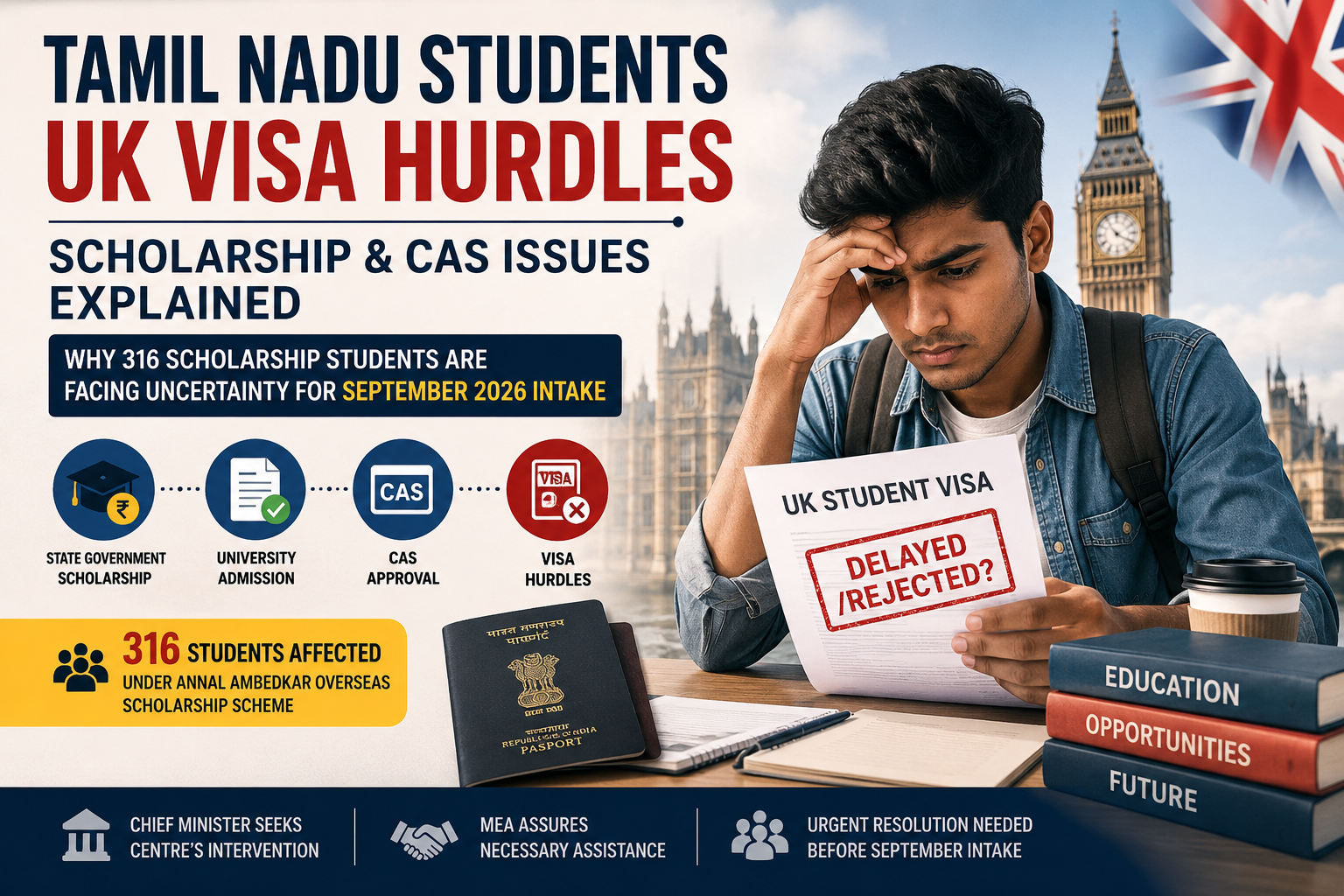
More than 300 Tamil Nadu students selected for overseas scholarships are facing uncertainty over UK student visas and Confirmation of Acceptance for Studies (CAS), with the September 2026 intake approaching. Here is what happened, why the sponsorship issue matters, what students can do now, and what needs to change to prevent similar problems in the future.
Introduction: When a scholarship is not enough
For a student who has earned admission to a UK university, receiving a government scholarship should be the moment when years of preparation finally turn into a clear path forward.
For more than 300 students from Tamil Nadu, however, the final stage has become unexpectedly complicated.
Students selected under the Annal Ambedkar Overseas Higher Education Scholarship Scheme have secured admission to UK universities, but some are facing difficulties because their Tamil Nadu government sponsorship is reportedly not being accepted in the way universities require for the Confirmation of Acceptance for Studies (CAS) and UK Student visa process.
The timing makes the situation more serious. The September 2026 intake is approaching, and students are working against university enrolment deadlines, visa-processing timelines, accommodation arrangements and travel plans.
On August 19, Tamil Nadu Chief Minister C Joseph Vijay wrote to Union External Affairs Minister S Jaishankar seeking urgent intervention, asking the Centre to help resolve the issue and ensure recognition of the state government’s sponsorship by the relevant UK authorities.
The Tamil Nadu government’s Social Justice Department has said the issue affects 316 students out of 362 students who were issued sponsorship letters for the 2026-27 academic year and had secured offers from UK universities. The wider scheme itself represents a significant public investment: the Tamil Nadu government’s 2026 budget provided ₹131 crore for the overseas scholarship scheme, with selected students eligible for assistance of up to ₹36 lakh.
This is therefore not simply a visa-processing problem.
It is a question of whether a student who has received an official state scholarship can actually convert that scholarship into a usable form of financial sponsorship for an international university and immigration system.
What is the current UK visa issue?
At the heart of the problem is the difference between being awarded financial assistance and having that financial assistance recognised as acceptable sponsorship for the UK Student visa and university CAS process.
The Tamil Nadu government has selected students and issued sponsorship letters. The students have then approached UK universities with those documents.
However, some institutions have reportedly told students that they recognise official financial sponsorship in specific forms and that Tamil Nadu’s state-government sponsorship does not currently fit their internal requirements.
The New Indian Express reported that institutions including Middlesex University informed students that only funding from the national government was being recognised as official financial sponsorship.
That creates a difficult chain:
Tamil Nadu scholarship → sponsorship letter → university financial verification → CAS → UK Student visa → enrolment
If recognition breaks down at one point, the entire chain can stall.
This distinction is important because a student can have a genuine scholarship and still be unable to move forward if the university or visa process cannot validate the funding in the required format.
Why the CAS is so important
The CAS, or Confirmation of Acceptance for Studies, is one of the most important documents in the UK Student visa process.
It is not simply another university admission document.
Under current UK sponsor guidance, students applying under the Student route need a CAS. UK universities and other licensed education providers issue CAS records through the UK’s sponsorship management system. The CAS contains information about the student, institution, course and relevant financial information.
That means the scholarship question can become a university-level compliance question before it becomes a visa application question.
A university needs to be satisfied that the student meets the relevant requirements before issuing the CAS. The institution also has responsibilities under its Student sponsor licence.
So, from a student’s perspective, the problem is not simply:
“I have a scholarship, therefore I can apply for a visa.”
The practical question is:
“Will my university accept this particular government sponsorship as valid financial evidence and reflect it correctly in my CAS and supporting documentation?”
That is where the current uncertainty matters.
What UK rules say about official financial sponsorship
The UK’s official guidance provides for students to demonstrate funding through an official financial sponsorship, among other permitted routes.
GOV.UK says financial evidence for a Student visa can include official financial sponsorship, such as sponsorship from a national government or university. Where sponsorship is not recorded on the CAS, the student may need a confirmation letter from the financial sponsor containing details such as the sponsor’s name, contact information, duration of sponsorship and amount of funding.
The UK’s caseworker guidance also explains an important point about government sponsorship.
Where UK immigration rules refer to government sponsorship, the guidance says this means sponsorship from His Majesty’s Government or the applicant’s national government. It further says that where an applicant relies on a scholarship from another country, the applicant must demonstrate, usually through an official financial sponsor’s confirmation letter, that the award comes from a national government.
This makes the present Tamil Nadu situation particularly significant.
The Tamil Nadu government is unquestionably a government authority at the state level. The unresolved question is whether the sponsorship documentation being issued under the scheme is being recognised by the relevant UK institutions and authorities in the form required for the students’ particular visa and CAS circumstances.
That is why diplomatic and administrative coordination has become necessary.
What exactly is the Annal Ambedkar Overseas Higher Education Scholarship?
The Annal Ambedkar Overseas Higher Education Scholarship Scheme is designed to help eligible students from Tamil Nadu pursue postgraduate and research-level education at universities outside India.
The scheme is aimed particularly at students from Adi Dravidar, Tribal and converted Christian Adi Dravidar communities, with the objective of reducing the financial barrier to studying at leading international universities.
The programme has already undergone significant expansion.
Tamil Nadu government material says the scheme was restructured and the annual family-income ceiling was increased from ₹3 lakh to ₹12 lakh. Assistance of up to ₹36 lakh per year is available for eligible postgraduate and research programmes in areas including arts, science, commerce, law, engineering and medicine.
For the 2026-27 application cycle, reported eligibility included admission to universities within the relevant QS World University Rankings, age requirements and the ₹12 lakh annual family-income ceiling.
This is important because the scheme is not a small private grant.
For many beneficiaries, it can be the difference between having an overseas academic opportunity and being unable to afford one.
The numbers behind the current crisis
The figures explain why the issue has attracted political and administrative attention.
According to the Tamil Nadu government’s reported figures:
- 362 students were selected under the overseas higher education scholarship scheme.
- 316 students among those issued sponsorship letters had secured UK university offers.
- The state allocated around ₹131 crore for the scheme in the 2026 budget.
- Selected students can receive assistance of up to ₹36 lakh.
- The scheme supports postgraduate and PhD-level study abroad.
The problem therefore potentially affects hundreds of individual academic journeys.
Behind every number is a student who may already have:
- completed an international university application;
- paid application or deposit charges;
- obtained an offer;
- arranged academic documents;
- prepared for visa procedures;
- applied for ATAS where required;
- searched for accommodation;
- planned travel;
- and built an academic plan around the September intake.
A delay at the sponsorship stage can therefore have consequences far beyond the visa application itself.
Why September 2026 makes the situation urgent
University admissions operate according to fixed academic calendars.
The September intake is one of the UK’s biggest international student entry periods. Universities set deadlines for accepting offers, paying deposits where applicable, completing CAS procedures and enrolling.
A student cannot simply wait indefinitely for a sponsorship clarification.
If the CAS is delayed, the visa application may be delayed.
If the visa is delayed, travel can be delayed.
If travel is delayed, enrolment can be affected.
And if enrolment is missed, the student may have to request a deferral.
That can create another problem: a scholarship awarded for one academic year may need administrative approval before it can be carried forward.
This is why the current dispute needs to be resolved quickly rather than becoming a prolonged exchange of letters between departments.
Tamil Nadu CM Vijay asks the Centre to intervene
The Tamil Nadu government’s response has now moved beyond the state-level administrative process.
On August 19, Chief Minister C Joseph Vijay wrote to External Affairs Minister S Jaishankar seeking urgent intervention.
According to the Tamil Nadu government release reported by The New Indian Express, the Chief Minister highlighted the visa and CAS difficulties affecting students under the Annal Ambedkar Overseas Scholarship Scheme and asked the Centre to help ensure that the state government’s scholarship is recognised by the relevant UK authorities.
This approach is significant because the final resolution may require communication between multiple parties:
Tamil Nadu government → Government of India → UK authorities → UK universities → students
The issue is therefore bigger than a single university or a single student’s visa file.
The Centre has already indicated that assistance will be provided
There has also been movement from the Ministry of External Affairs.
According to the Tamil Nadu government’s account, Apoorva Srivastava, Joint Secretary in the Europe West Division of the Ministry of External Affairs, assured officials that the Centre would provide necessary assistance.
The assurance reportedly came after the Director of Adi Dravidar Welfare met the official in New Delhi on August 17.
This matters because it indicates that the issue has reached the appropriate diplomatic level.
However, an assurance of assistance is not the same as a final operational solution.
Students ultimately need clear answers:
- Will their sponsorship letters be accepted?
- Will universities issue CAS using the sponsorship?
- What wording or documentation is required?
- Does UKVI require any additional evidence?
- What happens if the September deadline passes before the matter is resolved?
- Will scholarship funding remain valid if a student defers?
Those questions need written clarification.
Why universities may be cautious
It is easy to assume that a university refusing to accept a sponsorship letter is simply being unreasonable.
The reality is more complicated.
UK universities that sponsor international students have compliance obligations. They operate within the UK’s Student sponsor framework and must ensure that students meet the relevant Student route requirements.
UK sponsor guidance states that a university must only assign a CAS where it reasonably believes the student will meet the requirements of the Student route and comply with immigration conditions.
That creates an incentive for universities to be extremely careful about financial documentation.
If a university does not understand a foreign sponsorship arrangement, it may hesitate to rely on it.
That does not necessarily mean the scholarship itself is invalid.
It may mean the university needs formal confirmation that:
- the sponsor is a government authority;
- the funding is genuine;
- the amount is clearly stated;
- the duration is clear;
- the payment mechanism is understood;
- the student’s fees and living costs are covered as applicable;
- the sponsorship is irrevocable or sufficiently committed under the scheme;
- and the documentation satisfies the university’s compliance procedures.
This is exactly where government-to-government clarification can make a difference.
What students should understand about their visa finances
Students caught in this situation should not assume that the scholarship letter alone automatically resolves every Student visa requirement.
GOV.UK states that students may need to demonstrate sufficient funds for outstanding course fees and living costs, subject to the applicable rules and exemptions. Official financial sponsorship is one recognised route for demonstrating financial support.
Students should therefore ask their university’s international student or visa compliance team for a written assessment of their individual case.
They should specifically ask:
“Does my Tamil Nadu government sponsorship letter meet your requirements for financial sponsorship for CAS purposes?”
If the answer is no, ask:
“What exact additional confirmation or wording is required?”
That second question is crucial.
A general statement such as “state government sponsorship is not accepted” is less useful than a precise list of documents or confirmation required to approve the funding.
What students should do now
Students affected by the issue should avoid waiting passively.
1. Contact the university immediately
Contact the international admissions, CAS or visa compliance team.
Explain that the funding comes from the Government of Tamil Nadu under the Annal Ambedkar Overseas Higher Education Scholarship Scheme.
Attach the sponsorship letter and ask the university to confirm its requirements in writing.
2. Ask for the exact reason for rejection
If the university says the sponsorship is not accepted, ask whether the problem is:
- the identity of the sponsor;
- the wording of the letter;
- the payment mechanism;
- lack of confirmation from a national authority;
- CAS policy;
- financial evidence;
- or another compliance requirement.
This distinction can determine the solution.
3. Keep every document
Students should maintain copies of:
- scholarship selection letters;
- sponsorship letters;
- university offer letters;
- CAS correspondence;
- emails from university officials;
- fee invoices;
- deposit receipts;
- visa application documents;
- ATAS correspondence where applicable;
- and communications with Tamil Nadu government departments.
Documentation creates an evidence trail.
4. Do not submit contradictory financial information
If students are preparing their Student visa application, they should ensure that their financial information is consistent across the scholarship letter, CAS and visa application.
If there is uncertainty, students should obtain guidance from their university’s authorised immigration or international student advisers.
5. Ask about deferral protection
If the sponsorship issue cannot be resolved before the university deadline, students should ask whether their offer can be deferred to the next intake without losing their scholarship.
That question should be raised before the deadline expires.
The ATAS question: another possible delay
Some postgraduate and research students may also need to consider the Academic Technology Approval Scheme (ATAS).
ATAS is separate from the financial sponsorship issue.
It is an additional security-clearance process that applies to certain students studying specific sensitive subjects and depends on nationality, course and research area.
Students who require ATAS should not assume that resolving their sponsorship problem automatically resolves their entire visa timeline.
The Commonwealth Scholarship Commission, for example, advises scholarship students to consider ATAS requirements separately and to provide appropriate financial-sponsor information during the process.
For affected Tamil Nadu students, the practical lesson is simple:
Treat CAS, financial sponsorship, ATAS and Student visa requirements as separate checkpoints.
A student should know the status of each one.
The bigger issue: recognition of state government scholarships
The current problem exposes a broader question.
India has a federal structure.
State governments run their own scholarship programmes, education departments and welfare schemes. Students from different states may therefore receive funding from different government authorities.
International universities, meanwhile, may have standardised compliance systems designed around common categories such as:
- national governments;
- international organisations;
- universities;
- recognised scholarship bodies;
- or established funding institutions.
A state government scholarship may be completely legitimate in India but still require additional verification overseas.
That is the gap that needs to be closed.
The solution should not depend on individual students repeatedly explaining Indian constitutional structures to university administrators.
There should be a recognised process.
What the future solution should look like
The immediate priority is to solve the 2026-27 students’ cases.
But the long-term goal should be to prevent the same problem from returning next year.
A stronger system could include several measures.
1. Formal UK recognition framework
The Government of India and the UK government could establish a clear mechanism for verifying state-government scholarship programmes.
This could include a standard government directory containing:
- state government name;
- department;
- scheme name;
- official contact details;
- funding limits;
- payment structure;
- authorised officers;
- verification mechanism.
Universities could then independently verify a scholarship.
That would be much faster than evaluating every student’s letter separately.
2. Standardised sponsorship certificate
Tamil Nadu could develop a sponsorship certificate specifically designed for international use.
The document could clearly state:
- Government of Tamil Nadu as sponsor;
- responsible department;
- scholarship scheme;
- student’s name and passport details;
- university;
- course;
- start and end dates;
- tuition coverage;
- living-cost coverage;
- other permitted expenses;
- total approved amount;
- payment schedule;
- official contact details;
- verification instructions.
The aim should be to make the document understandable to an overseas compliance officer without requiring additional explanation.
3. Direct university verification portal
A secure online verification system could allow UK universities to enter a student’s scholarship reference number and confirm the award.
This could eliminate one of the biggest weaknesses of paper-based sponsorship.
Instead of asking:
“Is this letter genuine?”
the university could verify:
“This student was officially selected, this amount was approved and this department is responsible for payment.”
That is a much stronger model.
Scholarship planning needs to start earlier
One of the strongest lessons from this episode is that scholarship administration must be aligned with international admission timelines.
Students do not receive university offers at the last minute.
They normally spend months preparing applications, obtaining English-language test results where required, collecting transcripts, receiving offers and meeting university conditions.
Government scholarship processes should run alongside that timeline.
The current debate has already produced calls for earlier planning. Suggestions reported in Tamil Nadu include starting the application process earlier in the year, establishing formal recognition with foreign universities and giving students advance clarity about scholarship sanction and payment schedules.
That is a sensible direction.
A stronger annual timeline could look like this:
January–February: scholarship applications
March–April: screening and verification
April–May: preliminary selection
May–June: university offer and scholarship confirmation
June: final sponsorship documentation
June–July: CAS preparation
July–August: visa and ATAS processing
August–September: travel and university enrolment
The exact dates can vary, but the principle is important:
Scholarship administration should work backwards from the international university intake.
The financial planning problem
Another important lesson is that students need clarity about when the government will actually release funds.
A scholarship award is valuable only when the student can use it.
International education involves costs before arrival:
- University deposits;
- Tuition payments;
- Visa fees;
- Immigration Health Surcharge where applicable;
- Accommodation deposits;
- Flights;
- Document certification;
- Health-related requirements;
- Local transportation;
- Initial living expenses.
If a student has been selected for a scholarship but does not know when the government will pay, the student may still struggle to satisfy immediate university or visa requirements.
This is especially difficult for students from financially disadvantaged backgrounds the very students the scheme is intended to support.
Therefore, future versions of the scheme should publish a clear funding release calendar.
Why this matters beyond 316 students
The immediate story is about 316 students.
The long-term significance is much larger.
Tamil Nadu’s overseas scholarship programme represents an attempt to change who gets access to global higher education.
Studying at a leading international university can provide:
- specialised academic training;
- access to international research networks;
- exposure to new technologies;
- stronger professional networks;
- research collaboration;
- international work experience where legally permitted;
- and the ability to bring knowledge back to India.
For students from communities historically facing financial and social barriers to elite education, those opportunities can have an effect that extends beyond one individual.
One scholarship can influence an entire family.
A postgraduate degree can change career prospects.
A research opportunity can create a future academic or technology leader.
A successful graduate can eventually mentor others from the same community.
That is why administrative reliability matters.
The social impact of overseas scholarships
Scholarships are not merely financial transactions.
They are mobility programmes.
When governments fund students who would otherwise struggle to afford international education, they are investing in human capital.
The return may not appear immediately in a government balance sheet.
It may appear years later through:
- Better-trained professionals;
- Researchers;
- Entrepreneurs;
- Academics;
- Doctors;
- Engineers;
- Lawyers;
- Policy specialists;
- Technology professionals.
That makes continuity important.
Students should be able to trust that once they are selected, the government will provide the administrative support required to complete the journey.
What the UK side can do
The UK also has an opportunity to help resolve the wider issue.
Universities could develop a standard process for verifying Indian state-government scholarships.
The UK government could provide clearer guidance to universities on how state-government sponsorship should be assessed when the funding originates from an Indian state authority.
This does not require weakening immigration controls.
It requires clarity.
The UK’s Student sponsor system exists to maintain compliance. Clear verification of legitimate government funding can strengthen that system rather than weaken it.
A transparent verification mechanism would help universities identify genuine scholarships while protecting against fraudulent documents.
That is better for everyone.
What the Government of India can do
The Centre has a particularly useful role because it sits between state governments and foreign governments.
A permanent mechanism could be created within the relevant diplomatic and education channels to support state-sponsored students studying overseas.
The mechanism could:
- maintain a list of recognised state scholarship schemes;
- verify government departments;
- coordinate with foreign immigration authorities;
- communicate with universities when recognition problems arise;
- provide standard documentation formats;
- resolve urgent cases before university deadlines;
- and maintain guidance for students.
The current crisis could become the starting point for such a system.
What Tamil Nadu can do next
Tamil Nadu can also strengthen the scheme internally.
The state could create a dedicated Overseas Scholarship Visa Support Cell.
Its role would be simple:
Scholarship approved → admission confirmed → CAS check → visa documentation → ATAS check → travel clearance
Each student could receive a case status.
For example:
| Stage | Status |
|---|---|
| Scholarship selection | Completed |
| University admission | Completed |
| Sponsorship verification | Pending/Completed |
| CAS | Pending/Issued |
| ATAS | Required/Not required |
| Visa | Pending/Approved |
| Travel | Planned |
Such a system would immediately show where a student is stuck.
It would also allow officials to identify a systemic problem before hundreds of students encounter it.
The need for a student-first approach
The most important principle should be simple:
Students should not lose an academic opportunity because governments are unable to communicate with each other.
The students did not create the sponsorship framework.
They did not create the UK immigration rules.
They did not design the CAS system.
They applied for a scholarship, secured university admission and followed the process available to them.
If the documentation needs to change, governments and institutions should resolve that issue quickly.
A student who has met the academic requirements should not be forced to abandon a place because of an administrative gap.
What happens next?
The immediate next step is coordination.
Tamil Nadu has requested Central intervention.
The Ministry of External Affairs has indicated that assistance will be provided.
UK universities need clarity on the status and format of the Tamil Nadu government’s sponsorship.
The UK authorities may need to clarify how the sponsorship should be treated for the affected students.
And students need urgent written guidance before September enrolment deadlines arrive.
The most useful outcome would be a formal clarification that can be circulated to every affected university.
That would be far more effective than solving the cases one by one.
What students should remember
If you are one of the affected scholarship students, the current situation does not automatically mean that your UK study plan is cancelled.
It means that the sponsorship and CAS issue needs to be resolved.
Keep communicating with:
- your university’s international student team;
- CAS or visa compliance office;
- the Tamil Nadu scholarship authorities;
- and, where appropriate, official government channels.
Do not rely on social-media claims that a scholarship has been “rejected” unless you have received an official communication.
Most importantly, ask your university for the exact documentation required to recognise your sponsorship.
That turns a general problem into a specific administrative question.
Frequently Asked Questions
Is the Tamil Nadu scholarship itself cancelled?
There is no indication from the information currently available that the Annal Ambedkar Overseas Higher Education Scholarship Scheme has been cancelled.
The issue concerns recognition and use of the state government’s sponsorship for UK university/CAS and visa processes.
Tamil Nadu has continued to allocate substantial funding to the programme, including ₹131 crore in the 2026 budget.
How many students are affected?
The Tamil Nadu government’s reported figures indicate that 362 students were selected, while 316 students with sponsorship letters had secured UK university offers and are affected by the current UK-related issue.
Can a government scholarship be used as UK Student visa financial evidence?
UK guidance allows qualifying official financial sponsorship to be used as evidence of funding. GOV.UK specifically refers to official financial sponsorship, including sponsorship from a national government or university.
However, the exact documentation and how sponsorship is reflected in the CAS can matter. Students should therefore confirm their specific situation with their university.
What is CAS?
CAS stands for Confirmation of Acceptance for Studies.
It is a record issued by a licensed UK student sponsor and is required for a Student visa application. It contains information about the student’s course, sponsor and relevant application details, including financial information where applicable.
Does a sponsorship letter automatically guarantee a UK visa?
No.
A sponsorship letter is evidence of funding. Students must still satisfy the other requirements of the UK Student route.
The university must also issue a valid CAS.
What should students do if their university refuses to recognise the Tamil Nadu sponsorship?
Ask the university to provide the reason in writing and specify what additional documentation or government confirmation would make the sponsorship acceptable.
Then share that requirement with the Tamil Nadu authorities and relevant government officials.
What if the student misses the September 2026 intake?
The student should immediately ask the university about deferral options and separately ask the scholarship authority whether the sponsorship can be carried forward.
Do not assume either option automatically applies.
The road ahead: turning a visa problem into a policy improvement
The current crisis is frustrating.
But it also exposes an opportunity.
Tamil Nadu has built a major overseas education programme. The next step is to build the international administrative infrastructure around it.
A scholarship programme should not end when the government issues a selection letter.
It should continue until the student:
receives funding → secures CAS → obtains the visa → reaches the university → begins the course.
That is what a complete overseas scholarship system looks like.
The immediate priority is clear: resolve the sponsorship recognition problem before September 2026 students lose their university places.
The longer-term priority is even more important: create a system where the same problem does not happen to the next batch.
For students, the message should be one of caution but not panic.
The current issue is serious, but government intervention is now underway. Tamil Nadu has formally sought Central assistance, and the Ministry of External Affairs has indicated that it will assist in addressing the matter.
The next few weeks will be critical.
If Tamil Nadu, the Government of India, UK authorities and universities can establish a clear verification route for state-government sponsorship, the immediate crisis can be resolved—and a much stronger pathway can be created for future Indian students seeking international education.
The real measure of a scholarship is not simply how many students receive an award. It is how many students are actually able to use that award to reach the classroom they worked so hard to enter.
Leave feedback about this