
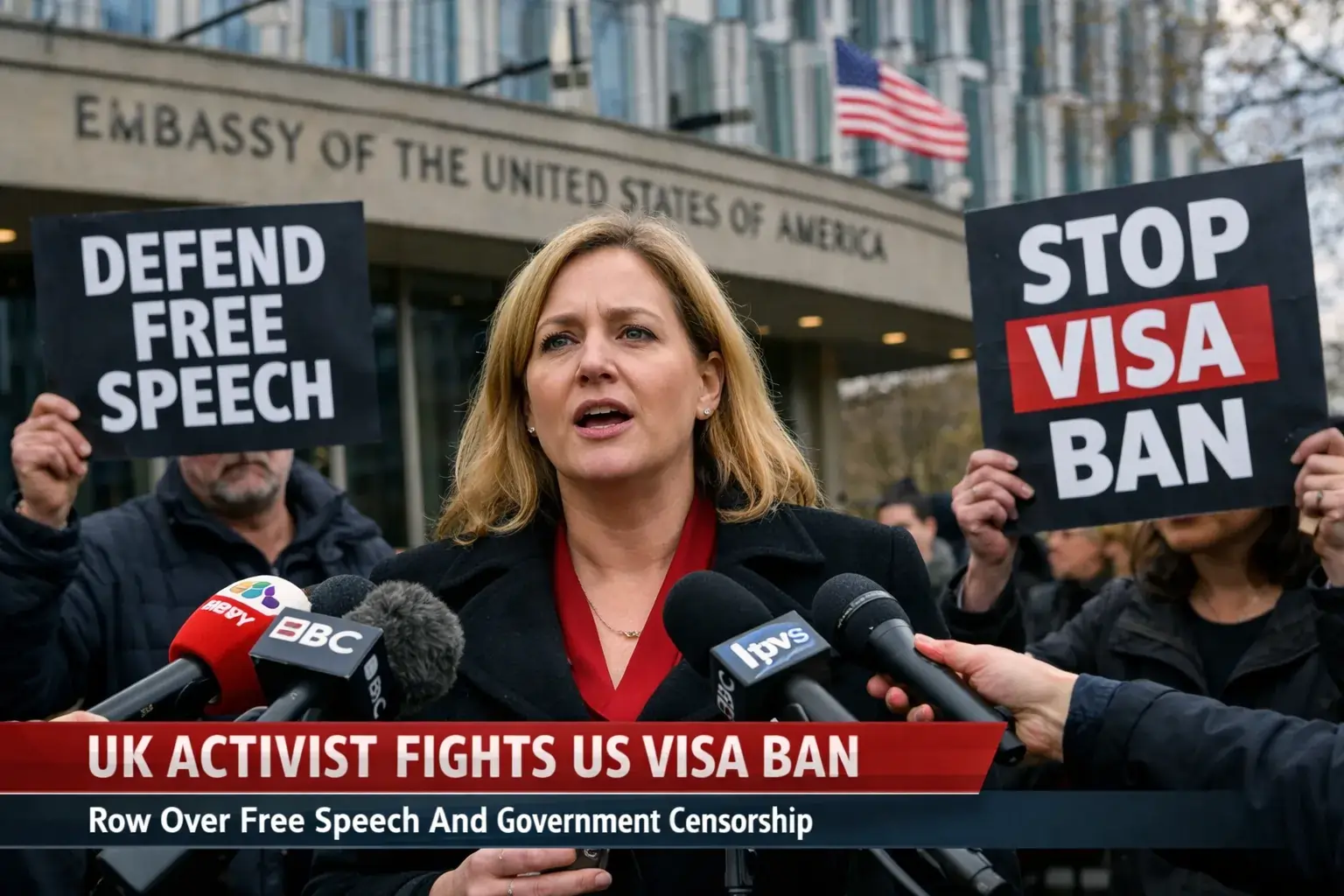
The battle over free speech, technology regulation, and immigration power has just crossed a new legal and political line.
A UK-based anti-disinformation leader has taken the Trump administration to court after being hit by a US visa ban that could force him out of the country despite holding permanent residency. The case has triggered sharp reactions in Europe and reopened uncomfortable questions about how immigration law is being used in global political disputes.
At the centre of the storm is Imran Ahmed, the British national who heads the Center for Countering Digital Hate (CCDH), a group known for challenging social media platforms over misinformation, hate speech and child safety.
What began as a visa restriction is now shaping up to be a constitutional showdown, with implications far beyond one individual.
| Aspect | United States | European Union |
|---|---|---|
| Core philosophy | Strong emphasis on free speech and minimal government interference, rooted in First Amendment protections. | Focus on harm prevention, public safety, and accountability of platforms operating in society. |
| View on content moderation | Often seen as a private company decision; government pressure on platforms is politically sensitive and controversial. | Treated as a regulatory responsibility, especially for large platforms with societal impact. |
| Role of government | Limited direct regulation; concern that oversight may become censorship or political control. | Active regulator through laws like the Digital Services Act, setting rules for transparency and risk mitigation. |
| Approach to misinformation & hate speech | Addressed mainly through market forces, civil society, and platform policies rather than law. | Considered a public risk that justifies legal obligations on platforms to act. |
| Criticism of regulation | Critics argue foreign or domestic rules threaten free expression and political debate. | Critics (especially in the US) label EU rules as overreach or indirect censorship. |
| Immigration & enforcement tools | Immigration powers may be used as part of national security or political strategy. | Immigration and regulation are generally treated as separate policy areas. |
| Impact on global companies | Companies enjoy broad speech protections but face public and political pressure. | Companies must comply with strict rules to operate in the EU market. |
1. What happened and why it matters
In December 2025, the US State Department placed Imran Ahmed on a list of European technology-regulation figures barred from entry or residency in the United States. The move accused them of attempting to pressure US social media companies into censoring political views an allegation Ahmed strongly denies.
Ahmed responded by filing a lawsuit in a New York district court, arguing that the visa ban is:
- Unconstitutional
- Politically motivated
- A misuse of executive immigration powers
The court has already granted a temporary restraining order, blocking Ahmed’s arrest or detention while the case proceeds a significant early legal signal.
For Ahmed, the issue is deeply personal. He says the action has separated him from his American wife and daughter during Christmas, despite his long-standing legal residence in the US.
For policymakers, however, the case raises a bigger question:
Can immigration tools be used to sideline critics in global regulatory disputes?
2. Why the Trump administration acted
The Trump administration has framed the visa ban as a matter of national sovereignty and free speech protection.
Officials argue that:
- The US is not obliged to admit or retain foreign nationals
- European regulators and advocacy groups have sought to influence US companies
- Content moderation rules abroad amount to censorship of American voices
The lawsuit names several senior officials, including Marco Rubio, reflecting how high-level the decision was.
From Washington’s perspective, this case sits at the intersection of:
- Immigration enforcement
- Tech industry lobbying
- Resistance to foreign regulatory influence
But critics say this approach turns immigration law into a political weapon.
3. The tech regulation fault line behind the dispute
This visa ban did not emerge in isolation. It is closely tied to escalating tensions between the US and Europe over technology regulation.
Several other Europeans targeted by the restrictions are linked to EU digital policy, including Thierry Breton, a key architect of the Digital Services Act (DSA).
The DSA requires large platforms to:
- Address harmful content
- Improve algorithmic transparency
- Protect children online
US conservatives have repeatedly criticised the law as state-backed censorship, while Brussels insists it is about accountability and consumer protection.
The involvement of the European Commission shows how quickly this has become a transatlantic regulatory clash, not just a visa issue.
4. Why Imran Ahmed says the ban is dangerous
Ahmed’s argument goes beyond personal harm. He says the visa ban sets a precedent where:
- Policy disagreement becomes grounds for exclusion
- Legal residents can be threatened without due process
- Advocacy work is redefined as national security risk
As the head of CCDH, Ahmed has openly criticised powerful technology executives, including Elon Musk, over misinformation and platform safety. He believes this visibility made him a target.
In his words, the case is about whether criticism of powerful interests can be punished indirectly through immigration enforcement.
That concern resonates far beyond the disinformation space.
5. Europe’s response and why it’s unusually sharp
European institutions reacted swiftly.
The European Commission said it is:
- Seeking urgent clarification from Washington
- Prepared to defend Europe’s regulatory independence
This matters because the EU sees its digital laws as sovereign policy choices, not interference in US politics.
If visa bans become a routine response to regulatory disagreement, Europe fears:
- Chilling effects on regulators and NGOs
- Retaliatory policy cycles
- Weakened cooperation on global tech governance
In simple terms, trust is being tested.
✔ Who Potentially Wins
Governments asserting control over tech policy, domestic political groups concerned about foreign influence, and platforms resisting external regulation may feel reinforced. The move signals a hard line on sovereignty and free speech priorities.
✖ Who Potentially Loses
Civil society groups, cross-border policy advocates, and legal residents caught in political disputes face greater uncertainty. Trust between the US and Europe on digital governance and rule-of-law cooperation also takes a hit.
6. The legal stakes: immigration law vs constitutional rights
This case is legally complex because it sits at a grey boundary.
Traditionally:
- The US government has wide discretion over visas
- Foreign nationals have limited constitutional protections
But Ahmed’s case is different because:
- He holds permanent US residency
- He alleges risk of detention and deportation without due process
- A federal judge has already intervened
If the court sides with Ahmed, it could:
- Limit how visa bans are applied to green-card holders
- Reinforce due-process protections
- Constrain executive power in politically sensitive cases
If the government wins, the message is stark:
Immigration status offers little shield when politics enter the equation.
7. Broader impact: who should be worried?
This case affects more than activists.
7.1 NGOs and policy advocates
International NGOs working on:
- Tech regulation
- Human rights
- Environmental policy
may worry that US access can be revoked if their work clashes with political priorities.
7.2 Global professionals on US visas
Permanent residents, academics and policy experts could see:
- Greater uncertainty
- Increased politicisation of immigration decisions
- Less predictability in long-term planning
7.3 US-EU relations
At a time of fragile cooperation on:
- AI governance
- Platform regulation
- Cybersecurity
this dispute risks hardening divisions rather than resolving them.
US–EU Tech Regulation Clash: How We Got Here
Key moments that shaped today’s dispute over free speech, regulation, and political power.
GDPR Sets the Tone
The EU’s General Data Protection Regulation (GDPR) comes into force, imposing strict rules on data use. US tech firms comply commercially, but criticism grows in Washington over European “over-regulation.”
Content Moderation Becomes Political
US debates over social media moderation intensify. European approaches to hate speech and misinformation are increasingly portrayed by US conservatives as censorship.
Digital Services Act Adopted
The EU passes the Digital Services Act (DSA), requiring large platforms to manage systemic risks, increase transparency, and protect users — including children.
US Pushback Intensifies
American politicians and commentators accuse the EU of exporting censorship. Tech executives warn of regulatory overreach and political interference.
Transatlantic Tensions Harden
Disputes expand beyond companies to include NGOs and advocacy groups involved in content moderation and disinformation research.
Visa Bans Enter the Conflict
US authorities impose visa restrictions on several European tech regulation figures, transforming a regulatory disagreement into a diplomatic and legal confrontation.
8. Is there any upside or “benefit” to the policy?
Supporters argue the policy:
- Signals a strong stance against perceived foreign censorship
- Reassures domestic political bases
- Reasserts US control over tech policy debates
But even some analysts sympathetic to immigration control question whether visa bans are the right tool for a regulatory disagreement.
Short-term political wins can carry long-term diplomatic and legal costs.
9. What happens next and how to plan for it
For Imran Ahmed
- The next court hearing will determine whether protections are extended
- A full constitutional review could take months
- The case may set precedent regardless of outcome
For governments and institutions
- Expect closer scrutiny of visa-based sanctions
- Potential EU diplomatic pushback
- Pressure to clarify red lines between regulation and censorship
For global professionals
- Document legal status carefully
- Monitor political risk, not just visa compliance
- Seek legal advice early if work intersects with sensitive policy areas
Step 1: Court Review
US courts assess whether the visa ban violates due process rights, especially given the individual’s permanent residency status.
Step 2: Temporary Protection
Injunctions or restraining orders may remain in place, preventing detention or removal while litigation continues.
Step 3: Political Response
Diplomatic pressure from Europe and public scrutiny may push the administration to clarify or narrow the policy.
Step 4: Long-Term Outcome
Either courts limit the use of visa bans in political disputes, or governments gain wider discretion with lasting global impact.
Final thought: a test of democratic confidence
This case is not just about a visa.
It is about whether democracies are confident enough to tolerate cross-border disagreement without reaching for blunt instruments like immigration bans.
For Imran Ahmed, the fight is personal about family, safety and principle.
For the US and Europe, it is about whether policy disputes will be settled through law and dialogue, or through exclusion and escalation.
| Risk Area | Legal Risks | Political Risks |
|---|---|---|
| Immigration authority | Courts may limit how visa bans apply to permanent residents, reinforcing due process protections. | Executives may push broader discretionary powers, setting precedents for future administrations. |
| Free speech protections | Judicial rulings could clarify whether advocacy work is protected expression under US law. | Political framing may redefine criticism or regulation as national security concerns. |
| International relations | Court decisions could de-escalate disputes by narrowing enforcement scope. | Visa actions may provoke diplomatic retaliation and weaken transatlantic cooperation. |
| Impact on individuals | Successful challenges may protect legal residents from sudden detention or removal. | Uncertainty may discourage activists, researchers, and policy advocates from cross-border work. |
| Long-term precedent | Courts could establish limits on politicised immigration enforcement. | Normalisation of visa bans as policy tools could expand their use globally. |
Frequently Asked Questions (FAQs)
1. Who is Imran Ahmed and why is he suing the US government?
Imran Ahmed is a UK-based anti-disinformation expert and head of the Center for Countering Digital Hate. He is suing the US government after being targeted by a visa ban that he says is unconstitutional and politically motivated.
2. Why did the Trump administration impose the visa ban?
US officials argue that Ahmed and other European figures were involved in efforts to pressure American technology companies into censoring views, an allegation Ahmed denies.
3. Does Imran Ahmed hold US permanent residency?
Yes. Ahmed holds permanent US residency, which is why the case has raised serious legal questions about due process and executive overreach.
4. What has the court decided so far?
A US district judge has issued a temporary restraining order preventing Ahmed’s arrest or detention, with further hearings scheduled.
5. Why has the European Union reacted strongly to this case?
The EU sees the visa ban as an attack on Europe’s regulatory independence, particularly in relation to digital laws like the Digital Services Act.
6. What broader issues does this case raise?
The case highlights growing tensions between the US and Europe over tech regulation, free speech, and whether immigration powers can be used in political disputes.