
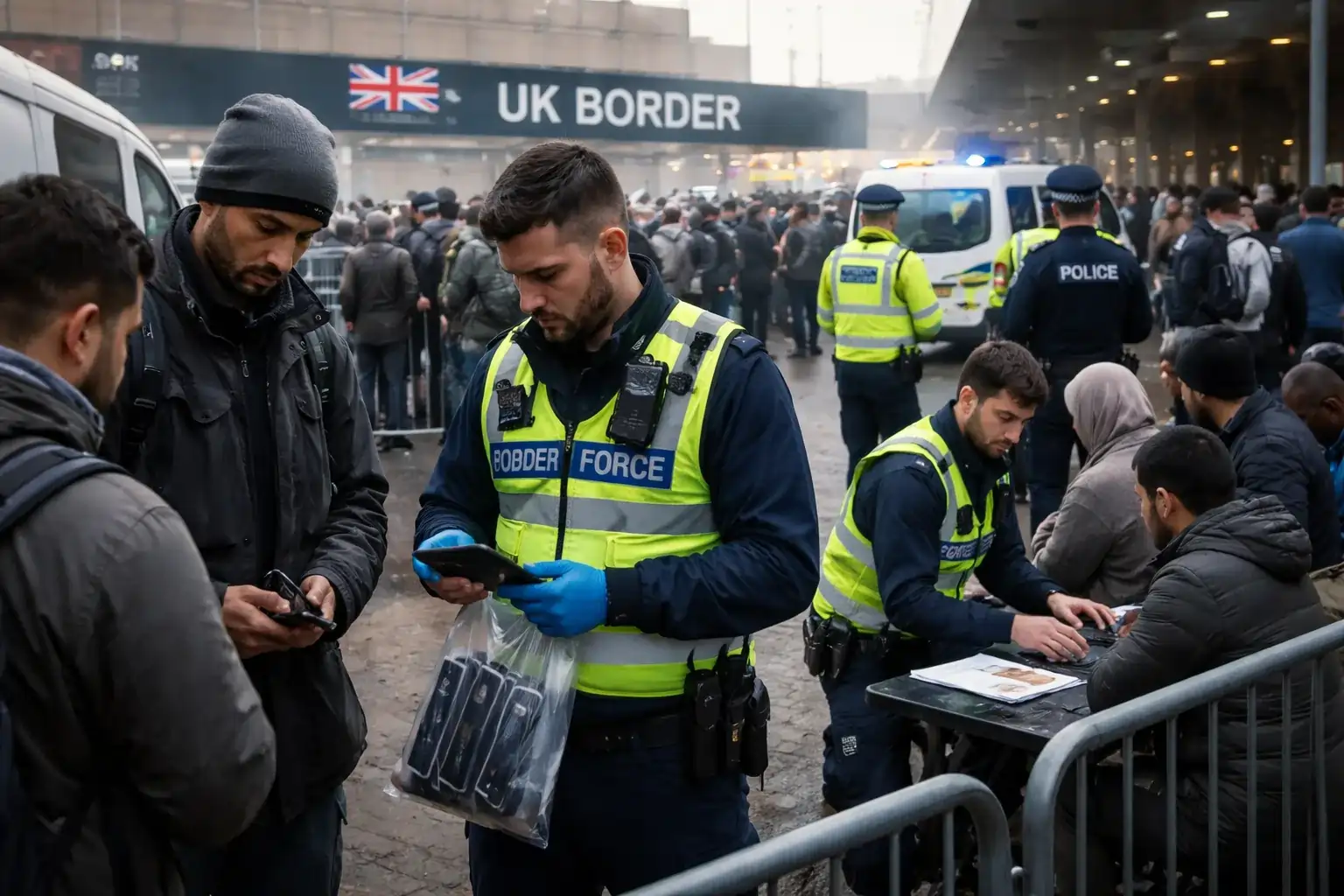
The UK’s immigration system is entering its most assertive phase in decades. With new powers allowing officers to seize phones and hidden SIM cards from migrants arriving illegally without arrest the government is signalling a decisive shift: from reactive border control to pre-emptive disruption of smuggling networks.
At the same time, sweeping asylum reforms, faster removals, and stricter visa rules for care workers are reshaping not just who can come to the UK, but how long they can stay, how easily they can settle, and what the economic trade-offs might be.
This article brings together official announcements, Home Office data, and expert warnings to explain:
- Why these new powers were introduced
- How they work in practice
- Who benefits and who may lose out
- What this means for migrants, employers, and the UK economy
- What to expect next, through 2026 and beyond
Legal Disclaimer
The information provided on this page is for general guidance and informational purposes only and does not constitute legal advice. UK immigration law and policy are subject to frequent change, and the application of the law depends on individual circumstances.
While every effort is made to ensure accuracy based on official sources at the time of publication, we cannot guarantee that the information is current or applicable to your specific situation. You should not rely on this content as a substitute for personalised legal advice.
For advice tailored to your circumstances, we recommend seeking guidance from a qualified UK immigration solicitor before taking any action.
1. What exactly has changed? The new phone-seizure powers explained
From January 2026, UK law enforcement officers can now seize mobile phones, SIM cards, and electronic devices from migrants who arrive illegally, particularly those crossing the English Channel in small boats.
Crucially, this can happen without an arrest.
The powers are part of the Border Security, Asylum and Immigration Act, introduced by the Labour government following reforms announced in November 2025.
According to the UK Home Office, the objective is clear:
To gather intelligence faster, disrupt people-smuggling networks earlier, and prevent dangerous crossings before they happen.
Where seizures are happening
- At arrival points such as Manston short-term holding facility in Kent
- During property and vehicle searches
- In raids linked to smuggling investigations
Officers can also:
- Ask migrants to remove outer clothing
- Search mouths if there is suspicion a SIM card is being concealed
This mirrors tactics used in counter-terrorism policing, where intelligence speed is often the difference between prevention and tragedy.
2. Why phones and SIM cards matter so much
For smuggling networks, phones are operational command centres.
They can reveal:
- WhatsApp and Telegram group links
- Payment trails
- Launch locations and tide data
- Names of organisers and financiers
- Links between UK-based facilitators and overseas gangs
The National Crime Agency has repeatedly said investigations previously took months or years because data was accessed too late.
Now, with on-site extraction technology:
- Leads can be identified immediately
- Arrests can happen earlier
- Entire supply chains can be dismantled, not just boat pilots
As Border Security Commander Martin Hewitt put it, smugglers “do not care if people live or die.” The new approach aims to remove the business model, not just intercept boats.
Key Takeaways at a Glance
- UK officers can now seize phones and SIM cards without arrest.
- New powers target people-smuggling networks, not lawful migrants.
- Asylum and visa reforms aim to speed up removals and reduce incentives.
- Care sector warns of staff shortages due to visa restrictions.
3. New offences, tougher penalties: what smugglers now face
The crackdown goes far beyond phone seizures.
Under the new law:
- Supplying or storing boat engines or equipment → up to 14 years in prison
- Researching routes, downloading maps or tide charts → up to 5 years
- Manufacturing or importing vehicle concealment compartments → up to 5 years
This expands criminal liability from just pilots to anyone involved at any stage.
The Home Office says arrests, convictions, and asset seizures rose 33% in the year to September 2025 a trend it expects to accelerate.
4. The “one-in, one-out” deal with France: how it fits in
Under the UK–France arrangement:
- For every migrant returned to France after arriving by small boat
- The UK accepts one asylum seeker from France via a safe and legal route
As of December 2025:
- 193 people had been returned under this scheme
The government argues this removes incentives for dangerous crossings while preserving humanitarian obligations.
Critics argue the numbers are still small but symbolically, the deal marks a shift toward bilateral enforcement cooperation rather than unilateral action.
5. The wider asylum reforms: tightening the system
The phone-seizure powers sit within a much broader overhaul announced by Shabana Mahmood.
Key elements include:
- Refugee status becoming more temporary
- Faster decisions for irregular arrivals
- Expanded use of detention where there is risk of absconding
- End of guaranteed housing support over time
- Creation of capped “safe and legal” routes
The stated aim: reduce pull factors, speed up removals, and restore confidence that the system is controlled.
Migrants & Asylum Seekers
Face faster enforcement, device seizures, and shorter timelines.
Employers & Care Providers
Risk staff shortages and higher costs due to visa restrictions.
6. Does it work? The early evidence
Enforcement results
- Nearly 4,000 disruptions against smuggling networks since the Border Security Command launched
- Increased cash seizures and asset confiscation
- Faster investigations due to early intelligence access
Migration reality
Despite enforcement:
- Small-boat arrivals remain high
- Asylum applications continue
- Push factors (conflict, repression, poverty) remain strong
This highlights a key truth: enforcement can reduce scale and speed but cannot eliminate migration entirely.
Best Practice Placement for In-Blog Sections
📌 After the Introduction → Key Takeaways
Place the Key Takeaways box immediately after the opening paragraphs. This helps readers quickly understand the core points, improves scroll depth, and reduces bounce rates.
📌 Mid-Article → Why This Matters / Who Is Affected
Insert the Why This Matters and Who Is Affected sections halfway through the article. These blocks re-engage readers, add context, and break up dense legal or policy explanations.
📌 Before the Conclusion → Risks vs Benefits / What Should You Do
Place Risks vs Benefits and What Should You Do just before the conclusion. This prepares readers for decision-making and naturally leads into legal guidance or a consultation call-to-action.
7. The care-visa backlash: a different kind of crisis
While border enforcement tightens, changes to legal migration routes are triggering alarm especially in social care.
The government closed the dedicated overseas care-worker route introduced during Covid and is:
- Raising skill and salary thresholds
- Consulting on longer settlement timelines
- Ending most overseas recruitment
Care providers warn of severe consequences.
Shweta Dowlot Maulayah, CEO of Maucare Services in Kent, says new rules could cost £15,000 extra per employee per year, making roles unaffordable.
Her warning is stark:
“Lots of people will be going without care. The NHS is going to get overwhelmed.”
What the New Law Allows
- Seizure of phones and SIM cards without arrest
- Early intelligence extraction at holding centres
- Criminal charges for preparatory smuggling acts
- Longer prison sentences for facilitators
8. Why the government is still pushing ahead
The government’s position is consistent across asylum and visas:
- Reduce reliance on overseas labour
- End exploitation and abuse
- Increase domestic recruitment
- Make settlement something that is earned, not automatic
Officials argue the care sector has relied too heavily on migration without fixing pay, training, or retention.
The counter-argument is equally strong: domestic recruitment has failed for years, and demand is rising with an ageing population.
9. Winners and losers in the new system
Who benefits
- Law enforcement agencies (faster, stronger tools)
- Communities affected by organised crime
- Public confidence in border control
- Victims of trafficking (earlier identification)
Who loses
- Asylum seekers facing more intrusive searches
- Care providers struggling to staff services
- Migrants facing longer uncertainty
- Local authorities managing transition costs
Potential Benefits
Faster arrests, fewer deaths, and better border control.
Potential Risks
Privacy concerns, labour shortages, and legal challenges.
10. Civil liberties and legal concerns
Critics raise questions:
- Can devices be seized without arrest safely?
- How is data stored and protected?
- What safeguards exist against misuse?
The Home Office insists all actions are:
- Lawful
- Proportionate
- Subject to oversight
But legal challenges are likely as powers are tested in practice.
11. The economic balance sheet: control vs capacity
From an economic perspective, the UK faces a balancing act:
- Too little control → public backlash, rising costs
- Too much restriction → labour shortages, slower growth
The care sector illustrates the risk perfectly: enforcement success at the border may be offset by systemic stress inside the economy.
What Should You Do Now?
If you are affected by UK immigration changes, rely only on lawful routes, monitor policy updates closely, and seek professional legal advice before making decisions.
12. What happens next (2026–2027 outlook)
Expect:
- Expansion of intelligence-led enforcement
- More bilateral returns agreements
- Fewer low-skill migration routes
- Longer paths to settlement
- Continued political focus on small boats
Also likely:
- Targeted concessions for high-skill and essential sectors
- Legal challenges to search powers
- Ongoing debate about fairness vs firmness
13. What migrants, employers, and advisers should do now
Migrants
- Understand that enforcement is faster and stricter
- Avoid assumptions about settlement
- Seek lawful, documented routes only
Employers
- Plan workforce needs years ahead
- Budget for higher compliance costs
- Engage early with immigration advice
Advisers and policymakers
- Monitor unintended consequences
- Balance security with sustainability
- Keep humanitarian obligations central
Final reflection: a harder border, a harder choice
The UK’s new immigration crackdown marks a decisive break with the past. Phone seizures without arrest, tougher offences, and faster removals show a system determined to act early and aggressively.
Yet enforcement alone cannot resolve deeper issues:
- Global displacement
- Labour shortages
- An ageing society
The real test of these reforms will not be how many phones are seized but whether the UK can control its borders without undermining its economy or its values.
In 2026, immigration is no longer just about who arrives.
It’s about how power is exercised, how risks are managed, and how consequences are shared.
The UK has introduced new powers to seize migrants’ phones and SIM cards without arrest. Explore what the immigration crackdown means for asylum seekers, borders, care visas, and the UK economy in 2026.
❓ Frequently Asked Questions (FAQs)
1. What is the UK’s new power to seize migrants’ phones?
UK officers can now seize mobile phones and hidden SIM cards from migrants who arrive illegally, particularly via small boats, without arresting them first. The aim is to quickly gather intelligence to disrupt people-smuggling networks.
2. Why are phones and SIM cards being targeted?
Phones often contain crucial evidence such as smuggler contacts, payment records, routes, and coordination messages. Accessing this data early helps authorities trace and arrest organised smuggling gangs faster.
3. Does this apply to all migrants?
No. These powers are targeted mainly at people arriving illegally, especially via the English Channel. They do not apply to people entering the UK legally on visas.
4. Is this part of a wider UK asylum reform?
Yes. The phone-seizure powers are part of broader asylum and border reforms aimed at tightening admissibility rules, speeding up decisions, increasing removals, and reducing incentives for irregular migration.
5. What is the “one-in, one-out” deal with France?
Under this agreement, the UK can return migrants who arrive illegally by small boat to France, while accepting an equal number of asylum seekers from France through a newly created safe and legal route.
6. Will these measures stop small-boat crossings?
They may disrupt smuggling networks and reduce crossings over time, but experts say enforcement alone cannot eliminate irregular migration because global conflicts and displacement continue to push people to move.
7. Are there civil liberties concerns with phone seizures?
Yes. Critics argue that seizing phones without arrest raises privacy and proportionality concerns. The government says safeguards, oversight, and lawful data-handling procedures are in place.
8. How does this affect asylum seekers already in the UK?
Asylum seekers may face faster decisions, tighter accommodation rules, and increased detention where there is a risk of absconding. The overall approach prioritises speed and enforcement.
9. What do these changes mean for the care sector?
Separately, visa restrictions for care workers have raised fears of staff shortages. Providers warn that higher salary thresholds and the end of overseas recruitment could overwhelm social care and the NHS.
10. How many people has the UK deported recently?
The government says it has removed around 50,000 people with no legal right to stay since July 2024, alongside a rise in arrests, convictions, and asset seizures linked to smuggling networks.
11. Is the UK closing its borders completely?
No. The UK is tightening enforcement against illegal migration while remaining open to legal routes such as study, skilled work, and limited humanitarian pathways — though with stricter conditions.
12. What should migrants and employers do now?
Migrants should rely only on lawful routes and avoid assumptions about settlement. Employers should plan early, budget for compliance costs, and prepare for stricter immigration scrutiny.