
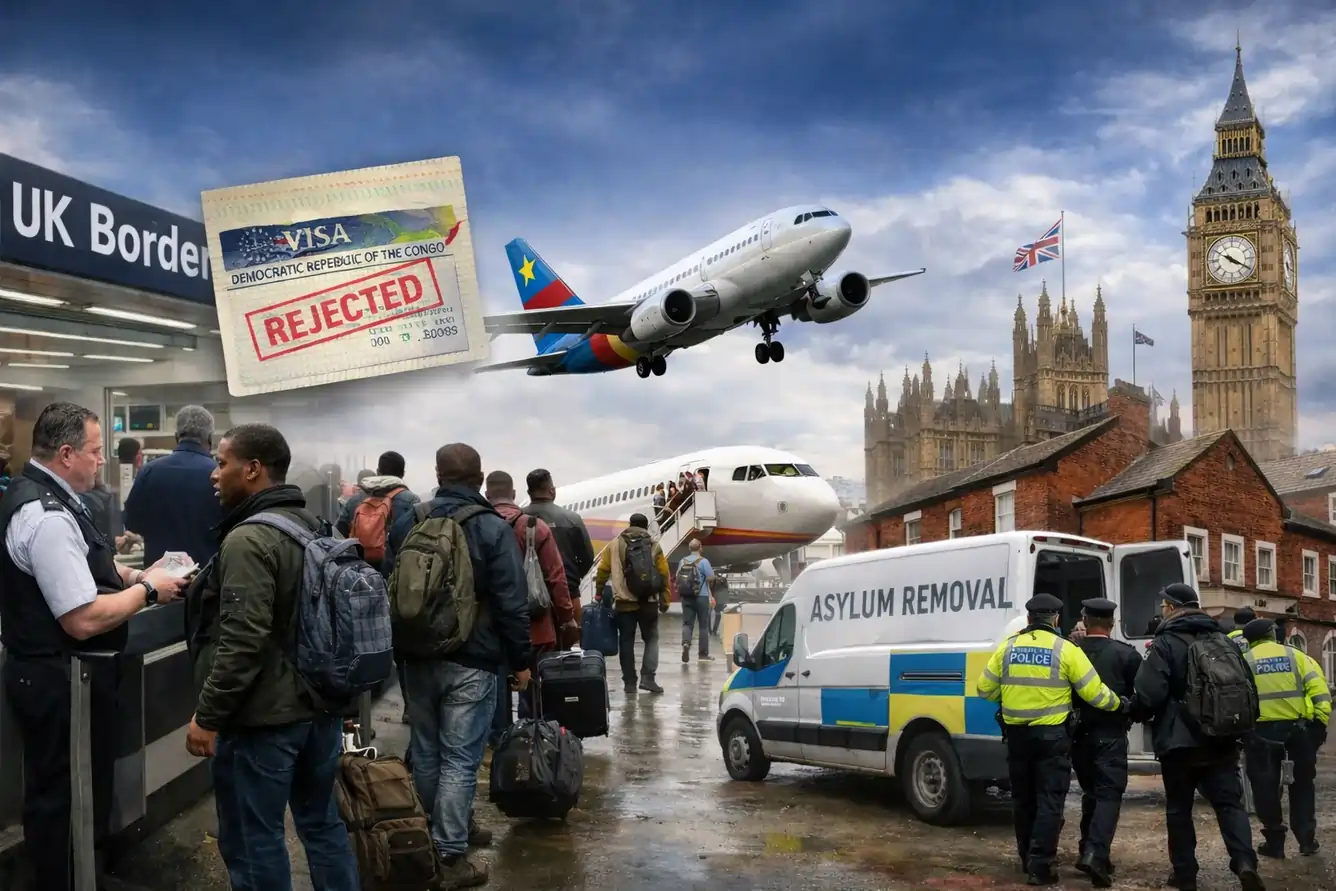
The UK has sent one of its clearest immigration signals in years: co-operate on migrant returns, or lose visa privileges.
In late 2025, the British government announced visa restrictions on people arriving from the Democratic Republic of Congo (DRC) after talks failed on returning illegal migrants and foreign national offenders. The move is part of a wider reset of the UK’s asylum and removals policy and it comes with a warning that other countries could be next.
At the heart of the decision is a new principle being enforced by Home Secretary Shabana Mahmood:
access to UK visas is no longer automatic if a country refuses to take its citizens back.
This article explains why the UK acted, what exactly has changed, who benefits, who is affected, and what this means for the future of UK immigration policy.
What This Policy Changes in Real Life
The UK’s decision to restrict visas for the Democratic Republic of Congo is not just a diplomatic signal. It has immediate, real-world consequences for migrants, travellers, and governments alike.
For Visa Applicants
Processing times are longer, fast-track routes are closed, and applications face stricter scrutiny — even for students, families, and business visitors with no link to asylum claims.
For the UK Government
Visa restrictions become leverage. The policy strengthens removal enforcement and signals that access to the UK depends on cooperation with returns.
For Other Countries
The message is clear: comply with migrant return obligations or face visa penalties. Angola and Namibia avoided sanctions — others may now reassess their stance.
1. What has the UK actually done?
The UK has not imposed a full visa ban on the Democratic Republic of Congo at least not yet. Instead, it has introduced targeted visa restrictions designed to increase pressure.
Key measures announced
- Fast-track visa processing is suspended for applicants from the DRC
- VIP, diplomatic and political preferential treatment ends
- Increased scrutiny of visa applications
- Explicit warning that a full visa ban remains possible if cooperation does not improve
In plain terms, visas from the DRC will now:
- Take longer
- Face stricter checks
- Lose political shortcuts
The Home Office says these steps are necessary because returns have been repeatedly blocked, often through delayed paperwork or refusal to accept returnees.
2. Why is the UK doing this now?
This move did not come out of nowhere. It is tied directly to the UK’s November 2025 asylum reforms, which significantly toughened the system.
The government’s core argument
The Home Office says removals were being “actively frustrated” by some governments, including:
- Failure to issue travel documents
- Requiring migrants to sign paperwork themselves (effectively a veto)
- Delays that allowed people to remain in the UK indefinitely
From the government’s perspective, this made deportation unenforceable, undermining the entire asylum system.
Shabana Mahmood summed it up bluntly:
“If one of their citizens has no right to be here, they must take them back.”
UK Asylum Reforms Timeline: November 2025 to 2027
How Britain’s asylum system is shifting from protection to enforcement.
Major Asylum Reform Package Announced
The UK government unveils sweeping asylum reforms: refugee status becomes temporary, guaranteed housing support is phased out, and visa penalties are introduced for countries refusing to accept deportees.
Visa Sanctions Used as Enforcement Tool
The Home Office threatens visa bans against the Democratic Republic of Congo, Angola, and Namibia. Angola and Namibia co-operate; visa restrictions are imposed on the DRC.
Expansion of Temporary Protection Model
Refugee leave is increasingly reviewed rather than settled automatically. Returns enforcement accelerates, and capped “safe and legal routes” replace open-ended schemes.
Broader Country-Based Visa Pressure
Additional countries may face visa penalties if return co-operation is weak. The Home Office reviews the effectiveness of sanctions and removal targets.
Full Enforcement Phase
Temporary refugee status, faster removals, and visa-linked diplomacy become the norm. Long-term settlement is limited, and asylum policy is fully integrated with foreign relations.
3. Why Angola and Namibia avoided sanctions
The UK had also threatened Angola and Namibia with similar visa penalties.
Both countries:
- Entered negotiations
- Agreed to speed up documentation
- Committed to accepting returns
As a result, sanctions were paused.
The Home Office described this as:
“The first delivery success from last month’s asylum reforms.”
The message is clear: cooperate and avoid penalties; resist and face restrictions.
4. How this fits into the UK’s new asylum strategy
The visa restrictions are just one lever in a much broader overhaul.
Core elements of the new UK asylum model
- Refugee status becomes temporary, not permanent
- Guaranteed housing support for asylum seekers will end
- New capped “safe and legal routes” will replace open-ended flows
- Stronger enforcement against illegal entry
- Visa penalties for non-cooperating countries
The UK is explicitly shifting from asylum as settlement to asylum as temporary protection.
Visa policy is now being used as a foreign-policy enforcement tool, not just an immigration filter.
Country-Risk Heat Map: UK Visa Sanctions Exposure
This conceptual heat map shows how the UK may categorise countries based on co-operation with migrant returns. It reflects policy logic — not official classifications.
🔴 High Risk
Low return cooperation, delayed paperwork, or refusal to accept nationals. Likely outcomes: fast-track suspension, VIP visa removal, potential full visa bans.
🟠 Medium Risk
Partial cooperation or slow engagement. Likely outcomes: warnings, diplomatic pressure, targeted visa restrictions.
🔵 Watch List
Co-operation exists but is inconsistent. Closely monitored; escalation possible if compliance weakens.
🟢 Low Risk
Active cooperation on returns and documentation. Visa processes continue normally with minimal disruption.
5. Who benefits from this approach?
From the government’s perspective, several groups benefit.
5.1 UK taxpayers and public services
- Faster removals reduce long-term housing and support costs
- Less pressure on asylum accommodation
- Lower backlog in the system
5.2 Immigration enforcement
- Removes the “dead end” problem where deportation is impossible
- Restores credibility to removal orders
- Sends a deterrent signal internationally
5.3 Diplomatic leverage
Visa access becomes negotiating capital. Countries now have a clear incentive to:
- Process returns
- Issue documents promptly
- Cooperate on enforcement
Will Other Countries Be Next?
Based on government statements and recent enforcement actions, the answer is: very possibly. The UK has signalled that visa restrictions will be used repeatedly where migrant return co-operation is weak.
- Countries with high asylum claim numbers but low return acceptance rates are most exposed.
- Governments delaying travel documents or requiring migrant consent may face sanctions.
- States reliant on UK visas for business, study, or diplomacy are more likely to comply quickly.
- Partial restrictions (ending fast-track and VIP visas) are likely before full bans.
6. Who is most affected and why critics are worried
While the policy may strengthen enforcement, it also raises serious concerns.
6.1 Ordinary travellers and students
Visa restrictions apply broadly, meaning:
- Students, families and business travellers face delays
- People with no link to asylum issues are caught in the net
This is a recurring criticism: visa sanctions punish populations, not governments.
6.2 Refugees and asylum seekers
The DRC is affected by ongoing violence and instability. Aid agencies warn that:
- Thousands fleeing conflict face dire conditions in neighbouring countries
- Tighter visa routes may reduce safe alternatives
- People may be pushed into more dangerous journeys
Critics argue this risks undermining humanitarian protections.
7. Will the policy actually work?
The early signs suggest it can work at least tactically.
- Angola and Namibia changed behaviour once sanctions were threatened
- The UK now has visible leverage
- Other governments are watching closely
However, long-term success depends on:
- Consistent enforcement
- Avoiding diplomatic backlash
- Maintaining legal safeguards
If overused, visa bans could:
- Damage international relations
- Encourage retaliation
- Undermine trust in UK visa fairness
Traveller Advisory Checklist
If you are planning to travel to the UK from a country affected by visa restrictions or diplomatic pressure, take these steps before applying or booking travel.
- Check whether fast-track or priority visa services are currently suspended for your nationality.
- Apply well in advance — processing times may be longer even for standard visitor or student visas.
- Ensure all documents are complete, accurate, and verifiable to avoid delays or refusal.
- Be prepared for stricter background and intent checks, even if you have travelled to the UK before.
- Avoid non-essential travel if your visa status or purpose may be unclear or time-sensitive.
- Monitor official UK Home Office updates, as restrictions may change or escalate with little notice.
- Seek professional immigration advice if travelling for study, work, or family reasons.
8. What happens next for the DR Congo?
The Home Office says engagement with the DRC has begun but is not yet sufficient.
Possible next steps include:
- Continued partial restrictions
- Escalation to a full visa ban
- Eventual lifting of sanctions if cooperation improves
The government has made one thing clear:
this is no longer a symbolic warning.
9. What this means for the future of UK immigration
This case marks a turning point.
The UK is now:
- Linking visas directly to deportation cooperation
- Willing to penalise entire countries
- Prepared to escalate quickly
For migrants, students, and international professionals, this means:
- Country-level politics now affect individual visa chances
- Visa certainty depends on diplomatic compliance, not just personal eligibility
For governments abroad, the message is even starker:
Fail to take your citizens back, and your access to the UK closes.
✔ Who Potentially Wins
- UK immigration enforcement — stronger leverage to secure migrant returns.
- UK government credibility — shows asylum reforms have real consequences.
- Co-operating countries — Angola and Namibia avoided sanctions by engaging early.
- Domestic political messaging — reinforces a tougher stance on illegal migration.
✖ Who Potentially Loses
- Ordinary DR Congo travellers — students, families, and business visitors face delays.
- Asylum seekers — fewer safe and predictable routes amid ongoing instability.
- UK–Africa relations — risk of diplomatic strain and long-term mistrust.
- Visa system neutrality — broader populations affected by state-level disputes.
Final thought: enforcement with consequences
The UK’s restrictions on the Democratic Republic of Congo are not just about one country. They are a test case for a tougher, more transactional asylum system.
Supporters see it as long-overdue enforcement.
Critics see collective punishment and humanitarian risk.
What’s certain is this: visa policy has become a frontline tool of migration control, and its use will shape who can enter the UK and on what terms for years to come.
Frequently Asked Questions (FAQs): UK Visa Restrictions on DR Congo
1. Why has the UK imposed visa restrictions on the Democratic Republic of Congo?
The UK has introduced visa restrictions because the government of the Democratic Republic of Congo has not agreed to measures that would allow the return of people in the UK illegally and foreign national offenders. The UK says removals have been blocked by delays and lack of cooperation.
2. Is this a full visa ban on DR Congo nationals?
No. This is not a full visa ban at this stage. The UK has suspended fast-track visa processing and ended preferential treatment for VIPs and politicians. However, the Home Office has warned that a complete visa ban remains possible if cooperation does not improve.
3. Who will be affected by these visa restrictions?
The measures affect all visa applicants from the DRC, including students, business travellers, family visitors, and officials. Even people with no connection to asylum claims may face longer processing times and stricter scrutiny.
4. What changes have been made to fast-track and priority visas?
Fast-track and priority visa services for DRC nationals have been suspended. This means applications will take longer to process, and urgent or premium options are no longer available.
5. Why did Angola and Namibia avoid similar visa restrictions?
Angola and Namibia agreed to improve cooperation on migrant returns after being warned by the UK. As a result, visa sanctions against them were paused.
6. What role do the UK’s new asylum reforms play in this decision?
The restrictions are part of broader asylum reforms announced in November 2025, which aim to make refugee protection temporary, speed up removals, and use visa policy as leverage against countries that refuse to take back their citizens.
7. Could other countries face similar visa restrictions?
Yes. The Home Office has indicated that other countries with poor cooperation on migrant returns could face visa penalties in the future. The DR Congo case is widely seen as a test of this new enforcement approach.
8. How does the UK justify using visas as a pressure tool?
The UK government argues that visa access is a privilege, not a right, and that countries must accept their citizens back if they have no legal right to remain in the UK. Visa restrictions are intended to restore credibility to the removal system.
9. What are the main criticisms of this policy?
Critics say visa restrictions amount to collective punishment, affecting ordinary travellers rather than governments. Aid groups also warn that tighter visa rules may reduce safe routes for people fleeing conflict and instability.
10. What should travellers from the DRC do now?
Travellers should apply well in advance, ensure documents are complete, monitor official UK updates, and seek professional advice if travelling for study, work, or family reasons, as visa rules may change quickly.
[…] powers are part of the Border Security, Asylum and Immigration Act, introduced by the Labour government following reforms announced in November […]