

The Great Indian Exit: Inside the UK’s 80% Net Migration Crash
View Transcript
In just two years, the UK has gone from record-high immigration to one of the sharpest slowdowns in its modern history.
UK Net Migration Crash – What It Means for Indians (2025)
Net migration to the UK has dropped sharply, and Indians are now both the largest group arriving and the largest group leaving. Here’s the picture in under a minute.
Key Numbers
- • Net migration: ~204,000 in year to June 2025 – down from ~649,000 the year before and far below the 2023 peak.
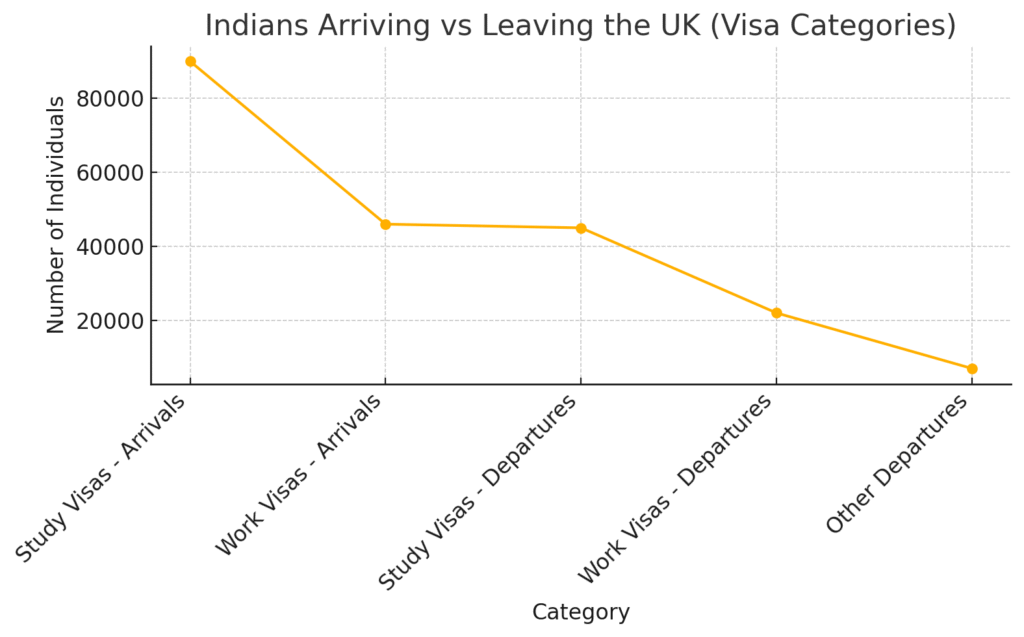
- • Indians leaving: 74,000 departures – around 45k ex-students, 22k workers, and 7k on other routes.
- • Work visas: 273,442 in year to September 2025 – a 39% drop, lowest since 2020.
- • Skilled / Health & Care visas: Q3 2025 grants down from 45k+ (Q3 2023) to just 11,733.
Why It’s Happening
- • Tighter student rules: dependants restricted, more scrutiny of courses and switching to work visas.
- • Higher work thresholds: big jumps in Skilled Worker salary & skill requirements; overseas care recruitment cut back.
- • New 10-year ILR model: settlement moving from 5 to 10 years for many, with stricter English and contribution tests.
- • Politics & costs: pressure to cut numbers, manage housing, NHS load and the rising cost of asylum.
New official data show that:
- Net migration (people coming minus people leaving) has dropped to around 204,000 in the year to June 2025 – down by almost two-thirds to four-fifths from the 2023 peak of about 944,000.
- Emigration (people leaving) hit 693,000, the highest level in more than a decade.
- Indians are now the single largest non-EU group leaving the UK: around 74,000 Indians left in the year to June 2025 45,000 on study visas, 22,000 on work visas and 7,000 on other visas.
At the same time, visa grants have fallen sharply:
- Total work visas: 273,442 in the year to September 2025, down 39% year-on-year and the lowest since 2020.
- Skilled Worker visas (especially Health & Care) have plunged – only 11,733 Health & Care Worker/Skilled Worker visas were issued in Q3 2025, versus over 45,000 in Q3 2023.
In this blog, I’ll walk you through:
- What these numbers actually mean
- Why so many Indians are leaving
- How policy changes are driving the shift
- The benefits and risks for the UK
- What Indian students, workers and families should do next
All based on ONS data, Home Office statistics and trusted media analysis.
1. First, What Is “Net Migration” – And What Has Actually Happened?
Net migration is a simple equation:
Net migration = Long-term immigration − long-term emigration
- If more people come than leave → net migration is positive
- If more people leave than come → net migration is negative
According to the Office for National Statistics (ONS):
- Net migration in the year to June 2025 was about 204,000
- That’s down from 649,000 a year earlier and from a peak of 944,000 in 2023
- Immigration fell to about 898,000
- Emigration rose to around 693,000
So yes, more people are still coming than leaving — but the gap is much smaller, and the trend is clearly downward.
Indians in the picture
Multiple analyses of the ONS data (Business Today, Economic Times, Financial Express) highlight that:
- 74,000 Indian nationals left the UK in the year to June 2025
- ~45,000 – former students, leaving after study
- ~22,000 – workers, leaving work routes
- ~7,000 – other categories (family/other visas)
- Indians are the largest non-EU group leaving the UK
- Chinese nationals were next, with about 42,000 departures
At the same time, Indians still top the arrivals list:
- Around 90,000 study visas granted to Indians
- Around 46,000 work visas granted to Indians in the same period
So this isn’t just an “exit story”. It’s a faster churn: many Indians still arrive, but more are also leaving.
2. Why Has Net Migration Dropped So Sharply?
The fall isn’t random. It reflects a deliberate policy shift across several fronts.
2.1 Tougher visa rules for students and dependants
From 2024 onwards, both the previous Conservative government and the current Labour government tightened rules for non-EU students. Key changes include:
- Ban on most taught-master’s students bringing dependants (except on research degrees)
- Stricter rules on switching from student visas into work routes
- More scrutiny of “low value” courses and institutions
- Higher maintenance and financial requirements
ONS officials have noted that non-EU students are now a major driver of emigration, as those who came during the post-pandemic surge are now finishing studies and leaving in larger numbers. Indians and Chinese are central to this trend.
2.2 Salary hikes and restrictions on Skilled Worker & Health & Care visas
The UK has also tightened its points-based work system:
- Minimum salary thresholds for Skilled Worker visas have risen significantly, with Home Office data showing thresholds now above £38,700 and moving towards £41,700, except for shortage roles.
- Skill level requirements have been raised to RQF Level 6 for most roles, closing off lower-paid jobs.
- In July 2025, overseas recruitment to many care roles was effectively halted, drastically reducing Health & Care Worker visas.
Result?
- Annual work visas down to 273,442, 39% lower than a year before and the lowest since 2020.
- Health & Care / Skilled Worker visas to main applicants down to 11,733 in Q3 2025, from 45,000+ in Q3 2023.
This hits Indian workers particularly hard because Indians have been the largest group on Skilled Worker and Health & Care routes in recent years.
2.3 New “earned settlement” (ILR) model and longer routes
The government has also signalled a shift to a 10-year standard qualifying period for Indefinite Leave to Remain (ILR), with tougher conditions around:
- English language (A-Level / C1)
- National Insurance contributions
- Clean criminal and immigration record
- Minimal or no benefit use
While this ILR reform is still under consultation, the direction is clear: settlement will get harder and slower for most migrants, particularly lower-paid workers. That makes the UK feel less attractive for those looking at 5–10 year life plans.
2.4 Politics and public pressure
High net migration became a top political issue after figures for 2022–2023 showed record numbers. Post-Brexit, both main parties promised “control” and “lower numbers”.
- Home Secretary Shabana Mahmood has publicly welcomed the fall, saying net migration is now at its lowest in half a decade and emphasising reforms so that “those who come here must contribute more than they take out.”
- At the same time, anti-immigration protests and local pressure about asylum hotels and housing costs have kept migration firmly on the front pages.
Politically, a sharp fall in net migration is a signal that the government is “doing something”.
3. Why Are So Many Indians Leaving?
From the data and commentary, you can see three main factors for the 74,000 Indian departures.
3.1 End of the “post-pandemic study wave”
Between 2021–2023, UK universities saw a huge surge in Indian students, particularly on one-year master’s programmes, helped by:
- The Graduate Route (post-study work visa)
- Relative ease of bringing dependants
- Strong marketing by institutions and agents
Those cohorts are now finishing their degrees and leaving:
- Some cannot secure qualifying jobs at the new salary/skill thresholds
- Others find better options in Canada, Australia, Europe or back in India
- Some simply came for a fixed 1–3 year plan and are following through
Hence the headline number: ~45,000 Indian students leaving in one year.
3.2 Harder path from student → worker → settlement
For many Indian students, the traditional dream path was:
Study → Graduate Route → Skilled Worker → ILR in 5 years → Citizenship
Now:
- Fewer roles qualify under the new Skilled Worker thresholds
- Employers face more compliance, salary and sponsorship costs
- ILR is likely to be 10 years, not 5, for most routes
So a significant number of Indians are looking at that landscape and deciding:
“I’ll take the UK degree, but I won’t build my entire career there.”
3.3 Families and cost-of-living pressures
The UK has seen:
- High inflation, high rent, and rising taxes
- Stricter rules for dependants and family formation
- Uncertainty over future immigration reforms
For Indian families, especially those supporting dependants or extended family back home, the calculation often becomes:
“Is this still worth it, compared with similar or better opportunities in Canada, Australia, UAE, or even India?”
For many, the answer in 2025 seems to be no, or at least “not forever”.
4. Impact on Skilled Worker Visas and the UK Labour Market
The fall in work visas – especially Health & Care and Skilled Worker – has serious implications.
4.1 The numbers in context
Official statistics and independent analysis show:
- Work visas overall: 273,442 in year to September 2025 (-39% YoY, lowest since 2020)
- Health & Care / Skilled Worker visas:
- Q3 2025: 11,733 visas
- Q3 2023: 45,000+ visas
- Skilled Worker grants (including Health & Care) are down more than 50% year-on-year
Dr Dora-Olivia Vicol of the Work Rights Centre has warned that drastic cuts to skilled routes may undermine economic growth, especially in sectors already facing shortages.
4.2 Sectors at risk
The biggest immediate risks are:
- NHS & social care – dependent on international nurses, doctors, carers
- Tech and engineering – where domestic skills gaps remain
- Hospitality and services – already struggling post-Brexit
Short-term, businesses can try to raise wages and invest in UK training. But in the medium term, big structural shortages could:
- Push up costs
- Reduce service levels
- Slow down growth and innovation
5. Benefits and Risks of the Net Migration Drop – From the UK’s Perspective
5.1 Potential benefits the government points to
From the government’s viewpoint, the sharp fall in net migration brings some clear political and policy “wins”:
- Lower headline numbers
- Net migration at 204,000, the lowest since 2021 and far below the 2022–23 peaks.
- Less pressure on services (in theory)
- Fewer arrivals should make it easier to manage housing, schools, NHS, transport – at least on paper.
- Reassuring voters who wanted lower migration
- Surveys show migration is a top concern for many voters; cutting numbers is politically valuable.
- A pivot to “quality over quantity”
- Focusing on high earners, high contributors while reducing lower-paid migration fits the new earned settlement narrative.
5.2 But there are serious risks and trade-offs
- Economic growth and productivity
- Fewer skilled workers means fewer staff for hospitals, care homes, labs, startups, and export-facing sectors.
- The OBR and independent economists already warn that UK growth prospects are weak; cutting productive migration can worsen this.
- University finances and global competitiveness
- International students – especially Indian and Chinese – cross-subsidise UK research and home-student teaching.
- If fewer come, or more leave quickly, university budgets suffer, potentially reducing course options and quality.
- Soft power and India–UK relations
- The Indian diaspora is central to UK-India trade, investment and diplomacy.
- A narrative of “India sends students, UK sends them back faster” is not helpful when the UK is trying to deepen ties via trade deals.
- Asylum and irregular migration still rising
- Even as legal migration falls, asylum claims and small-boat arrivals remain high – around 96,000–110,000 long-term asylum arrivals and record claims in the latest data.
- Asylum accommodation is now projected to cost over £15.3 billion across a decade – triple original estimates.
So the government can say “we cut legal migration”, but irregular migration and asylum costs remain very expensive and politically toxic.
6. What Does This Mean for Indian Students, Workers and Families?
Let’s break this down practically.
6.1 Indian students planning to study in the UK
Reality check:
- The UK is still welcoming large numbers of Indian students (≈ 90,000 visas), but it’s no longer an easy long-term route.
What to think about:
- Don’t assume automatic work & settlement.
- Graduate Route is still there for now, but switching to Skilled Worker is harder: higher salaries, narrower eligible roles.
- Choose course + university strategically.
- Prioritise STEM, health, tech, finance, AI, data, engineering – sectors where sponsorship is more likely.
- Check each university’s graduate employment and sponsorship stats, not just marketing.
- Plan for multiple outcomes.
- Option A: Stay in the UK if you secure a qualifying job.
- Option B: Leverage your UK degree in India, Canada, Middle East, Singapore, etc.
- Option C: Further study or switching to routes like Global Talent if you’re highly qualified.
- Budget realistically.
- High rent, living costs and rising taxes mean you must assume no guaranteed UK job and plan finances accordingly.
6.2 Indian professionals and Skilled Workers
If you’re already in the UK or planning to enter on a work route:
- Check updated salary thresholds and skill levels.
- Use the latest Home Office and gov.uk guidance; thresholds have moved multiple times.
- Talk to your employer early.
- Many smaller employers are now more cautious about sponsorship due to cost and admin.
- Ask clearly: Will you sponsor long term? Can you meet the salary levels?
- Think in 3–10 year horizons, not 1–2.
- With ILR moving towards 10 years for many, ask yourself:
- Do I want a decade here?
- Is the career progression worth it vs other countries?
- With ILR moving towards 10 years for many, ask yourself:
- Build a strong “earned settlement” profile.
- Stable employment and NI record
- Zero immigration or criminal issues
- Strong English and professional credentials
These things will matter more under the new settlement model.
6.3 Indian families and dependants
For families:
- Spouses of British citizens and certain family routes still have relatively stable 5-year ILR paths, but may face higher incomes and stricter checks.
- Student dependants have been heavily restricted, especially for one-year taught master’s courses.
Planning tips:
- Clarify the route for the whole family, not just the main applicant.
- Model worst-case scenarios – what if a visa extension is refused?
- Consider diversifying your geographic risk – for example, one spouse in the UK now, the other building optionality in another country or in India.
7. What Could Happen Next? Future Outlook (2026–2028)
Based on the current policy trajectory and official commentary:
7.1 Net migration likely to stay lower – but not zero
- The government wants numbers closer to 200,000 or below, not the 700k–900k highs of 2022–23.
- Expect continued pressure on:
- Student routes
- Lower-paid work routes
- Family/reunification rules
7.2 Continued focus on “high contribution” migrants
- Faster settlement for:
- High earners
- Global Talent
- Possibly new investor or entrepreneurship routes (if adopted)
If you are highly skilled, in tech/finance/AI/health, and earning at least higher-rate tax, the UK will still work hard to keep you.
7.3 Asylum and irregular migration will shape the debate
- Asylum claims and small-boat crossings remain high and very expensive (asylum accommodation costs projected over £15.3bn this decade).
- Expect more headline-grabbing reforms on:
- Temporary refugee protection
- Reduced rights to settlement
- Faster removals
But that does not directly help Indian students/workers; it just keeps migration in the political spotlight.
Should You Still Choose the UK? (Quick Pros & Cons)
👍 Pros
- •World-class universities, research labs & academic reputation.
- •Strong tech, finance, healthcare & engineering job markets.
- •Graduate Route still open (as of 2025) for post-study experience.
- •High salaries in specialised sectors that meet Skilled Worker thresholds.
- •Global Talent, Innovator Founder & high-earner fast-track ILR remain attractive.
👎 Cons
- •Tougher Skilled Worker rules: higher salaries & restricted sponsor hiring.
- •Most master’s students can no longer bring dependants.
- •ILR expected to shift from 5 years → 10 years for most migrants.
- •Increasing living costs: rent, transport & tax burden rising.
- •More students/workers leaving as pathways become uncertain.
8. Key Takeaways – In Plain Language
- Net migration has dropped dramatically – from almost 1 million at peak to around 204,000 now.
- Indians are at the centre of this story – both as the largest new arrivals and now the largest group leaving (74,000).
- The fall is driven by policy changes, not just personal preferences: tougher student rules, higher salary thresholds, care-worker clampdowns, and a more demanding ILR model.
- The UK government sees this as a success, but there are real risks: skills shortages, weaker universities, a cooler environment for global talent, and strained ties with key partners like India.
- For Indian students and workers, the lesson is clear:
- Don’t treat the UK as a guaranteed long-term migration route.
- Come with a clear plan, backup options, and realistic expectations about work and settlement.
Final Verdict – Should You Still Choose the UK?
The UK remains a strong destination for high-skilled talent, but it’s no longer a universally easy path for long-term settlement. Here’s the bottom line.
✔ When the UK Still Makes Sense
- •You’re pursuing STEM, AI, finance, research or high-growth careers.
- •You qualify for Skilled Worker salaries or Global Talent/Innovator routes.
- •You have a clear career track that supports a long-term ILR strategy.
- •You want a world-class education or entry into global job markets.
✖ When the UK May Not Be Ideal
- •You expect an easy route from study → work → PR.
- •Your profession cannot meet new Skilled Worker thresholds.
- •You need dependant visas on 1-year master’s courses.
- •You seek quick ILR—most migrants may face 10 years under new rules.
FAQ Section – Indians Leaving the UK & Net Migration Drop
1. Why did 74,000 Indians leave the UK in 2025?
ONS data shows that most Indian departures were former students who finished their studies under older rules and left due to stricter switching regulations, higher salary thresholds for Skilled Worker visas, and fewer dependant allowances. Many workers also left because employers struggled to meet new sponsorship costs and salary requirements.
2. Are Indians still coming to the UK despite the high exit numbers?
Yes. Indians remain the largest nationality group receiving new visas around 90,000 study visas and 46,000 work visas were issued. The UK still attracts Indian talent, but the churn rate is much higher than before.
3. Why has overall UK net migration dropped so sharply?
Key drivers include:
- Tighter student rules
- Higher Skilled Worker salary thresholds
- Reduced Health & Care Worker recruitment
- Slower employer sponsorship
- Policy shift toward “high contribution” migration
- More students returning after study peaks from 2021–2023
4. Are changes in UK Skilled Worker visas affecting Indians the most?
Yes. Indians historically dominated Skilled Worker and Health & Care visas. The reduction of eligible roles, increased salary thresholds, and the clampdown on care-sector recruitment significantly impacted Indian professionals.
5. Is the Graduate Route still available for Indian students?
Yes, the Graduate Route remains open as of late 2025. However, switching from Graduate Route to Skilled Worker is harder due to salary changes and employer hesitancy.
6. Will the new 10-year ILR proposal affect Indians planning long-term settlement?
Most likely yes. The new “earned settlement” model would require many migrants including Indians to demonstrate higher English proficiency, consistent employment, tax contributions, and little or no benefit usage across a longer 10-year period.
7. What fields still offer strong opportunities for Indians in the UK?
Sectors with strong hiring include AI, data science, engineering, fintech, healthcare specialists, academia, and high-paid corporate roles areas that meet Skilled Worker thresholds and offer sponsorship.
8. Should Indian students still choose the UK for higher studies?
Yes, but with realistic expectations. The UK remains excellent for global education and short-term work experience, but does not guarantee long-term settlement unless students enter high-skilled, high-salary routes.
9. Is the UK becoming less attractive for dependants and families?
For many families, yes. Dependants are now restricted for most taught-master’s courses, and long-term settlement is harder. Families must plan finances, timelines and career routes more carefully.
10. Will net migration continue to fall in 2026?
Most likely. The government aims to maintain numbers around 200,000 or lower, with more restrictions expected for work, family, and student routes. High-skilled and high-earning migrants may receive preference.