
The United Kingdom is trying to build something much bigger than a fusion power plant.
It is trying to build an industrial ecosystem around the science, engineering, software, skills and intellectual property that fusion research creates.
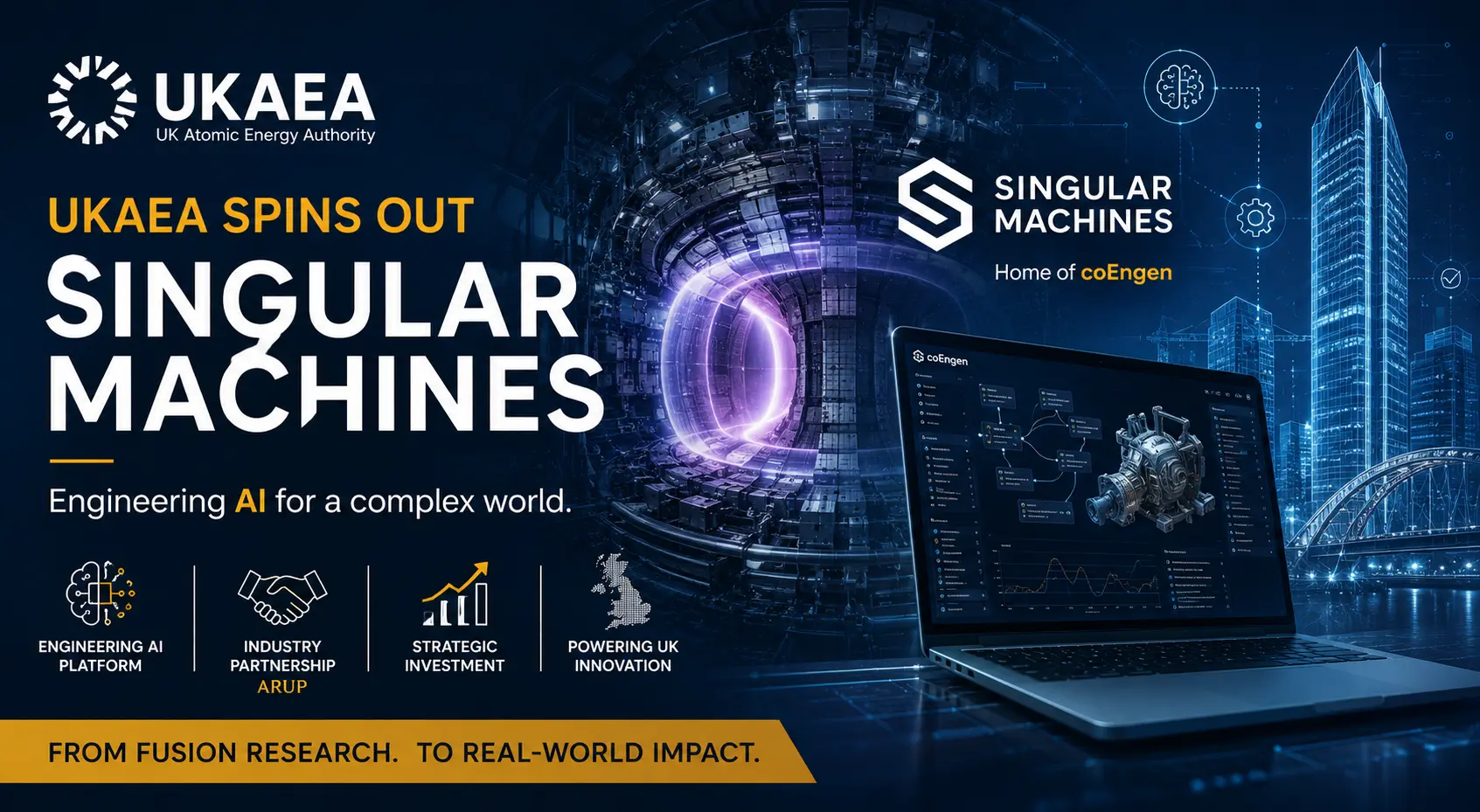
The latest example is Singular Machines, a new UK engineering automation company spun out from the UK Atomic Energy Authority (UKAEA). The company is developing coEngen, an agentic artificial intelligence platform designed to help engineers manage complex projects while preserving traceability, assurance and professional judgement.
The company has now completed a strategic investment round involving the UK Innovation and Science Seed Fund, managed by Future Planet Capital, Oxford Science Enterprises, global engineering firm Arup, and Japan’s Miraisozo Investments. At the same time, Arup has signed a new contract to use the coEngen platform in real engineering work.
This matters for a simple reason: the technology began in the demanding world of fusion engineering, but its potential market is much broader.
The story is therefore not only about another AI startup.
It is about how public research can become commercial technology, how advanced AI could change engineering, and how the UK’s fusion strategy is increasingly being designed to generate economic value beyond fusion itself.
What Is Singular Machines?
Singular Machines is a UK engineering automation company that emerged from UKAEA’s research and innovation environment.
Its origins are important because fusion is one of the most demanding engineering problems in the world. A future fusion power plant will require scientists and engineers to coordinate complex systems involving plasma physics, materials, robotics, fuel cycles, advanced computing, manufacturing, safety and plant integration.
UKAEA’s 2026–2030 strategy explicitly recognises that knowledge created through fusion research can have value in other industries. Its commercialisation programme covers technologies ranging from software and scientific data to expertise and intellectual property, with potential routes including spinouts, licensing, joint ventures and industry partnerships.
Singular Machines is a practical example of that strategy.
Rather than keeping the technology inside a public research organisation, UKAEA has helped create a standalone business capable of raising private investment, working directly with industry and developing a commercial product.
UKAEA says its innovation team helped Singular Machines get off the ground, while the company now moves into the next stage: building industrial partnerships and taking its technology into the wider engineering market.
The company’s UK corporate record shows that Singular Machines Limited was incorporated in August 2024 and operates in engineering design activities for industrial process and production.
That distinction is useful.
The company is not simply an AI business looking for an engineering problem.
Its roots are in engineering itself.
What Is coEngen and Why Does It Matter?
At the centre of Singular Machines’ business is coEngen, an agentic AI platform for engineering.
The phrase “agentic AI” is increasingly common, but in engineering its meaning is more demanding than simply asking a chatbot to generate text.
Traditional generative AI is usually built around a prompt-and-response model. A user asks a question and receives an answer.
Engineering projects are different.
A major engineering project may involve thousands of requirements, drawings, calculations, assumptions, design decisions, simulations, standards, specifications, test results and reviews. Changes in one part of the project can affect many others.
The difficult problem is not simply producing information.
It is coordinating information while maintaining confidence in where that information came from, why a decision was made and who remains responsible for it.
That is the problem Singular Machines is attempting to address.
UKAEA describes coEngen as an agentic AI platform designed to maintain the traceability, assurance and professional judgement that engineering practice depends on, while helping engineers work more efficiently.
This is an important design philosophy.
The goal is not necessarily to replace the engineer.
The goal is to give engineers a better system for handling complexity.
What Is coEngen?
coEngen is an agentic AI platform being developed by Singular Machines for complex engineering environments. Instead of treating AI as a simple question-and-answer tool, the platform is designed around the demands of engineering work, where decisions need evidence, traceability, assurance and professional judgement.
Traceability
Help engineers maintain visibility over information, requirements and decisions throughout complex workflows.
Assurance
Support engineering processes where confidence, checking and reliable outcomes are essential.
Efficiency
Help engineers work more efficiently as projects become larger, more interconnected and harder to coordinate.
Professional Judgement
Keep engineering expertise and human decision-making at the centre of the process rather than removing it.
Why Engineering Needs a Different Kind of AI
Engineering has always depended on software.
Computer-aided design, simulation packages, digital twins, project-management platforms and specialist analysis tools have already transformed the industry.
But many of these tools solve individual problems.
One tool may handle structural analysis.
Another may manage project information.
Another may perform computational modelling.
Another may manage documentation.
Another may support manufacturing.
The engineer still has to connect the pieces.
That human coordination becomes increasingly difficult as projects become larger.
Consider a major infrastructure project.
A change to a material specification could affect:
- Structural calculations;
- Manufacturing requirements;
- Procurement;
- Cost;
- Weight;
- Safety margins;
- Maintenance;
- Regulatory documentation;
- Testing;
- Construction sequencing.
A person can understand these relationships, but the number of connections grows rapidly as projects become more complicated.
This is where agentic AI could become particularly useful.
Instead of simply generating an answer, an agentic system can potentially coordinate tasks, analyse relationships, retrieve relevant information, identify conflicts and support engineers through a chain of decisions.
Singular Machines’ proposition is built around that type of engineering coordination.
Innovate UK Business Connect has separately recognised coEngen in its Advanced Manufacturing category through the Agentic AI Pioneers Prize, describing it as a multi-agent engineering platform that brings disciplines together through a shared data model and enables rapid, traceable optimisation of complex systems.
That provides another indication of where the technology is positioned: not as a generic office AI assistant, but as an AI system aimed at complex engineering and advanced manufacturing.
Why Modern Engineering Is Becoming Harder to Coordinate
Engineering projects are no longer isolated technical exercises. They increasingly bring together multiple disciplines, large volumes of information and decisions that depend on one another.
More Engineering Disciplines
Mechanical, electrical, software, materials, robotics, computing and safety specialists may all contribute to the same complex system.
More Connected Decisions
A change to one component or requirement can create consequences for design, manufacturing, testing, procurement and safety.
More Data to Manage
Engineers work with requirements, calculations, simulations, specifications, drawings, test results and project documentation.
Constant Iteration
Engineering projects evolve as testing produces new information, designs change and new constraints emerge.
Decisions Must Be Defensible
In high-assurance environments, engineers need to know not only what decision was made, but why it was made and what evidence supports it.
Humans Connect the Pieces
Engineers often have to bring information from different tools, teams and disciplines together before making important technical decisions.
Why Did the Technology Start in Fusion?
Fusion is an unusually good testing ground for this kind of technology.
Building a fusion power plant requires the integration of technologies that are individually difficult and collectively even harder.
UKAEA’s 2026 fusion roadmap identifies four interconnected challenges:
- An effective fusion core
- Fuel self-sufficiency
- Systems integration
- Affordability and attractiveness
The organisation is working across plasma science, fuel cycles, advanced materials, robotics and automation, fusion technologies, component production, integration and design, and advanced computing.
The common thread is complexity.
Fusion therefore creates an environment where engineering teams cannot afford to treat every discipline as an isolated activity.
A successful system must work as a whole.
That lesson has value well beyond fusion.
The same basic problem appears in aerospace, defence, energy, transport, advanced manufacturing, construction and major infrastructure.
Aerospace projects contain huge numbers of interconnected requirements.
Energy infrastructure involves complex regulatory and technical constraints.
Advanced manufacturing combines machines, software, materials and production processes.
Large construction programmes require constant coordination between engineering disciplines, contractors, designers and suppliers.
The technology developed in one difficult environment can therefore have applications across many others.
That is one of the most interesting parts of the Singular Machines story.
Fusion is the starting point, not necessarily the final market.
From Fusion Research to Commercial AI
Singular Machines shows how expertise developed while solving demanding fusion-engineering problems can move beyond the laboratory and become commercial technology for a much wider engineering market.
Fusion Research
UKAEA works on some of the world’s most complex scientific and engineering challenges.
Engineering Innovation
New software, knowledge and engineering approaches emerge from solving those difficult problems.
Spinout
Technology with commercial potential can move into a dedicated company such as Singular Machines.
Investment
Strategic investors provide capital and support to help develop the technology commercially.
Industry Partnership
Industrial partners can test the technology using real engineering workflows and requirements.
The Arup Investment and Contract: Why It Is Significant
The involvement of Arup gives this development another dimension.
Arup is not simply an investor in Singular Machines. Under the new arrangement, it will also provide technical, commercial and strategic support and help shape and test the platform using real engineering workflows.
Arup has also signed a fresh contract to use coEngen.
That creates a useful bridge between technology development and real-world deployment.
For an engineering AI company, access to actual engineering workflows can be extremely valuable.
A technology can look impressive in a demonstration.
The real test comes when engineers have to use it on projects with deadlines, constraints, standards, documentation requirements and accountability.
Real-world use can expose the difficult questions:
- Does the system produce traceable outputs?
- Can engineers understand why it reached a conclusion?
- Can information be checked?
- Can changes be tracked?
- Does the system preserve professional responsibility?
- Can it work with existing engineering processes?
- Does it save meaningful time?
- Does it reduce rather than introduce engineering risk?
Those questions cannot be answered properly through a laboratory demonstration alone.
They have to be tested in practice.
Arup’s role therefore potentially gives Singular Machines something more valuable than capital: an industrial environment in which the technology can mature.
Why the Arup Partnership Matters
The relationship between Arup and Singular Machines goes beyond financial investment. Arup will use coEngen through a new contract and support the company with technical, commercial and strategic expertise while helping shape and test the platform through real-world engineering workflows.
Strategic Investment
Arup has joined the strategic investment round alongside the UK Innovation and Science Seed Fund, Oxford Science Enterprises and Miraisozo Investments.
Industry Deployment
Arup has signed a fresh contract to use the coEngen platform, giving Singular Machines an opportunity to develop the technology around real engineering requirements.
Who Is Investing in Singular Machines?
The strategic investment brings together organisations with different roles.
The round is led by the UK Innovation and Science Seed Fund, managed by Future Planet Capital, and Oxford Science Enterprises, with participation from Arup and Japan’s Miraisozo Investments.
The combination is notable because it brings together public-sector innovation capital, venture-building expertise, an international investor and a major engineering company.
Each participant can potentially contribute something different.
Public innovation investment
The UK Innovation and Science Seed Fund represents the connection between publicly supported innovation and commercial technology.
For research-heavy businesses, early funding is often difficult to secure.
The technology may be scientifically credible but not yet commercially mature.
Investment at this stage can provide the time and resources needed to turn research into a product.
Oxford’s deep-tech ecosystem
Oxford Science Enterprises is another important part of the wider UK science and technology investment landscape.
Its model focuses on turning advanced research into companies capable of addressing major problems, particularly across deep technology and science-led industries.
Singular Machines therefore fits into a broader trend in which UK research institutions are increasingly looking beyond publications and patents towards companies, investment and commercial deployment.
Industrial investment
Arup’s participation is arguably the most directly connected to product development.
An engineering company can provide something a financial investor cannot easily replicate: access to real technical problems.
International capital
Miraisozo Investments adds an international dimension.
That matters because technologies developed for global engineering markets will ultimately need customers and partners outside the UK.
The commercialisation story is therefore international from an early stage.
The Strategic Investment Ecosystem
Singular Machines’ funding round brings together organisations with different strengths: early-stage innovation capital, science-led commercialisation experience, engineering expertise and international investment.
UK Innovation and Science Seed Fund
The fund, managed by Future Planet Capital, provides investment support for innovative UK technology businesses at an early stage.
Oxford Science Enterprises
Brings experience in turning science and research-based innovation into commercially focused companies.
Arup
Adds engineering expertise, commercial insight and access to real-world engineering workflows through its partnership with Singular Machines.
Miraisozo Investments
Adds an international investment dimension from Japan, supporting the company’s potential beyond the UK market.
Why the combination matters
A deep-tech company needs more than funding. It also needs technical validation, commercial experience, access to industry and a route towards wider markets. The Singular Machines round brings several of these capabilities together at the same stage of the company’s development.
The Bigger UKAEA Strategy Behind the Spinout
Singular Machines should not be viewed in isolation.
It fits directly into UKAEA’s 2026–2030 strategy.
The strategy states that UKAEA intends to increase the commercial exploitation of knowledge assets and develop a pipeline of potential spinouts, intellectual-property licences and joint ventures.
UKAEA’s commercialisation model includes:
- spinout companies;
- IP licences;
- strategic contracts;
- commercial partnerships;
- supplier engagement;
- joint ventures;
- investment mechanisms for new companies.
The organisation’s innovation funnel starts with an idea, moves through assessment and innovation projects, then progresses towards IP protection and exploitation. Possible routes include licensing, spinouts, joint ventures, consultancy and open-source approaches.
That is a significant change in emphasis.
Public research does not have to end when the research project ends.
The knowledge can become a company.
The company can attract investment.
The investment can support product development.
The product can enter industry.
And industry adoption can create further economic value.
Singular Machines is one example of this chain in action.
How UKAEA Turns Research Into Commercial Opportunity
Singular Machines is part of a broader UKAEA approach to commercialisation. The organisation is building a pipeline that can move knowledge and technology from research into intellectual property, partnerships and new commercial companies.
Research & Ideas
Scientific research, engineering work, software, data, expertise and new technologies can create ideas with potential value beyond the original research programme.
Opportunity Assessment
Potential opportunities can be assessed against factors including market demand, technology maturity, strategic priorities and possible economic impact.
Innovation Development
Promising technologies can receive further development, protection and support before a commercial route is selected.
Commercial Route
UKAEA can choose the route that best fits the technology, market and long-term UK economic opportunity.
Industry & Wider Market
The technology can move towards customers, industry partnerships, licensing or a new commercial company.
Why UK Fusion Research Is Becoming an Economic Strategy
For years, fusion has often been discussed primarily as an energy challenge.
Can scientists make fusion work?
Can plasma be controlled?
Can a reactor produce useful energy?
Can engineers develop materials capable of surviving extreme conditions?
Those questions remain fundamental.
But the UK’s current strategy adds another layer.
What economic value can the UK create while solving those problems?
UKAEA estimates that fusion could represent a global capital investment opportunity of approximately £3 trillion to £12 trillion between 2050 and 2100. The organisation also highlights the benefits that fusion research can generate for robotics, materials, medicine and artificial intelligence.
That does not mean the UK will automatically capture a large share of this potential market.
It means there is a strategic reason to build domestic capability now.
If UK research produces valuable technologies but those technologies are commercialised elsewhere, much of the economic benefit may leave the country.
Spinouts provide one route to retaining more of that value in the UK.
The Financial Commitment Behind the Strategy
The commercialisation programme is supported by a much broader public investment in fusion.
Under the government’s 2025 Spending Review settlement, around £2.5 billion is allocated to fusion between 2025/26 and 2029/30, with almost £2.48 billion allocated to UKAEA Group.
The allocation includes:
- £1.3 billion for UK Fusion Energy and the next phase of STEP;
- £920 million for UKAEA’s National Fusion Laboratory R&D infrastructure and facilities;
- £190 million for international research, innovation, commercialisation and wider industry support;
- £125 million for the AI Growth Zone at Culham;
- £50 million for fusion skills and training.
This is important context for Singular Machines.
The spinout is not a standalone technology story.
It is part of a much larger attempt to create a research-to-industry pipeline.
UK Fusion Investment: 2025/26–2029/30
The Singular Machines spinout is part of a much larger UK investment in fusion research, infrastructure, artificial intelligence, commercialisation and skills.
AI and Fusion: A Partnership That Could Grow
AI is becoming increasingly important to fusion because fusion produces enormous amounts of complex data and requires advanced modelling.
UKAEA’s strategy identifies advanced computing as a critical technical enabler across fusion technologies and lifecycle stages.
The organisation is also developing the Culham AI Growth Zone, including the Sunrise fusion-dedicated supercomputer.
The 2026–2030 strategy sets a target for Sunrise to begin operations in 2026 and describes it as expected to be the world’s most powerful fusion-specific AI supercomputer.
This creates a potentially powerful ecosystem.
On one side, there is advanced computing and AI infrastructure.
On another, there is world-class fusion research.
Then there are engineering organisations and technology companies capable of commercialising what comes out of that research.
Singular Machines sits at the intersection of those trends.
What Could coEngen Change for Engineers?
The potential benefits are not simply about doing work faster.
The larger opportunity is changing how engineering teams handle complexity.
1. Faster engineering workflows
If AI can automate repetitive coordination and information-processing tasks, engineers could spend more time on difficult technical decisions.
That does not mean removing engineers from the process.
It means reducing the amount of time they spend searching, checking, organising and transferring information between systems.
2. Better traceability
Engineering decisions need evidence.
An engineer may need to know:
- where a requirement came from;
- which assumption was used;
- which calculation supports a decision;
- what changed;
- what dependencies are affected;
- who reviewed the result.
An AI platform that preserves those relationships could make complex engineering workflows easier to audit.
3. Better collaboration
Large engineering projects involve multiple disciplines.
Mechanical engineers, electrical engineers, software engineers, materials specialists, safety professionals and project managers may all work on different parts of the same system.
A shared AI-supported environment could help connect those disciplines.
4. Faster iteration
Engineering is rarely a straight line.
Designs change.
Requirements move.
New information arrives.
Testing reveals problems.
A more connected system could help teams understand the consequences of those changes more quickly.
5. Keeping professional judgement central
Perhaps the most important benefit is also the most easily overlooked.
Engineering is not simply data processing.
Professional judgement matters.
Safety matters.
Accountability matters.
The design philosophy behind coEngen is therefore important because it explicitly focuses on keeping engineering expertise at the centre of decision-making.
What Are the Risks and Challenges?
The excitement around agentic AI should not hide the difficult questions.
Engineering is a high-assurance environment.
An incorrect answer in an ordinary business document may be inconvenient.
An incorrect engineering recommendation can have much more serious consequences.
That means engineering AI needs stronger safeguards than many consumer AI applications.
Accuracy
AI systems can make mistakes.
A useful engineering platform must have mechanisms for validation and verification rather than assuming that an AI-generated result is correct.
Traceability
Engineers need to understand the basis for decisions.
A black-box system will struggle to gain trust in high-assurance environments.
Accountability
AI cannot simply become the person responsible for an engineering decision.
Professional responsibility still has to sit with qualified humans and organisations.
Data security
Engineering projects may involve commercially sensitive information, intellectual property or security-sensitive designs.
Any AI platform operating in this environment must address data governance and access controls.
Integration
Engineering teams already use large numbers of software systems.
A new platform must fit into existing workflows rather than create another isolated data island.
Human adoption
Even technically strong AI will fail if engineers do not trust or understand it.
The challenge is therefore partly technological and partly organisational.
Why the Human Engineer Still Matters
There is a tendency to describe AI development as a race to automate everything.
Engineering may follow a different path.
The most valuable systems may be those that increase the capability of engineers rather than attempt to eliminate them.
This is especially important in safety-critical fields.
An engineer understands context.
An experienced professional can recognise when a result does not make sense.
A specialist can make a judgement when evidence is incomplete.
AI can process information at extraordinary speed, but speed alone does not equal engineering competence.
Singular Machines’ positioning around traceability, assurance and professional judgement recognises this distinction.
The future may therefore look less like “AI replaces engineers” and more like:
engineers + intelligent agents + connected engineering data + stronger verification.
That is a much more realistic model for complex industries.
The Future May Be Human Engineer + AI
In complex engineering, the goal of AI does not have to be replacing professional expertise. A more practical model is to combine the processing and coordination capabilities of AI with the experience, responsibility and judgement of qualified engineers.
What AI Can Help With
- Processing large volumes of engineering information
- Connecting related requirements and project data
- Supporting repetitive coordination tasks
- Identifying patterns and relationships
- Helping teams work through complex workflows
What Engineers Bring
- Professional engineering judgement
- Understanding of real-world context
- Verification and technical review
- Responsibility for engineering decisions
- Experience in dealing with uncertainty
From Fusion to Other Industries
The commercial opportunity for Singular Machines could ultimately be much larger than fusion.
The company says the underlying problem exists across engineering because projects have become so complex that they are reaching the limits of what human coordination alone can handle.
Potential areas include:
Aerospace
Aircraft and spacecraft involve tightly connected systems and strict verification requirements.
Energy
Power generation, grids, nuclear projects, renewables and hydrogen infrastructure all require complex engineering coordination.
Construction and infrastructure
Large infrastructure projects involve huge numbers of stakeholders, design documents and changing requirements.
Advanced manufacturing
Modern factories combine robotics, software, materials, production systems and quality controls.
Automotive
Vehicle development increasingly depends on the integration of mechanical, electrical and software systems.
Defence
Defence engineering involves highly complex systems where traceability, reliability and security are critical.
The exact commercial applications will depend on how the technology develops.
But the underlying problem is common.
Complexity is becoming an engineering bottleneck.
Where Could Engineering AI Be Used?
The underlying challenge addressed by engineering AI is not unique to fusion. Many industries are dealing with increasingly complex systems, interconnected requirements and growing volumes of engineering information.
Fusion & Advanced Energy
Complex engineering systems require coordination between physics, materials, robotics, computing, plant systems and other technical disciplines.
High-assurance engineeringNuclear Engineering
Safety-critical projects depend on rigorous requirements, verification, documentation and coordination across complex engineering systems.
Safety & assuranceAerospace
Aircraft and spacecraft bring together mechanical, electrical, software and materials engineering within highly controlled design environments.
Systems integrationEnergy Infrastructure
Power generation and infrastructure projects involve interconnected engineering, regulatory, construction and operational requirements.
Complex infrastructureAdvanced Manufacturing
Modern factories increasingly combine robotics, software, automated processes, materials, machines and quality systems.
AutomationConstruction & Infrastructure
Large infrastructure programmes involve multiple engineering disciplines, suppliers, contractors, requirements and changing project conditions.
Project coordinationWhat Does This Mean for the UK Deep-Tech Sector?
The Singular Machines spinout also says something about the UK’s wider technology strategy.
The UK has strong universities, research organisations and engineering companies.
Historically, however, turning research strength into large commercial companies has been a persistent challenge.
The spinout model attempts to close that gap.
Research stays connected to a commercial pathway.
Investors provide capital.
Industrial partners provide practical use cases.
Researchers and engineers provide expertise.
The startup creates a focused organisation capable of selling technology.
That model can turn public R&D into companies, jobs, exports and industrial capability.
UKAEA’s own strategy explicitly identifies patents, licences, prototypes, joint ventures and spinout companies among the benefits it wants to generate by 2030.
Singular Machines is therefore not only a company launch.
It is evidence of the type of commercialisation pipeline UKAEA wants to build.
What Happens Next?
The next phase will be more important than the announcement itself.
Investment creates potential.
Industrial deployment determines whether that potential becomes a sustainable business.
There are several things to watch.
First: Real-world deployment
Arup’s contract provides an important test.
The key question will be whether coEngen can demonstrate measurable value inside real engineering workflows.
Second: Product development
The platform will need to evolve based on what engineers actually need.
Real engineering environments expose problems that are difficult to identify during early development.
Third: Market expansion
If coEngen proves itself in engineering workflows connected to fusion and advanced engineering, Singular Machines could expand into other sectors.
Fourth: International growth
Engineering is a global industry.
The involvement of a Japanese investor could be one early signal of the international market opportunity.
Fifth: More UKAEA spinouts
Perhaps the most interesting development will be whether Singular Machines becomes one example of a larger pipeline.
UKAEA’s strategy explicitly aims to increase the cadence of spinouts, licences and service contracts as the decade progresses, with routine commercial exploitation of technologies in fusion and adjacent sectors by 2030.
The 2026–2030 Road Ahead
UKAEA has set out a clear commercialisation trajectory.
UKAEA Commercialisation Roadmap: 2026–2030
UKAEA’s strategy sets out a five-year progression for turning research and intellectual property into commercial value, with increasing emphasis on spinouts, licences, partnerships and industry adoption.
Accelerate Commercialisation
Accelerate commercial exploitation, secure future revenue opportunities and prepare new spin-offs from the innovation pipeline.
Expand Contracts & Licences
Increase technical services contracts and licences, while expanding UKAEA technologies into wider sectors and markets.
Increase Innovation Returns
Generate greater return from UKAEA innovation by using intellectual property and commercial partnerships more effectively.
Mature the Spinout Pipeline
Mature revenue streams and the spinout pipeline, increasing the cadence of spinouts, licences and technical service contracts.
Commercialisation Becomes Routine
Embed commercial exploitation throughout UKAEA, with companies routinely spun out and technologies licensed into fusion and adjacent sectors.
What Could This Mean for UK Jobs and Skills?
Commercialisation is also a skills story.
A successful spinout does not only generate revenue.
It creates demand for people.
That can include:
- software engineers;
- AI specialists;
- engineering researchers;
- data scientists;
- systems engineers;
- product specialists;
- technical sales professionals;
- project managers;
- manufacturing specialists.
UKAEA’s wider strategy includes a major skills programme and aims to support thousands of apprenticeships, graduates, PhDs and other fusion-related training opportunities across the UK.
The important point is that not every future job created by fusion will necessarily involve working inside a fusion laboratory.
A spinout can take knowledge into another industry.
That creates a broader employment ecosystem.
How Fusion Spinouts Could Strengthen the UK Deep-Tech Economy
A successful research spinout can create value beyond the technology itself. It can attract private investment, create specialist jobs, develop intellectual property and help transfer expertise from public research into the wider economy.
Attracting Private Investment
Spinouts create a structure through which external investors can provide capital to develop research-based technology into commercial products and services.
Building Intellectual Property
Research-derived software, engineering methods and technical knowledge can become intellectual property with potential commercial value.
Creating High-Skill Employment
Deep-tech companies can create demand for engineers, software specialists, AI researchers, data professionals and other highly skilled workers.
Strengthening UK Capability
Commercialising domestic research can help build companies and industrial capabilities around technologies developed through UK public R&D.
Developing New Expertise
The combination of fusion, engineering and AI creates opportunities for people working across traditional disciplinary boundaries.
Potential Export Opportunities
Engineering technologies developed in the UK can potentially be adapted for international markets where similar engineering challenges exist.
Skills That Could Become Increasingly Important
Why This Matters for UK Students and Young Professionals
For people considering careers in engineering, AI, robotics or energy, developments such as Singular Machines are worth watching.
The boundaries between disciplines are becoming less rigid.
An engineer increasingly needs to understand software.
An AI specialist may need to understand engineering workflows.
A robotics researcher may work with materials and manufacturing specialists.
A systems engineer may work across an entire product lifecycle.
Fusion is helping accelerate this convergence.
The UK government’s fusion strategy is explicitly intended to create economic and industrial benefits while developing the skills required for the future fusion sector.
That could create opportunities not only for traditional nuclear or physics graduates, but also for people working in AI, software, advanced manufacturing, robotics, data and systems engineering.
The Bigger Lesson: Public Research Can Become Commercial Infrastructure
There is a deeper lesson behind this announcement.
Research institutions are often judged by scientific breakthroughs.
Companies are judged by commercial results.
The most valuable innovation ecosystems need both.
A breakthrough sitting inside a laboratory may be scientifically impressive.
A commercial company without strong research may struggle to build defensible technology.
The combination is more powerful.
UKAEA provides the scientific and engineering environment.
Singular Machines provides a focused commercial vehicle.
Investors provide capital.
Arup provides an industrial testbed and engineering expertise.
Customers provide real-world validation.
If that cycle works, the result can be much larger than the original research project.
Why Singular Machines Could Matter Beyond Fusion
The significance of Singular Machines is not limited to the creation of one engineering AI company. It represents a possible model for how difficult public-sector research can generate technologies, companies and industrial capability that extend into other markets.
Turning Difficult Research Into Technology
Fusion research creates engineering knowledge and tools because researchers must solve problems at the limits of current capability.
Moving Technology Into a Company
A spinout creates a focused commercial structure capable of raising investment, developing products and pursuing customers.
Testing With Real Engineering Problems
Industry partnerships can expose technology to practical workflows and help identify where it can deliver genuine value.
Building Wider Industrial Capability
Successful commercialisation can potentially create investment, skills, intellectual property, jobs and new technology businesses.
What Makes Singular Machines Different?
There is no shortage of AI companies.
There is also no shortage of engineering software.
The interesting part of Singular Machines is the combination.
Its technology originates from an environment where engineering assurance matters.
Its product is designed around complex engineering work rather than generic office productivity.
Its commercialisation is supported by an engineering partner.
And its investment includes both UK and international participants.
That combination could help it avoid one of the biggest problems facing emerging technology companies: building a technically impressive product without a clear route into real industry.
The Arup relationship gives the company a direct connection to engineering practice.
That will be worth watching.
UKAEA & Singular Machines: Key Takeaways
The Singular Machines spinout brings together fusion research, engineering AI, commercial investment and industrial partnerships. Here are the most important points to remember.
A UKAEA Spinout
Singular Machines has emerged from the UK Atomic Energy Authority’s fusion research and innovation environment.
Engineering-Focused AI
The company is developing coEngen, an agentic AI platform designed around complex engineering workflows.
Traceability Matters
coEngen is designed to support traceability, assurance and professional engineering judgement.
Arup Is an Industrial Partner
Arup has invested in Singular Machines and signed a contract to use coEngen in real engineering workflows.
Part of a Wider UKAEA Strategy
The spinout fits UKAEA’s broader plan to commercialise research through spinouts, licences and partnerships.
Fusion Is the Starting Point
The underlying engineering challenge could potentially have applications beyond fusion across other industries.
AI + Engineering Skills
The development of engineering AI could increase demand for people who understand both technical engineering and advanced digital technologies.
The Bigger Goal
UKAEA wants national fusion R&D to generate wider economic, industrial and technological value for the UK.
Frequently Asked Questions
What is Singular Machines?
Singular Machines is a UK engineering automation company spun out from the UK Atomic Energy Authority. It is developing coEngen, an agentic AI platform for complex engineering workflows.
What is coEngen?
coEngen is an agentic AI platform designed to support engineering work while maintaining traceability, assurance and professional judgement. Innovate UK Business Connect has described it as a multi-agent engineering platform using a shared data model to support traceable optimisation of complex systems.
Who invested in Singular Machines?
The strategic investment round involves the UK Innovation and Science Seed Fund, managed by Future Planet Capital, Oxford Science Enterprises, Arup and Japan’s Miraisozo Investments.
What is Arup’s role?
Arup has invested in Singular Machines and signed a new contract to use coEngen. It will also provide technical, commercial and strategic support and help test and shape the platform using real engineering workflows.
Why is UKAEA spinning out companies?
UKAEA’s 2026–2030 strategy aims to commercialise knowledge, software, data, expertise and intellectual property created through its research. Spinouts, licences, joint ventures and partnerships are among the routes it plans to use.
Is Singular Machines only focused on fusion?
No. Fusion is where the technology originated, but the company is targeting the broader problem of engineering complexity. Its technology could potentially be applied across several engineering-intensive industries.
Will coEngen replace engineers?
That is not how the platform is positioned. The stated objective is to help engineers work more efficiently while keeping engineering expertise and professional judgement central to decision-making.
Why is this important for the UK?
The spinout demonstrates how publicly funded research can be transformed into commercial technology, attracting private investment, creating industrial partnerships and potentially generating skilled jobs and future exports.
Final Takeaway
The announcement of Singular Machines may look like a relatively small deep-tech funding story.
It is not.
It represents a much bigger shift in how the UK is approaching fusion research.
The objective is no longer only to solve the scientific problem of fusion.
It is also to capture the engineering knowledge, software, intellectual property and industrial capability created while solving it.
Singular Machines is one of the clearest examples yet of that approach.
Its coEngen platform takes a problem born in fusion how to manage increasingly complex engineering work and turns it into a commercial proposition for a much wider market.
The investment from the UK Innovation and Science Seed Fund, Oxford Science Enterprises, Arup and Miraisozo Investments gives the company financial and strategic backing. The new Arup contract gives it an opportunity to test its technology in real engineering workflows.
The bigger story, however, is what happens next.
If coEngen can demonstrate that agentic AI can reduce engineering coordination burdens without compromising traceability, assurance or professional judgement, it could become part of a new generation of engineering software.
And if UKAEA can repeat the model across robotics, AI, advanced computing, materials and other fusion technologies, the impact could extend far beyond the fusion sector.
That is ultimately the promise of the UKAEA spinout strategy.
Build difficult technologies for fusion. Commercialise what can be useful elsewhere. Bring private industry into the process. Create companies. Develop skills. Build intellectual property. And turn public research into long-term industrial capability.
Singular Machines is an early example of that model.
The real measure of success will not be the investment announcement.
It will be whether the technology becomes useful enough for engineers around the world to adopt.
If it does, a piece of technology developed from Britain’s fusion research programme could end up influencing how complex engineering projects are designed, coordinated and delivered across industries far beyond fusion.
And that may be the most important part of the story.
Leave feedback about this