
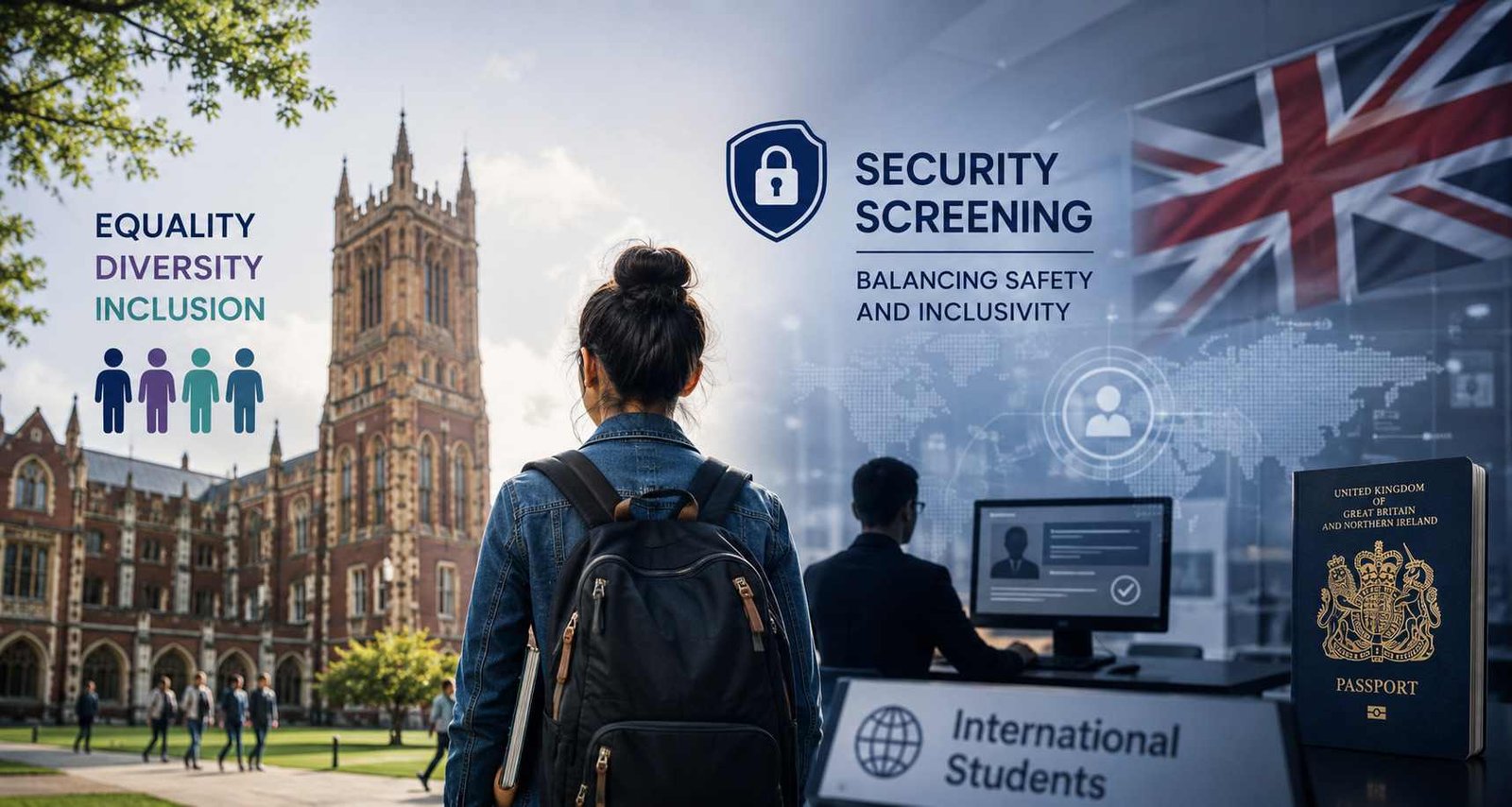
The United Kingdom has built its reputation as one of the world’s leading destinations for higher education. Every year, hundreds of thousands of international students choose British universities because of their academic excellence, multicultural environment, globally recognised qualifications, and commitment to Equality, Diversity and Inclusion (EDI).
For many students, particularly those arriving from Asia, Europe, Africa and the Middle East, studying in the UK represents much more than earning a degree. It is an opportunity to experience a welcoming society, build international careers and become part of one of the world’s most respected education systems.
However, a recent opinion article published by Times Higher Education has reignited an important conversation about whether UK universities are successfully balancing national security obligations with their public commitments to inclusion and equal treatment.
The discussion centres around the Academic Technology Approval Scheme (ATAS), a UK Government security screening process required for certain international students studying sensitive scientific and technological subjects.
Some academics argue that the way universities implement ATAS-related checks—particularly through institutional IT systems—can unintentionally make students from specific nationalities feel singled out before their studies even begin.
At the same time, universities maintain that they are simply complying with legal obligations imposed by the UK Government.
So where does the truth lie?
Does ATAS conflict with universities’ Equality, Diversity and Inclusion (EDI) commitments?
Or is it simply a necessary national security measure in an increasingly complex geopolitical environment?
This guide explains the issue using official UK Government guidance, explores why the debate has emerged, examines its implications for international students and universities, and considers what the future may hold.
Why This Debate Has Returned to the Spotlight
The discussion gained renewed attention after Singaporean art historian Hu Chao shared his personal experience while studying at a UK university.
According to his account, when activating his university email account, the university’s IT system displayed an additional declaration asking nationals of specific countries to confirm compliance with the Academic Technology Approval Scheme before access could be granted.
While the process reflected existing Government requirements, Hu argued that displaying nationality-based screening publicly during account activation appeared inconsistent with universities’ strong public commitments to Equality, Diversity and Inclusion.
His opinion piece has since prompted broader discussions across higher education about whether security compliance can be implemented in ways that avoid creating perceptions of unequal treatment.
It is important to note that Hu Chao’s article represents a personal viewpoint rather than official Government policy. Nevertheless, it has encouraged renewed examination of how security procedures affect the student experience.
Understanding the Academic Technology Approval Scheme (ATAS)
Before discussing the controversy, it is essential to understand what the Academic Technology Approval Scheme actually is.
ATAS is not a university-created policy.
It is a UK Government requirement administered by the Foreign, Commonwealth & Development Office (FCDO).
Its purpose is to prevent sensitive scientific knowledge and advanced research from being used in programmes that could contribute to the development of weapons of mass destruction or advanced military technologies.
Students requiring ATAS approval must obtain an ATAS certificate before:
- Applying for a Student visa (where required)
- Beginning certain postgraduate courses
- Conducting research in sensitive disciplines
- Extending permission to remain where ATAS applies
The requirement generally applies to postgraduate courses involving advanced science, engineering, mathematics, technology and related research disciplines.
Subjects commonly affected include:
- Artificial Intelligence
- Quantum Technologies
- Nuclear Engineering
- Aerospace Engineering
- Chemical Engineering
- Advanced Physics
- Materials Science
- Biotechnology
- Mechanical Engineering
- Certain Computing programmes
Importantly, ATAS does not apply to every international student.
Thousands of international students studying business, law, humanities, social sciences, education, media, arts, finance and many other subjects are unaffected.
Why Does the UK Require ATAS?
Every country protects sensitive technologies that could have military or strategic applications.
The UK is no exception.
The Government states that some advanced research areas may involve knowledge that could potentially contribute to:
- Weapons development
- Military technologies
- Nuclear programmes
- Chemical technologies
- Biological research
- Dual-use technologies
Dual-use technology refers to innovations that have both civilian and military applications.
For example:
Artificial intelligence developed for healthcare may also have defence applications.
Drone technology used for agriculture may also be adapted for military purposes.
Advanced materials research may contribute to aerospace engineering.
Because of these possibilities, the UK Government introduced ATAS as part of its national security framework.
The policy is therefore intended to assess academic programmes rather than target students personally.
How Does the ATAS Process Work?
The process is relatively straightforward.
Students who require ATAS approval must:
- Receive an offer from a UK university.
- Confirm whether their course requires ATAS.
- Submit an online ATAS application.
- Receive an ATAS certificate.
- Include the certificate with their Student visa application where applicable.
Universities are required to verify that students possess valid ATAS clearance before enrolment if their course falls within the relevant subject areas.
This means universities themselves are complying with Government regulations rather than independently creating security policies.
Why Are Some Students Concerned?
The recent debate is not about the existence of ATAS itself.
Instead, it concerns how universities communicate and implement these requirements.
Some students have reported that institutional systems ask nationality-related questions during account activation or enrolment.
Critics argue that when these prompts are visible during standard onboarding processes, they may create the impression that students from certain countries are viewed differently before they have even attended their first lecture.
For those students, the experience may appear inconsistent with university messaging around inclusion and equal treatment.
Supporters of reform argue that these administrative processes could potentially be redesigned so that necessary compliance checks occur privately, without making nationality-based prompts a visible part of the general student onboarding experience.
Equality, Diversity and Inclusion (EDI): What Do UK Universities Promise?
Nearly every UK university has published Equality, Diversity and Inclusion policies.
Although wording differs between institutions, most commit to principles such as:
- Equal opportunities for all students.
- Respect regardless of nationality, ethnicity, religion or background.
- Fair access to education.
- Inclusive learning environments.
- Zero tolerance for discrimination and harassment.
These commitments are supported by the Equality Act 2010, which protects individuals from unlawful discrimination based on protected characteristics such as race, religion, sex, disability and age.
Nationality itself is not always treated identically under every legal framework, particularly where immigration or national security legislation applies. As a result, universities may have legal obligations under immigration and security rules that exist alongside their equality commitments.
This creates a challenging balance between complying with Government requirements and maintaining an inclusive student experience.
The Challenge for Universities
Universities today operate in a complex environment.
On one hand, they must comply with:
- UK immigration law
- National security requirements
- Export control regulations
- ATAS guidance
- Sponsor licence responsibilities
On the other hand, they are expected to provide welcoming, inclusive campuses where international students feel respected and valued.
For institutions hosting thousands of overseas students each year, achieving both objectives is not always straightforward.
Administrative systems designed primarily for regulatory compliance may unintentionally affect how students perceive fairness and inclusion.
As international education becomes increasingly competitive, universities may need to consider whether security processes can be implemented in ways that remain fully compliant while also improving transparency, privacy and the overall student experience.
Does ATAS Conflict with Equality, Diversity and Inclusion (EDI)?
One of the biggest questions raised by recent discussions is whether the Academic Technology Approval Scheme (ATAS) conflicts with the Equality, Diversity and Inclusion (EDI) values that UK universities actively promote.
The answer is not entirely straightforward.
From the UK Government’s perspective, ATAS is a national security measure designed to protect research in highly sensitive scientific and technological fields. It is not presented as a policy aimed at discriminating against students based on ethnicity or culture.
However, critics argue that the way ATAS-related checks are implemented at some universities can affect students’ sense of belonging. If students from certain nationalities encounter additional steps during registration or account activation while others do not, they may feel they are being treated differently before their academic journey has even begun.
This distinction is important. The debate is less about whether the UK has the right to protect sensitive research and more about how those protections are communicated and applied within universities.
Many higher education experts suggest that compliance and inclusion do not have to be competing priorities. Universities can meet their legal obligations while also designing processes that are private, respectful, and clearly explained to affected students.
Why National Security Has Become a Greater Priority
The ATAS debate cannot be separated from wider global developments.
Over the past decade, governments around the world have increased scrutiny of research partnerships, technology transfer, and international collaboration in areas such as:
- Artificial Intelligence (AI)
- Quantum computing
- Cybersecurity
- Semiconductor technology
- Aerospace engineering
- Biotechnology
- Advanced materials
- Robotics
- Defence-related research
Many countries—including the UK, the United States, Australia, Canada, and several European nations—have strengthened policies intended to safeguard sensitive technologies.
Universities are no longer viewed solely as centres of education. They are also major contributors to innovation, scientific discovery, and technological advancement. As a result, governments increasingly expect higher education institutions to play a role in protecting research with potential strategic or military applications.
This broader geopolitical context helps explain why security screening has become more prominent in recent years.
The Importance of Chinese Students to UK Higher Education
Despite the current debate, one fact remains clear: Chinese students have played a vital role in the success of UK higher education.
For many years, China has been one of the largest sources of international students studying in the UK. These students contribute not only through tuition fees but also through research, innovation, cultural exchange, and local economies.
Their impact includes:
- Supporting university research projects.
- Contributing billions of pounds to the UK economy through tuition and living expenses.
- Enriching classrooms with diverse perspectives.
- Strengthening academic collaboration between the UK and Asia.
- Supporting jobs across universities, accommodation providers, hospitality, retail, and transport.
Many universities depend on international student income to fund teaching, research, scholarships, and campus development. A decline in international enrolment can therefore have significant financial consequences.
For this reason, how international students perceive the UK matters not only for individual institutions but for the long-term sustainability of the sector.
International Students Want More Than a Visa
Obtaining a UK Student visa is only one part of the international education journey.
Students also expect:
- A welcoming campus environment.
- Transparent university policies.
- Equal treatment regardless of nationality.
- Respect for cultural diversity.
- Fair access to academic resources.
- Confidence that they belong within the university community.
Universities invest heavily in promoting these values through EDI strategies, student support services, and international recruitment campaigns.
When students encounter administrative processes that appear to single them out, even if those processes are legally required, it can create confusion and affect their first impressions of university life.
This highlights the importance of clear communication. Students are more likely to accept necessary security procedures if they understand why they exist and how their personal information will be handled.
Could Better Communication Reduce Misunderstandings?
Many concerns surrounding ATAS stem from uncertainty rather than the policy itself.
Students may not know:
- Why they are being asked to provide additional information.
- Whether the requirement comes from the university or the UK Government.
- How their data will be used.
- Whether the process affects their academic standing.
- Whether it applies to all students on similar courses.
Universities can help reduce anxiety by explaining:
- That ATAS is a UK Government requirement for certain courses.
- That the process is based on the nature of the course and applicable regulations, not a judgment about an individual’s character.
- That universities are legally required to verify compliance.
- That personal information is handled in accordance with UK data protection laws.
Providing this context early in the admissions process may help students understand the purpose of the checks and reduce perceptions of unfair treatment.
The Legal Position: Equality and Security Must Coexist
UK universities operate within multiple legal frameworks.
On one side, they have obligations under the Equality Act 2010, which promotes equal treatment and protects individuals from unlawful discrimination.
On the other, they must comply with:
- UK immigration rules.
- Sponsor licence requirements.
- National security legislation.
- Export control regulations.
- ATAS requirements for relevant courses.
These obligations are not mutually exclusive. Universities are expected to uphold equality while also meeting legal responsibilities imposed by the Government.
The challenge lies in implementing these requirements in a way that is proportionate, transparent, and respectful of students’ experiences.
How Other Countries Approach Research Security
The UK is not alone in introducing research security measures.
Several countries have adopted similar approaches to protect sensitive technologies and critical research.
For example:
| Country | Security Approach |
|---|---|
| United States | Export controls, visa screening, research security guidance, restrictions on certain technologies. |
| Australia | University Foreign Interference Taskforce, research security framework. |
| Canada | National security guidance for research partnerships. |
| European Union | Increased focus on protecting critical technologies and research collaboration. |
| Japan | Enhanced oversight of sensitive research and technology transfers. |
While the specific mechanisms differ, the common objective is to safeguard research with potential national security implications.
This indicates that the debate is part of a wider international trend rather than a uniquely British issue.
Financial Impact on UK Universities
International students contribute significantly to the UK higher education sector.
Beyond tuition fees, they support:
- University accommodation.
- Local businesses.
- Public transport.
- Hospitality.
- Tourism.
- Graduate employment opportunities.
- Regional economies.
If international students begin to perceive the UK as less welcoming, universities could face several challenges:
- Lower international applications.
- Reduced tuition fee income.
- Greater competition from countries such as Canada, Australia, and Germany.
- Pressure on research funding.
- Difficulties maintaining specialist academic programmes.
In recent years, universities have already faced financial pressures linked to changing immigration policies, rising operational costs, and fluctuations in international student demand.
Maintaining the UK’s reputation as an inclusive study destination is therefore increasingly important.
Reputation and the UK’s Soft Power
Higher education is one of the UK’s greatest global strengths.
Graduates of British universities often go on to become:
- Business leaders.
- Government officials.
- Scientists.
- Entrepreneurs.
- Diplomats.
- Academics.
Their positive experiences contribute to the UK’s international influence, often referred to as “soft power.”
A welcoming university experience encourages graduates to maintain long-term professional, cultural, and economic ties with the UK.
Conversely, if students feel unfairly treated or misunderstood, it may affect how they view the country after graduation.
For this reason, many experts argue that protecting both national security and student trust is essential to preserving the UK’s global reputation.
Looking Ahead: Finding the Right Balance
The discussion surrounding ATAS and EDI is unlikely to disappear.
As technology continues to evolve and geopolitical tensions shape research policy, universities will need to balance competing priorities:
- Protecting sensitive research.
- Complying with Government regulations.
- Supporting international collaboration.
- Providing an inclusive student experience.
Achieving this balance will require ongoing dialogue between the UK Government, universities, researchers, and international students.
A system that is secure, transparent, and respectful can help maintain confidence in UK higher education while ensuring that legitimate national security concerns are addressed.
What This Means for Prospective International Students
If you are planning to study in the UK, the recent discussion around the Academic Technology Approval Scheme (ATAS) should not discourage you from pursuing your education. Instead, it highlights the importance of understanding the UK’s immigration and higher education requirements before you begin your journey.
The vast majority of international students complete their studies without encountering issues related to ATAS. The scheme applies only to specific postgraduate courses in sensitive subject areas, and many undergraduate and taught postgraduate programmes are entirely outside its scope.
If your chosen course requires ATAS clearance, the process should be viewed as an additional administrative step rather than a reflection of your academic ability or personal background.
Being well-informed will help you prepare your documents, understand the timeline, and avoid unnecessary delays in your visa or university enrolment.
How to Check Whether Your Course Requires ATAS
Before accepting your university offer, take the following steps:
1. Review Your Offer Letter
UK universities normally indicate whether an ATAS certificate is required for your course. This information may also appear in your Confirmation of Acceptance for Studies (CAS).
2. Check the Official GOV.UK Guidance
The UK Government maintains official guidance explaining:
- Which subjects require ATAS.
- Who needs an ATAS certificate.
- How to apply.
- Expected processing times.
Always rely on GOV.UK rather than unofficial websites or social media discussions.
3. Contact Your University
If you are unsure whether ATAS applies to your programme, contact your university’s admissions or international student support team. They can clarify your requirements and advise you on the next steps.
4. Apply Early
ATAS applications can take several weeks to process, particularly during peak admission periods. Applying early helps reduce the risk of delays to your Student visa application or course start date.
Practical Tips for Students Requiring ATAS
If your course requires ATAS approval, careful preparation can make the process smoother.
- Apply for your ATAS certificate as soon as you receive your unconditional offer or when instructed by your university.
- Ensure that the information in your ATAS application matches your passport, CAS, and university records.
- Double-check your course title and research area before submitting your application.
- Keep digital and printed copies of your ATAS certificate for future reference.
- Inform your university immediately if there are any delays in receiving your certificate.
- Avoid making travel arrangements until your visa and required approvals are in place.
Planning ahead is one of the simplest ways to minimise stress during the admissions process.
Recommendations for UK Universities
The recent debate also provides an opportunity for universities to review how security requirements are communicated to students.
Institutions can strengthen trust without compromising legal compliance by adopting a student-focused approach.
Improve Transparency
Explain clearly why ATAS exists, who requires it, and how it supports national security. Students are more likely to accept additional requirements when they understand the reason behind them.
Enhance Privacy
Where possible, design enrolment and IT systems so that sensitive compliance checks are handled privately rather than appearing as part of a general registration process.
Train Staff
Admissions teams, IT staff, and student support officers should understand both the legal requirements and the importance of respectful communication.
Provide Clear Guidance
Dedicated webpages, FAQs, webinars, and pre-arrival information can help students understand the process before they arrive in the UK.
Listen to Student Feedback
Universities should regularly gather feedback from international students to identify areas where administrative processes can be improved while remaining fully compliant with Government requirements.
The Future of Research Security in UK Higher Education
Research security is likely to become an increasingly important aspect of higher education over the coming years.
Several trends suggest that universities will continue to strengthen governance around sensitive research:
- Greater international collaboration in emerging technologies.
- Increased Government investment in artificial intelligence and advanced engineering.
- Growing concern about cyber security and intellectual property protection.
- Expansion of export control regulations.
- Increased focus on research integrity and international partnerships.
Rather than reducing international collaboration, these developments are expected to encourage more structured risk management and clearer guidance for researchers and institutions.
Universities that successfully combine robust security measures with inclusive student support are likely to remain attractive destinations for talented students from around the world.
What This Debate Means for the UK’s Global Reputation
The UK has long been recognised as one of the world’s leading education destinations.
Its universities consistently attract students because of:
- Academic excellence.
- Internationally recognised qualifications.
- High-quality research.
- Diverse campus communities.
- Strong graduate employment prospects.
Maintaining these strengths requires more than excellent teaching. It also depends on ensuring that students feel respected, valued, and supported throughout their academic journey.
The recent discussion surrounding ATAS highlights the importance of balancing national security with openness, fairness, and effective communication.
When students understand why certain procedures exist and experience them in a respectful way, confidence in UK higher education is strengthened.
Key Takeaways
- ATAS is a UK Government requirement, not a policy created independently by universities.
- It applies only to certain sensitive postgraduate courses, primarily in science, engineering, and technology.
- The purpose of ATAS is to protect research with potential military or strategic applications.
- Recent debate has focused on how some universities implement ATAS-related checks, particularly during student onboarding.
- Universities must balance legal compliance with their commitments to Equality, Diversity, and Inclusion (EDI).
- Clear communication, transparency, and privacy can help improve the student experience while maintaining security requirements.
- International students should always rely on official UK Government guidance and advice from their chosen university.
Frequently Asked Questions (FAQs)
1. What is the Academic Technology Approval Scheme (ATAS)?
ATAS is a UK Government security clearance required for certain international students studying sensitive postgraduate subjects in science, engineering, technology, and related fields.
2. Does every international student need an ATAS certificate?
No. Only students enrolling in specific courses identified by the UK Government are required to obtain ATAS approval.
3. Is ATAS part of the Student visa application?
If your course requires ATAS, you must obtain your ATAS certificate before submitting your Student visa application or beginning your studies, depending on your circumstances.
4. Are universities responsible for creating ATAS rules?
No. Universities implement ATAS because they are required to comply with UK Government regulations.
5. Why has ATAS become controversial?
The debate centres on whether some university administrative processes unintentionally make students from certain nationalities feel singled out, even though the underlying requirement comes from Government policy.
6. Does ATAS mean a student is suspected of wrongdoing?
No. ATAS is a precautionary security measure linked to certain areas of study. It does not imply any personal suspicion or misconduct.
7. Can ATAS affect admission decisions?
Universities generally require a valid ATAS certificate where applicable before enrolment. Failing to obtain one may delay or prevent registration for a course that legally requires it.
8. Can universities improve the process?
Many experts believe universities can enhance communication, privacy, and transparency while continuing to meet all legal obligations.
9. Should this debate discourage international students from studying in the UK?
For most students, no. The UK remains one of the world’s leading destinations for higher education. Understanding the relevant requirements and preparing early can help ensure a smooth admissions process.
10. Where can I find official guidance?
The most reliable information is available from GOV.UK and your chosen university’s admissions or international student support office.
Final Thoughts
The discussion around the Academic Technology Approval Scheme and universities’ Equality, Diversity, and Inclusion commitments reflects a broader challenge faced by higher education systems worldwide: how to protect national security while maintaining an open, welcoming, and inclusive academic environment.
ATAS itself is an established Government policy aimed at safeguarding sensitive research, but the recent debate demonstrates that how policies are implemented can be just as important as the policies themselves. Universities have an opportunity to improve transparency, protect student privacy, and ensure that international students understand why certain requirements exist.
For prospective students, the key message is clear: do not rely on rumours or isolated experiences. Instead, check the official guidance for your course, communicate with your university, and prepare your application well in advance.
With accurate information and careful planning, international students can confidently navigate the admissions process and continue to benefit from the world-class education, research opportunities, and global career prospects that UK universities offer.