
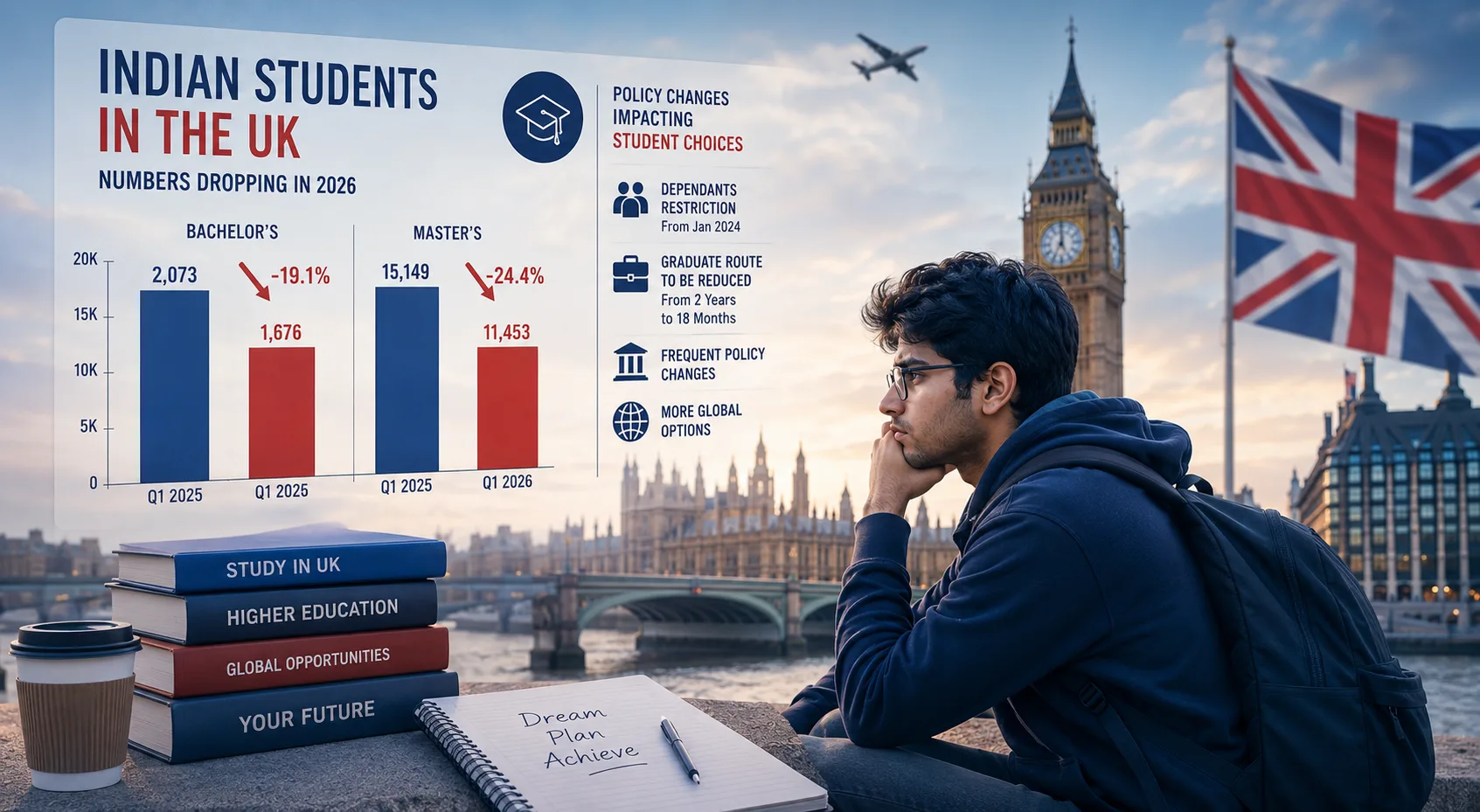
The United Kingdom has long been one of the top destinations for Indian students seeking internationally recognised degrees and global career opportunities. However, the latest figures released by the UK Home Office indicate that fewer Indian students are choosing the UK in 2026.
The decline is visible across both undergraduate and postgraduate courses, continuing a trend that began in 2025. While the UK remains a popular study destination, recent immigration reforms, changes to post-study work rights, and restrictions on dependants appear to be influencing students’ decisions.
Here’s what the latest data reveals, why applications are falling, and what it means for Indian students planning to study in the UK.
UK Study Visa Trends: Indian Student Numbers at a Glance
The latest UK Home Office figures show that Indian student enrolments have declined in both undergraduate and taught postgraduate programmes during the first quarter of 2026 compared with the same period in 2025.
1,676
Bachelor’s Students (Q1 2026) ▼ 19.1% YoY11,453
Master’s Students (Q1 2026) ▼ 24.4% YoY732
PhD Applications (2025) ▲ Higher than 633 in 2024Jan 2024
Dependants Rule Changed Major Immigration Reform2025 vs 2026 Student Enrolment Comparison
| Programme | Q1 2025 | Q1 2026 | Change |
|---|---|---|---|
| Bachelor’s | 2,073 | 1,676 | ▼ 19.1% |
| Master’s | 15,149 | 11,453 | ▼ 24.4% |
| PhD Applications* | 633 (2024) | 732 (2025) | ▲ 15.6% |
Timeline: Immigration Changes Affecting International Students
January 2024
Most taught Master’s and undergraduate students became ineligible to bring dependants to the UK.
Throughout 2025
Universities reported declining international postgraduate admissions as immigration policies tightened.
2026
Indian student enrolments continued falling while research-based PhD admissions remained comparatively stable.
Future Proposal
The UK government has proposed reducing the Graduate Route from two years to 18 months for future graduates.
Why Are Indian Student Numbers Falling?
👨👩👧 Dependants Restriction
Most international students can no longer bring spouses or children unless enrolled in research programmes.
🎓 Graduate Route Changes
The proposed reduction from two years to 18 months has created uncertainty among future applicants.
📜 Frequent Policy Changes
Repeated immigration reforms have affected confidence among prospective international students.
🌍 More Global Choices
Indian students increasingly compare opportunities in Canada, Australia, Ireland and Germany.
Key Takeaway
The latest data does not indicate that the UK has stopped accepting Indian students. Student Visas remain available, but changing immigration policies, dependant restrictions, and uncertainty surrounding post-study work rights are influencing student decisions more than ever before.
Source: UK Home Office (Quarter 1 2026 Student Enrolment Data), publicly reported higher education statistics and university admissions figures.
Indian Student Numbers Continue to Fall
According to the latest UK Home Office data for the first quarter of 2026:
| Course Level | Q1 2025 | Q1 2026 |
|---|---|---|
| Bachelor’s | 2,073 | 1,676 |
| Master’s | 15,149 | 11,453 |
The figures show a noticeable reduction in Indian students enrolling in both undergraduate and taught postgraduate programmes.
The decline follows a similar pattern throughout 2025, when universities also reported lower international student admissions after years of strong growth.
Why Are Fewer Indian Students Choosing the UK?
Several immigration policy changes introduced over the past two years have changed how prospective students evaluate the UK as a study destination.
1. Restrictions on Bringing Family Members
Since January 2024, most international students studying taught master’s and undergraduate programmes can no longer bring dependants to the UK.
Only students enrolled in research-based postgraduate programmes, such as PhDs and certain doctoral courses, remain eligible to bring spouses and children.
For many Indian students, particularly mature applicants and married professionals, this change has reduced the attractiveness of studying in Britain.
2. Proposed Changes to the Graduate Route Visa
Another major concern is the UK’s proposed reform of the Graduate Route.
The government has announced plans to reduce the post-study work period for bachelor’s and master’s graduates from two years to 18 months.
Although the proposal is expected to apply to future graduates and has not yet affected everyone, the announcement has created uncertainty among prospective students.
Many international students consider post-study work opportunities a key factor when deciding where to study.
3. Frequent Immigration Rule Changes
Universities across the UK have also expressed concerns that repeated immigration policy announcements have created uncertainty among international applicants.
While institutions continue to welcome overseas students, ongoing political discussions about reducing migration have affected perceptions abroad.
Some students now worry that immigration policies may continue changing during their studies.
PhD Applications Show a Different Story
While undergraduate and master’s enrolments have fallen, doctoral-level applications have remained comparatively strong.
According to the available figures:
- 633 doctoral applications were recorded in 2024.
- 732 applications were received during 2025.
- The first quarter of 2026 also recorded continued PhD applications.
This suggests that research-focused students remain confident in the UK’s world-class universities and research opportunities.
Unlike taught master’s students, doctoral candidates are generally still eligible to bring dependants, making these programmes more attractive for some applicants.
What Does This Mean for Indian Students?
The latest figures do not mean the UK is closing its doors to Indian students.
Student visas remain available, and thousands of Indian applicants continue to receive UK Student Visas every year.
However, students are becoming more selective when comparing destinations such as:
- United Kingdom
- Canada
- Australia
- Germany
- Ireland
- New Zealand
Many applicants now compare:
- Post-study work opportunities
- Immigration pathways
- Tuition fees
- Living costs
- Family visa options
- Long-term settlement prospects
Should You Still Choose the UK?
Despite recent policy changes, the UK continues to offer significant advantages.
These include:
- Globally recognised universities
- One-year master’s programmes
- Strong academic reputation
- Access to international employers
- High-quality research facilities
- Diverse student communities
For students focused on education quality and career development, the UK remains one of the world’s leading higher education destinations.
The key is understanding the latest immigration rules before submitting your application.
Tips for Students Planning to Study in the UK
If you’re considering studying in Britain, it is important to:
- Check the latest Student Visa requirements.
- Understand Graduate Route eligibility.
- Review dependant rules carefully.
- Plan your finances well in advance.
- Apply early to your preferred university.
- Stay updated with UK immigration announcements.
Professional immigration advice can also help students avoid mistakes during the application process.
What Could Happen Next?
Immigration experts expect student visa policy to remain an important topic as the UK government balances economic growth with migration targets.
Future announcements may include:
- Final confirmation of Graduate Route reforms.
- Additional Student Visa guidance.
- Updates to dependant rules.
- New measures affecting international recruitment.
Students planning to begin their studies in 2026 or 2027 should monitor official UK government announcements and university communications before making decisions.
Final Thoughts
The latest UK Home Office data confirms that fewer Indian students enrolled in undergraduate and master’s programmes during the first quarter of 2026 compared with the previous year.
Changes to dependant rules, uncertainty surrounding the Graduate Route, and ongoing immigration reforms appear to be influencing student choices.
However, the UK continues to attract thousands of talented Indian students every year thanks to its globally respected universities, excellent teaching standards, and strong career opportunities.
For prospective students, careful planning and staying informed about the latest immigration policies will be more important than ever.
Frequently Asked Questions
Why are fewer Indian students applying to UK universities?
Recent UK immigration changes, including restrictions on dependants and proposed Graduate Route reforms, have made some students reconsider their study destination.
Can Indian students still apply for a UK Student Visa?
Yes. The UK Student Visa remains open for eligible international applicants who meet the visa requirements.
Can international students bring family members?
Currently, only most research-based postgraduate students, such as PhD candidates, are generally permitted to bring dependants. Students on taught master’s and undergraduate courses are usually not eligible.
Is the Graduate Route ending?
No. The Graduate Route has not ended. However, the UK government has proposed reducing the post-study work period for future bachelor’s and master’s graduates from two years to 18 months.
Is the UK still a good destination for Indian students?
Yes. The UK remains one of the world’s leading destinations for higher education, offering internationally recognised degrees, excellent research opportunities, and strong global career prospects despite recent immigration reforms.