

A significant change to the UK immigration rules could give vulnerable sponsored workers something they have often lacked: a realistic way to leave an abusive employer without automatically putting their immigration position at risk.
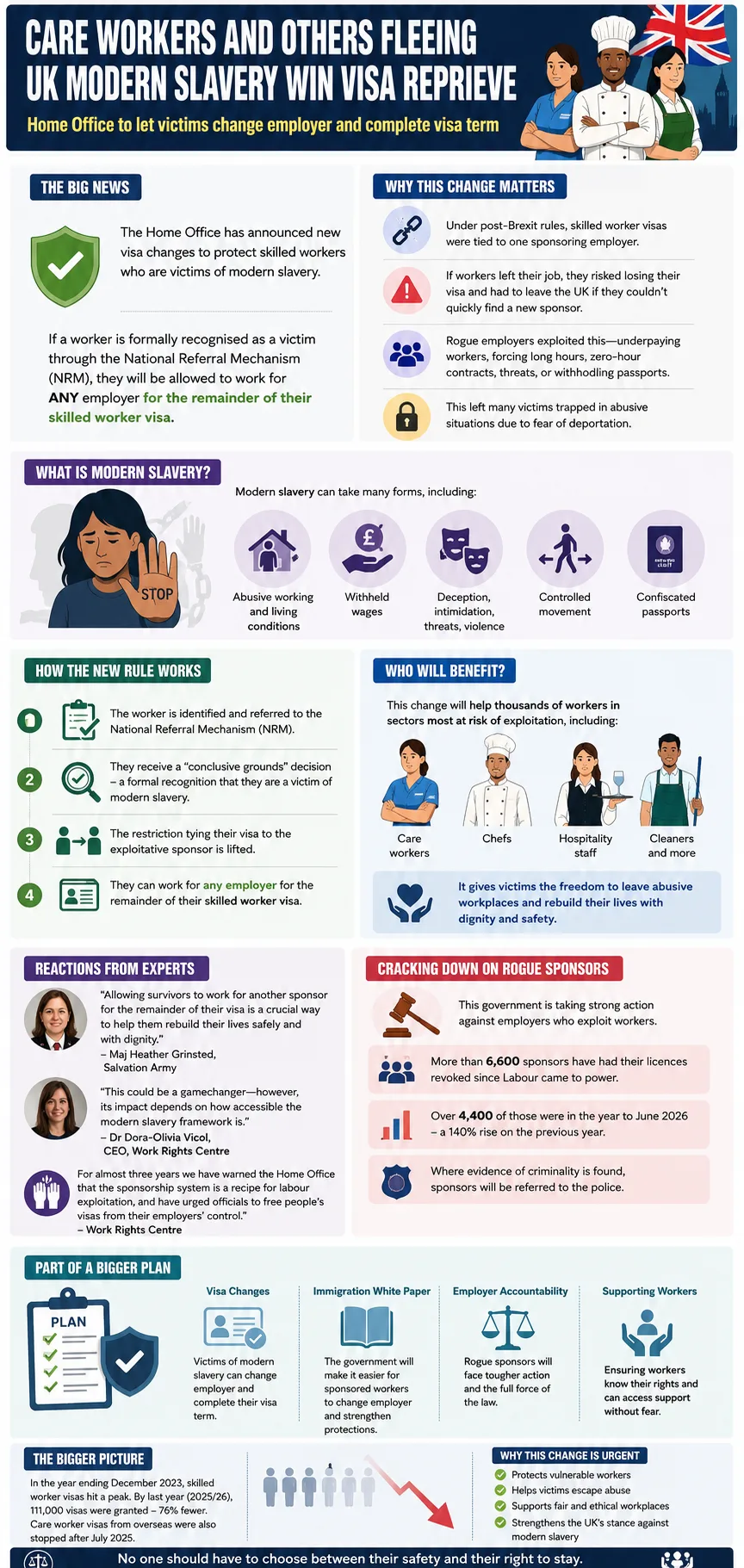
From 3 September 2026, the UK has changed the Skilled Worker rules for people who have been formally recognised as victims of modern slavery. Where the required conditions are met, a Skilled Worker can have their work conditions changed so that they are permitted to work for any employer for the remainder of their existing immigration permission, rather than being restricted to the sponsor connected to their original visa. The new rule also permits self-employment and voluntary work, although professional sportsperson work remains excluded.
This is particularly important for workers in sectors such as social care, hospitality, catering and other sponsored occupations, where dependence on a sponsoring employer can make leaving an exploitative workplace extremely difficult.
But there is an important point to understand: this is not a blanket amnesty for every Skilled Worker who experiences poor treatment. The new protection is tied to the National Referral Mechanism (NRM) and a positive Conclusive Grounds decision made during the worker’s most recent period of permission.
That distinction matters.
For international workers, prospective migrants, employers and advisers, the new policy represents a major shift in how immigration status and workplace exploitation interact.
What has changed in the UK Skilled Worker visa rules?
Under the normal Skilled Worker system, immigration permission is linked closely to the sponsored job.
A Skilled Worker normally needs to update their visa if they change employer, and changing jobs can involve a fresh application and meeting the relevant requirements. The official Skilled Worker guidance confirms that a visa update is generally required when a worker changes to a different employer or certain other job circumstances.
That creates an obvious vulnerability.
Imagine a worker who arrives in the UK after accepting a genuine job offer. Once in the country, the reality turns out to be very different. Their wages may be withheld. Their working hours may be excessive. Their accommodation may be controlled by the employer. They may be threatened with dismissal or told that leaving the job will mean losing their visa.
For someone whose immigration status is connected to that employer, the fear is not simply:
“What happens if I lose my job?”
It can become:
“What happens to my right to remain in the UK if I leave?”
The 3 September 2026 Immigration Rules changes directly address this problem for recognised victims of modern slavery. The new Skilled Worker provision allows a person who has been referred into the NRM and received a positive Conclusive Grounds decision during their most recent permission to have their work conditions amended. They can then undertake any work, including self-employment and voluntary work, except work as a professional sportsperson or sports coach.
In practical terms, the policy creates a firewall between the victim’s immigration status and the exploitative employer.
Why was this change needed?
The policy has to be understood in the context of the UK’s post-Brexit immigration system.
The Skilled Worker route was designed around sponsorship. An approved employer sponsors a worker for a particular role, and the worker’s immigration permission is connected to that employment.
That system has an important benefit: it allows the UK to control who is coming to work, in which occupations and under which employers.
But sponsorship can also create a power imbalance.
A worker who depends on one employer for immigration sponsorship may feel unable to challenge unlawful or abusive behaviour.
This is particularly serious where the worker has:
- paid substantial recruitment or migration-related costs;
- borrowed money to come to the UK;
- relocated with family expectations;
- limited knowledge of UK employment rights;
- limited English proficiency;
- little understanding of immigration procedures;
- no immediate alternative sponsor;
- or fears removal from the UK.
The government itself has acknowledged serious concerns around exploitation in the social care sector. When overseas recruitment of care workers was closed in July 2025, the government cited concerns about workers arriving to find themselves in debt, being treated unfairly or, in extreme cases, discovering that promised jobs did not exist.
The 2025 immigration reforms also recognised problems involving care workers who became unemployed because employers had overestimated demand or lost their sponsor licence, alongside concerns about abuse and exploitation.
The new 2026 rule therefore tackles a very specific weakness: an immigration system should not inadvertently give an abusive employer additional leverage over someone they employ.
Who can benefit from the new protection?
This is perhaps the most important question for current Skilled Worker visa holders.
The new rule is not based simply on someone saying that they have been exploited.
The official Immigration Rules specify that the Skilled Worker must:
- have been referred into the National Referral Mechanism;
- have received a positive Conclusive Grounds decision; and
- have received that positive decision during their most recent permission.
When those requirements are met, the work conditions can be amended so that the individual can undertake any work, subject to the professional sportsperson exception.
This means the protection is particularly relevant to a Skilled Worker who has already gone through the formal modern slavery identification process.
What occupations could be affected?
The change is not limited to care workers.
The new rule sits within Appendix Skilled Worker, rather than creating a special occupation-specific rule for care workers.
That means the protection can potentially be relevant to recognised modern slavery victims across the Skilled Worker route.
Depending on the person’s circumstances, this could include workers employed in areas such as:
- adult social care;
- hospitality;
- catering;
- chef roles;
- other sponsored service-sector positions;
- and other eligible Skilled Worker occupations.
The key issue is not the job title alone.
The critical issue is whether the individual meets the requirements of the new Skilled Worker provision.
What does “positive Conclusive Grounds decision” mean?
Understanding the NRM is essential.
The National Referral Mechanism, or NRM, is the UK’s framework for identifying and referring potential victims of modern slavery and ensuring that appropriate support can be considered. Modern slavery can include human trafficking, slavery, servitude and forced or compulsory labour.
A person does not necessarily need to know exactly how the legal definition applies to their situation before seeking help.
The official NRM guidance specifically recognises that victims may not realise that they are being trafficked or exploited. It also says that a person may have consented to parts of their situation and still potentially be a victim.
The NRM process involves decisions at different stages.
Reasonable Grounds
A positive Reasonable Grounds decision means there are reasonable grounds to believe that the person is a victim of modern slavery.
It is an important stage, but it is not the same as a Conclusive Grounds decision.
Conclusive Grounds
A positive Conclusive Grounds decision goes further.
The Home Office explains that a positive Conclusive Grounds decision indicates that, on the balance of probabilities, there is sufficient information to consider the individual a victim of modern slavery.
For the new Skilled Worker protection, this distinction is crucial.
A positive Reasonable Grounds decision alone is not the condition specified in the new Skilled Worker rule.
The worker needs the qualifying positive Conclusive Grounds decision.
What exactly can a recognised victim do after the change?
This is where the policy becomes particularly significant.
Ordinarily, Skilled Worker permission is designed around a specific sponsored employment arrangement.
Under the new provision, qualifying victims can have their work conditions amended so that:
1. They can work for another employer
The biggest practical benefit is the ability to leave the exploitative sponsor and work elsewhere without the new rule tying their remaining work permission to that original employer.
2. They can work outside the original sponsored occupation
The wording of the new provision is broader than simply allowing a person to find another sponsor for an identical role.
It permits any work, subject to the stated exception.
This could give a victim considerably more freedom when rebuilding their employment situation.
3. Self-employment is permitted
The new provision expressly includes self-employment.
That is a notable difference from the ordinary structure of sponsored employment.
4. Voluntary work is permitted
Voluntary work is also covered by the new condition.
5. Professional sport remains excluded
There is an important exception.
The amended permission does not allow work as a professional sportsperson, including a sports coach.
Does the new rule give victims a completely new visa?
No.
This is one of the most important points for applicants and existing visa holders.
The new provision is about changing the conditions attached to existing Skilled Worker permission.
It does not mean that every recognised victim automatically receives a brand-new visa.
The government describes the change as allowing qualifying Skilled Workers to work for any employer for the remaining duration of their existing permission.
So if someone has six months remaining on their Skilled Worker permission, the new freedom does not automatically create another two or three years of immigration permission.
The existing expiry date remains important.
That means workers should think about two separate questions:
First: Can I leave the exploitative employer and work elsewhere?
Second: What immigration route will I use when my current permission eventually expires?
The new rule primarily answers the first question.
Why the change could be a major protection against exploitation
The central issue is bargaining power.
A worker who knows they can leave an abusive employer is in a fundamentally stronger position than someone who believes leaving could destroy their immigration status.
The government says the change is intended to encourage victims to come forward earlier and prevent employers from weaponising the sponsorship system against vulnerable workers.
That matters because exploitation often survives through fear.
A worker might tolerate:
- Unpaid wages;
- Excessive working hours;
- Unlawful deductions;
- Threats;
- Unsafe accommodation;
- Intimidation;
- Document confiscation;
- Deception about employment;
- Restrictions on movement;
- Coercive working arrangements
because the alternative appears even more frightening.
Modern slavery is not simply a question of whether someone is paid less than expected.
Official modern slavery guidance recognises a much wider range of exploitation, including forced labour, trafficking and slavery-like conditions.
What does modern slavery look like in the workplace?
It is important not to reduce modern slavery to one stereotype.
A person can be legally employed, hold a valid visa and still potentially be exploited.
Warning signs can include:
Withheld wages
A worker is promised a particular salary but does not receive it, or wages are withheld to control them.
Debt-based control
A person may be placed under severe financial pressure through recruitment fees, debts or deductions.
Deception
The job offered overseas may not resemble the job actually provided in the UK.
Excessive or forced working hours
Workers may be pressured into working significantly longer than expected, particularly when they fear losing employment.
Threats and intimidation
An employer or intermediary may threaten dismissal, immigration consequences, police involvement or other retaliation.
Control over accommodation
Accommodation may become another mechanism of control, particularly where the worker is dependent on the employer for both employment and housing.
Confiscation of passports or documents
Taking or controlling a worker’s documents can severely restrict their ability to leave or seek alternative help.
Restricted movement
A worker may be prevented from leaving accommodation or the workplace freely.
These indicators should not be treated as a checklist that automatically proves modern slavery. Each case must be assessed on its own facts.
But workers should not assume that exploitation is “not serious enough” simply because they entered the UK legally.
The care sector is especially important
The timing of this reform is significant for international care workers.
The UK made a major change to the care-worker immigration route in July 2025, closing new overseas applications for care workers and senior care workers.
However, the government introduced a transition period under which eligible people already in the UK can continue making in-country applications until 22 July 2028, subject to the relevant requirements.
The change followed concerns about exploitation and problems involving care workers arriving in the UK under sponsorship arrangements.
The scale of the policy shift can be seen in the Home Office data.
Health and Care Worker visa grants rose sharply after care workers became eligible for the route, reaching a peak in 2023. But by the year ending March 2026, Health and Care Worker visas issued had fallen substantially, while visas issued to workers in caring personal service occupations had fallen by 82% compared with the December 2023 peak.
So the new protection arrives during a period when the UK is already redesigning its approach to overseas recruitment in social care.
The wider Skilled Worker system is also changing
This reform should not be viewed in isolation.
The UK has been tightening immigration rules while simultaneously trying to address vulnerabilities in the sponsorship system.
The government’s 2025 Immigration White Paper proposed a stronger focus on skills, domestic workforce development and reducing reliance on international recruitment.
The July 2025 immigration changes included:
- a higher general Skilled Worker skill threshold;
- a higher general salary threshold;
- restrictions on overseas recruitment for care workers;
- changes to the Immigration Salary List;
- and transitional arrangements for some existing Skilled Workers.
This produces an interesting policy balance.
On one side, the UK is making immigration routes more restrictive.
On the other, it is making a targeted part of the system more protective for vulnerable migrants.
That distinction is important.
The new modern slavery protection should not be interpreted as the UK broadly relaxing its Skilled Worker immigration system.
It is a targeted safeguard.
What happens through the National Referral Mechanism?
For someone who believes they are being exploited, the NRM can be an important part of the process.
The official guidance says that potential adult victims in England and Wales can be referred into the NRM by designated First Responder Organisations. These can include specified public bodies and organisations that are authorised to make referrals.
A potential victim does not have to prove the entire case before a referral can be considered.
The NRM exists precisely because identification and assessment are required.
Support can also be available
For adults in England and Wales who are recognised as potential victims through the NRM, specialist support can include:
- accommodation where required;
- legal advice;
- protection;
- emotional and practical assistance;
- and other tailored support.
The government says adults entering the NRM can receive specialist support for at least 30 days while their case is considered, subject to the applicable arrangements.
Following a positive Conclusive Grounds decision, people receiving support through the Modern Slavery Victim Care Contract can receive a further minimum 45-day move-on period in England and Wales.
That recovery period can be especially important for someone who has just escaped an abusive employer.
The NRM backlog remains an important issue
There is, however, a practical challenge.
Recognition does not always happen instantly.
The Home Office has been working through a backlog of cases awaiting Conclusive Grounds decisions.
In the first quarter of 2026, the government reported 4,726 cases that had received a positive Reasonable Grounds decision but were still awaiting a Conclusive Grounds decision at the end of March. This was down substantially from the peak of 29,275 at the end of 2022.
The government has committed to eliminating the backlog by December 2026.
This is directly relevant to the new Skilled Worker protection.
Why?
Because the new immigration benefit depends on the qualifying Conclusive Grounds outcome.
A system can offer a powerful protection on paper, but its real-world effectiveness depends partly on whether vulnerable people can enter the NRM, receive appropriate support and obtain decisions within a reasonable period.
What are the benefits for international workers?
The potential benefits are substantial.
1. Greater freedom to leave an abusive workplace
This is the biggest benefit.
A recognised victim is no longer placed in the same position as an ordinary sponsored worker who must remain tied to the original sponsorship arrangement.
2. Reduced fear of losing employment
Finding another job becomes more realistic because the worker’s immigration permission can support work beyond the original employer.
3. Greater bargaining power
An employer has less leverage if the worker can legally leave.
That can discourage abusive behaviour.
4. More employment flexibility
The ability to undertake any work means a victim is not necessarily required to find an identical sponsored role.
5. Opportunity to rebuild financially
Self-employment and broader employment options may allow victims to stabilise their income after leaving exploitation.
6. Encouragement to report abuse
The government explicitly says the change is intended to encourage victims to come forward earlier.
That could be important.
If workers believe that reporting exploitation will leave them without employment and immigration security, they may remain silent.
A credible exit route can change that calculation.
What are the wider benefits for the UK?
The reform is not only about individual workers.
It can also strengthen the integrity of the immigration system.
Better employer accountability
Sponsors know that immigration status cannot be used indefinitely as leverage over a recognised victim.
More reporting
Victims may become more willing to disclose exploitation.
Better enforcement
Where criminality is identified, authorities can investigate and take appropriate enforcement action.
A healthier sponsorship system
The Skilled Worker route depends on legitimate employers following the rules.
If abusive sponsors can use immigration dependency to retain workers, the sponsorship system becomes distorted.
Removing that leverage helps restore confidence in the route.
What does the change mean for employers?
Legitimate employers should not see this policy as a threat.
In fact, it can strengthen the position of employers that treat migrant workers properly.
Sponsors should ensure that:
- employment contracts are accurate;
- workers receive the wages they are entitled to;
- working hours comply with employment law;
- deductions are lawful and transparent;
- recruitment practices are compliant;
- accommodation arrangements do not become coercive;
- workers understand their rights;
- and concerns are dealt with seriously.
The government has also said it is increasing action against rogue sponsors.
This is particularly important because sponsor licence compliance has become a major part of the UK’s immigration enforcement strategy.
The message is increasingly straightforward:
A sponsor is not being given ownership of a worker’s immigration status.
Sponsorship is a regulatory relationship, not a licence to control an employee.
What should a Skilled Worker do if they believe they are being exploited?
This is where careful planning matters.
A person experiencing exploitation should not simply assume that leaving the workplace, disappearing from employment and sorting out the immigration position later is the safest approach.
Instead, they should seek appropriate advice as quickly as possible.
Step 1: Record what is happening
Where it is safe to do so, keep evidence such as:
- employment contracts;
- payslips;
- bank records;
- messages with the employer;
- work schedules;
- photographs;
- accommodation information;
- recruitment documents;
- evidence of deductions;
- threats or intimidating messages;
- and details of working hours.
Do not put yourself in danger just to collect evidence.
Step 2: Seek specialist advice
Immigration law and modern slavery law can overlap in complicated ways.
A regulated immigration adviser, solicitor or appropriate support organisation can help assess the situation.
Step 3: Consider the NRM
Where modern slavery may have occurred, an appropriate First Responder can consider making an NRM referral.
The official NRM guidance makes clear that a potential victim does not need to be certain of the legal classification before raising concerns.
Step 4: Understand the immigration consequences
A worker should establish exactly what immigration permission they currently hold, when it expires and what protection may become available following an NRM decision.
Step 5: Plan beyond the immediate crisis
Even after obtaining protection from the original employer, the worker needs to consider:
- remaining visa duration;
- future immigration options;
- employment;
- accommodation;
- financial stability;
- family circumstances;
- and longer-term settlement plans.
A positive Conclusive Grounds decision does not automatically mean settlement
Another important distinction is between protection from exploitation and long-term immigration status.
The UK’s temporary permission route for victims of human trafficking or slavery exists in appropriate circumstances, but the government explicitly states that this route is not a route to settlement.
Similarly, the new Skilled Worker provision does not itself create indefinite residence.
For someone whose Skilled Worker permission is nearing expiry, professional immigration advice may still be necessary to determine the best future route.
Possible future options will depend on the individual’s circumstances and the immigration rules applicable at that time.
What the new rule does NOT mean
There are several misconceptions worth clearing up.
It does not mean every exploited worker can work for anyone immediately
The specific Skilled Worker protection requires the qualifying NRM and positive Conclusive Grounds circumstances set out in the Immigration Rules.
It does not automatically extend the visa
The change allows broader work for the remaining duration of existing permission.
It does not create automatic settlement
A positive modern slavery decision and the new work conditions do not by themselves create permanent residence.
It does not remove every immigration requirement
Other immigration conditions and future applications still need to be considered.
It does not mean every employment dispute is modern slavery
Unpaid wages or an employment disagreement can be serious without necessarily meeting the legal definition of modern slavery.
The NRM process exists to assess the circumstances.
The future of UK immigration: protection alongside tighter controls
The bigger story here is not simply a visa rule.
It is about what the UK’s immigration system should look like in the coming years.
The UK is moving towards a more controlled immigration model.
The government has raised skills requirements, increased salary requirements and restricted overseas recruitment in certain lower-skilled occupations. The care-worker route is a particularly clear example of that direction.
But a stricter immigration system also needs safeguards.
When people are admitted to the country to fill labour shortages, the government has a responsibility to ensure that immigration status does not become a tool for exploitation.
The September 2026 rule is therefore significant because it recognises a basic principle:
Immigration control and worker protection do not have to be opposites.
A system can control who enters the UK while also protecting people who have been abused after arrival.
What should international workers plan for in 2026?
For anyone currently working in the UK on a Skilled Worker visa, immigration planning should go beyond simply checking whether the current employer is legitimate.
Workers should understand:
Your sponsor
Know exactly which company sponsors your visa.
Your occupation code
Understand what occupation your permission is based on.
Your visa expiry date
Do not wait until the final weeks to think about your next immigration step.
Your employment rights
Understand your basic employment protections and contractual rights.
Your immigration conditions
Know what work you are permitted to undertake.
Your options if employment ends
This is particularly important if your employer loses its sponsor licence, makes you redundant or stops providing the promised work.
Warning signs of exploitation
Knowing the signs early can prevent a difficult situation from becoming a dangerous one.
What this means for future migrants coming to the UK
The new rule should also change the way prospective migrants approach overseas recruitment.
Before accepting a sponsored job, applicants should carry out reasonable checks.
Check the employer
Make sure the company is a legitimate sponsor and that the job actually exists.
Read the employment contract
Do not rely solely on verbal promises made by recruiters.
Understand salary and deductions
Know what you are expected to earn and what deductions are permitted.
Be cautious about recruitment debt
Large debts can make workers especially vulnerable once they arrive.
Keep copies of documents
Retain copies of your passport, visa, employment contract, Certificate of Sponsorship information, payslips and important communications.
Do not surrender your original documents unnecessarily
If an employer attempts to control your passport or other documents, seek advice.
Know where to seek help
Do this before there is a crisis.
That one step can make a significant difference.
A practical planning checklist for Skilled Workers
| Situation | What to consider |
|---|---|
| Employer is treating you fairly | Keep records and understand your visa conditions |
| Employer threatens your visa if you leave | Seek specialist immigration advice |
| Wages are being withheld | Preserve evidence and seek employment/immigration advice |
| Passport is being controlled | Treat this as a serious warning sign |
| Job promised is different from actual job | Keep recruitment evidence |
| You believe you are being exploited | Consider whether an NRM referral is appropriate |
| Positive Reasonable Grounds decision | Understand that this is not the same as the new qualifying Conclusive Grounds requirement |
| Positive Conclusive Grounds decision | Check whether the new Skilled Worker provision applies to your most recent permission |
| New work permission applies | Understand exactly what your amended conditions allow |
| Visa is approaching expiry | Plan your next immigration route early |
The road ahead: what could happen next?
The September 2026 change is likely to be watched closely by migrant-rights organisations, employers and policymakers.
Its success will depend on more than the wording of the Immigration Rules.
Three things will matter.
1. Accessibility
Workers need to know that help exists.
A protection that people are afraid to access will have limited impact.
2. Speed
The longer a vulnerable person remains trapped while waiting for recognition, the harder the situation can become.
The government’s commitment to address the Conclusive Grounds backlog by December 2026 will therefore be important.
3. Enforcement
Changing the victim’s work conditions addresses one side of the problem.
The other side is holding abusive employers accountable.
The government has indicated that where evidence of criminality is identified, sponsors can be referred to the police.
That enforcement component will be essential.
Final thoughts: a visa should not become a trap
The most important part of this change is simple.
A person may have come to the UK to work. They may have followed the immigration rules, paid the required fees and accepted a job with a licensed sponsor.
If that employer later exploits them, the worker should not have to choose between personal safety and immigration security.
The new Skilled Worker protection does not solve every problem. It is not available automatically to everyone who leaves a job. It does not extend a visa indefinitely. And it does not replace the need for proper legal advice.
But for people who meet the requirements, it represents a meaningful change.
From 3 September 2026, a Skilled Worker who has been referred into the NRM and receives the qualifying positive Conclusive Grounds decision during their most recent permission can have their work conditions changed to allow any work for the remainder of that permission, including self-employment and voluntary work, subject to the professional sportsperson exception.
That can turn an impossible choice into a genuine exit route.
And that is the real significance of the policy.
The future of UK immigration is becoming more controlled, more selective and more focused on compliance. But if that system is going to work fairly, it also needs a clear line that employers cannot cross.
Sponsorship can regulate employment. It should never become a mechanism for trapping someone in exploitation.
Frequently Asked Questions
Can a Skilled Worker change employer after being recognised as a victim of modern slavery?
Under the new 3 September 2026 rule, a qualifying Skilled Worker with a positive Conclusive Grounds decision made during their most recent permission can have their work conditions amended to permit any work for the remaining period of their permission, except professional sportsperson or sports coach work.
Do I need a positive Conclusive Grounds decision?
For the specific new Skilled Worker provision, yes. The Immigration Rules require the worker to have been referred into the NRM and to have received a positive Conclusive Grounds decision during their most recent permission.
Can I work for any employer?
Where the new provision applies and the conditions have been amended, the rules permit any work for the remaining duration of the existing permission, subject to the professional sportsperson exception.
Can I become self-employed?
Yes. The new provision expressly includes self-employment.
Does the change extend my visa?
No. The protection concerns the remaining duration of existing permission. It does not automatically add a new period of leave.
What is the National Referral Mechanism?
The NRM is the UK’s framework for identifying and referring potential victims of modern slavery and ensuring appropriate support can be considered.
Is a positive Reasonable Grounds decision enough?
Not for the specific new Skilled Worker provision. The rule refers to a positive Conclusive Grounds decision made during the worker’s most recent permission.
Can care workers benefit from the change?
Potentially, if they meet the requirements of the new Skilled Worker provision. The protection is not written exclusively for care workers; it is contained in Appendix Skilled Worker.
Can people still apply from overseas to become care workers?
Since 22 July 2025, the UK has closed the care worker and senior care worker route to new overseas applicants. Eligible in-country applications can continue during the transition period, currently until 22 July 2028, subject to the relevant rules.
Where can a potential victim get support?
The NRM guidance explains how potential victims can be referred and what support may be available. In England and Wales, support can include accommodation, legal advice, protection and emotional and practical assistance.
Official sources and further reading
For readers who want to verify the policy directly, the most important source is the 3 September 2026 Statement of Changes to the Immigration Rules, particularly the changes to Appendix Skilled Worker.
UK Immigration Rules – Statement of Changes HC 584, 3 September 2026
Home Office – Explanatory Memorandum to HC 584
National Referral Mechanism guidance for adult potential victims
Modern Slavery: NRM statistics, Quarter 1 2026
Skilled Worker visa – changing job or employer
UK government guidance on overseas recruitment for care workers
Important: Immigration rules can change, and individual cases can depend on the exact visa history, NRM decision and circumstances. This article is intended as general information and should not be treated as individual immigration or legal advice.