
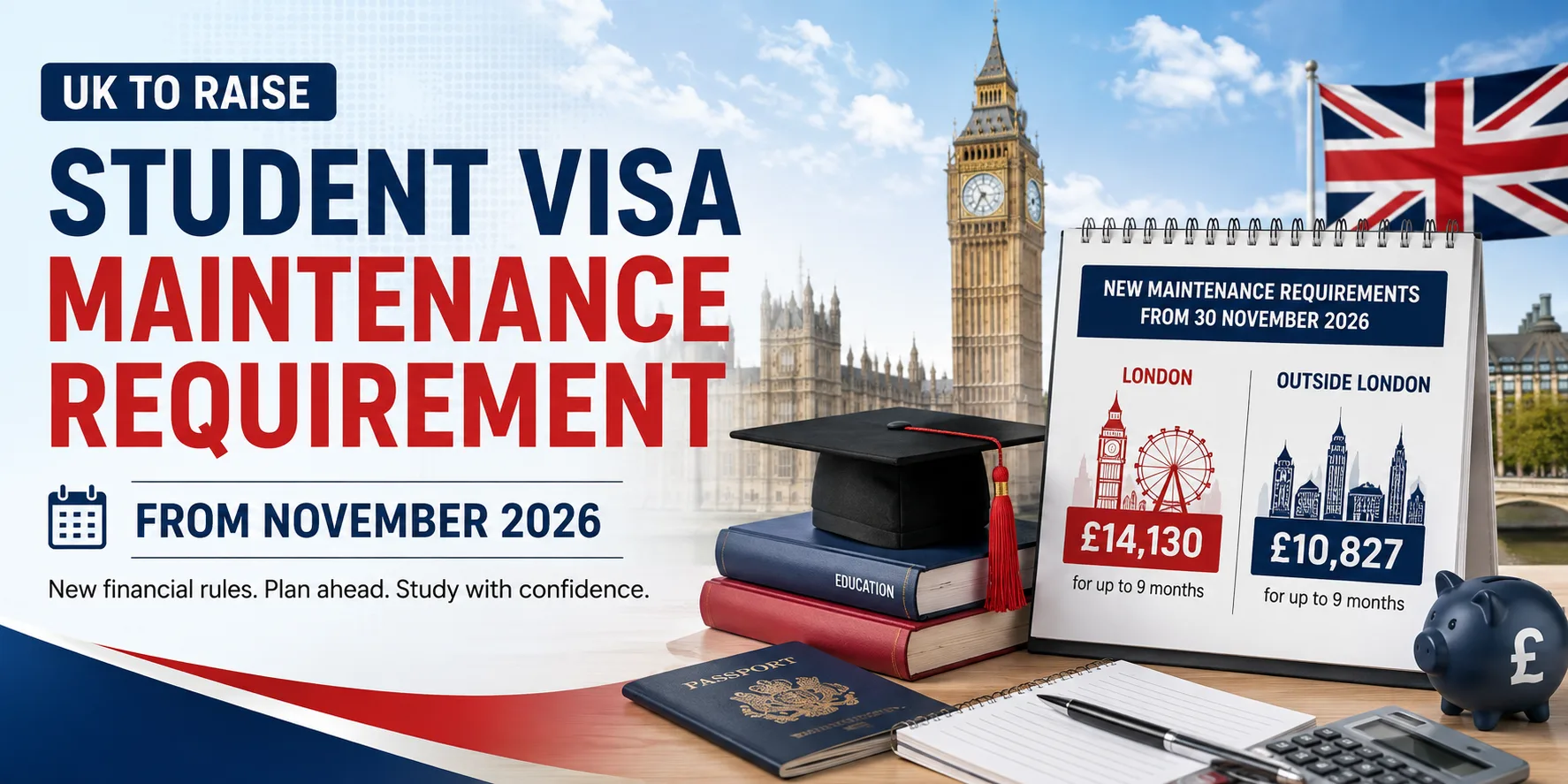
The UK is increasing the amount of money international students must show for living costs when applying for a UK Student visa from 30 November 2026.
The change is part of the latest update to the UK Immigration Rules published by the Home Office on 3 September 2026. Under the new rules, students studying in London will need to demonstrate £1,570 per month, compared with the current £1,529. For students studying outside London, the requirement will rise from £1,171 to £1,203 per month. The requirement can apply for up to nine months.
That means the maximum living-cost evidence for a student will become:
| Study location | Current requirement | From 30 November 2026 | Maximum for 9 months |
|---|---|---|---|
| London | £1,529/month | £1,570/month | £14,130 |
| Outside London | £1,171/month | £1,203/month | £10,827 |
The increase may look relatively small when viewed month by month. But for an international student already budgeting for tuition fees, accommodation, visa fees, healthcare costs, flights and other expenses, every additional pound matters.
More importantly, students should understand that this is not simply a recommendation about how much they should spend. It is a financial requirement connected to the visa application. Applicants who are required to provide financial evidence need to demonstrate that they have the required funds in the prescribed way.
The good news is that the change does not mean the UK Student visa is becoming unavailable. It means applicants need to plan their finances earlier and make sure their evidence meets the rules.
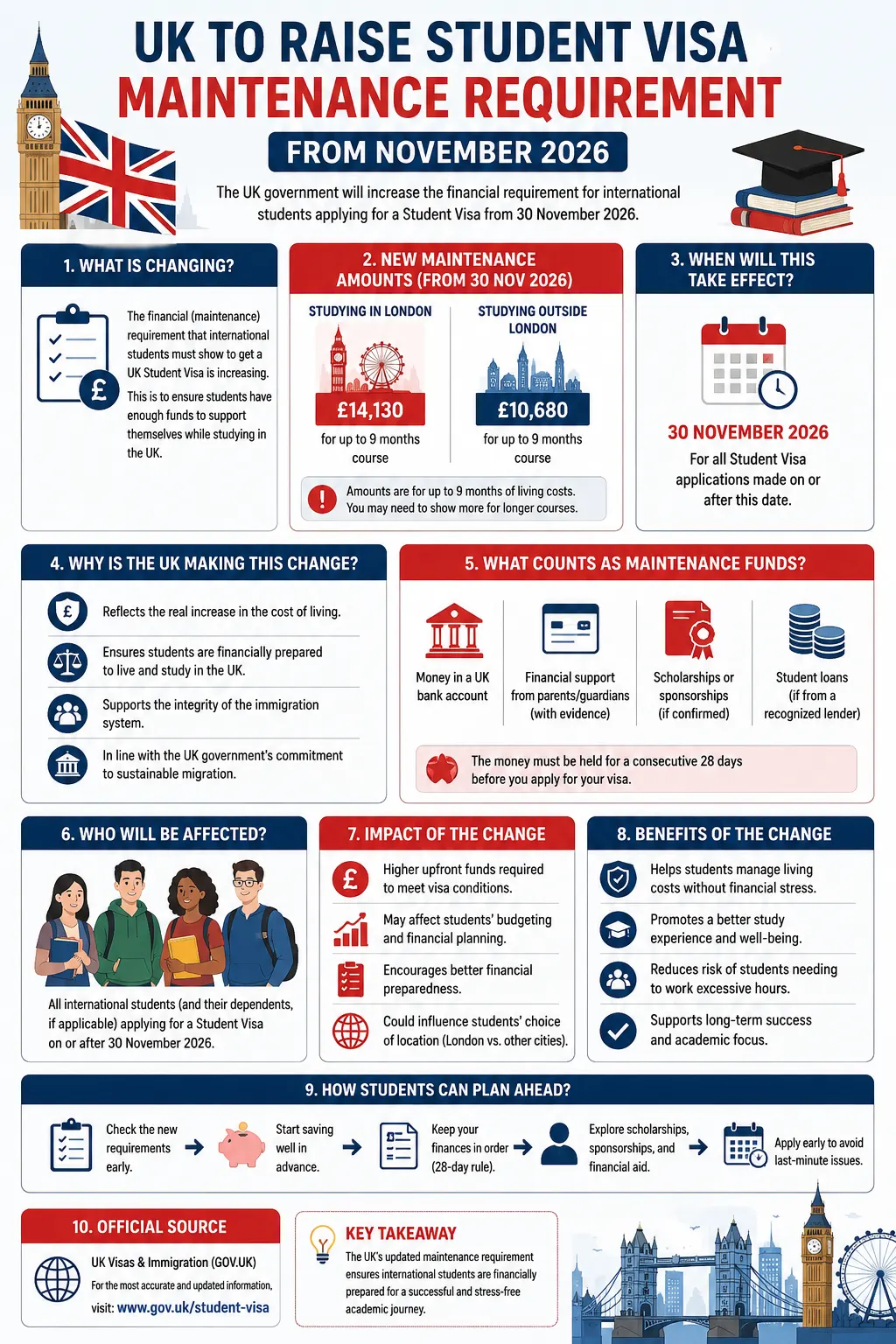
What is changing in the UK Student visa maintenance requirement?
The UK Student visa system requires certain applicants to show that they can financially support themselves while studying in the country.
This is separate from tuition fees.
A student may have enough money to pay their university tuition but still need to demonstrate additional funds for living costs. GOV.UK explains that applicants normally need enough money to pay their course fees and support themselves in the UK.
The Home Office has now confirmed an annual uplift to the Student route maintenance requirement.
From 30 November 2026, the new figures will be:
Students studying in London
The requirement will increase to:
£1,570 per month
For the maximum nine-month period:
£1,570 × 9 = £14,130
Students studying outside London
The requirement will increase to:
£1,203 per month
For nine months:
£1,203 × 9 = £10,827
The Home Office says the annual uplift is intended to keep the Student route maintenance requirement aligned with the maintenance loans available to home students. The government has indicated that this alignment will continue in future years.
So this should not be viewed as a one-off increase that students can assume will remain unchanged forever. The figures are subject to annual review.
When will the new UK Student visa financial requirement start?
The new maintenance figures take effect on:
30 November 2026
This date is particularly important for students who are preparing applications around the end of November.
The latest Statement of Changes to the Immigration Rules states that the relevant Student route changes will take effect on 30 November 2026. It also clearly provides transitional treatment: applications made before 30 November 2026 will be decided under the Immigration Rules in force on 29 November 2026.
This means the date of the application matters.
Students should therefore avoid assuming that a January 2027 course automatically means they must use the new figures. The correct assessment depends on when the visa application is made and which rules apply at that time.
A simple example
Suppose a student is starting a January 2027 course.
If the student submits a valid Student visa application before 30 November 2026, the application will be dealt with under the rules applicable before the new maintenance provisions take effect.
If the student submits the application on or after 30 November 2026, the new maintenance figures apply.
For this reason, students with upcoming intakes should not leave their financial documentation until the last minute.
Why is the UK increasing the Student visa maintenance requirement?
The increase is not being introduced in isolation.
The Home Office explains that the Student route maintenance requirement is linked to the level of maintenance loans available to home students. These domestic maintenance-support figures are reviewed annually. The latest change brings the immigration requirement into line with the 2026/27 academic year levels.
There is also a wider immigration-policy background.
The Home Office says the annual uplift was already agreed as part of measures announced in 2024 to address abuse of the Student route.
In practical terms, the government wants students applying for a UK Student visa to demonstrate that they have a realistic financial foundation for their stay.
This matters because international students face costs beyond university tuition. Accommodation, food, transport, utilities, study materials and everyday expenses can quickly add up.
The government is therefore increasing the amount applicants must demonstrate before they are granted immigration permission.
It is important, however, to distinguish between the government’s visa evidence requirement and the actual cost of living.
The £1,570 London figure does not mean that every student will spend exactly £1,570 every month. It is the amount specified by the immigration rules for financial evidence.
Actual living costs can be higher or lower depending on accommodation, lifestyle, location, transport, course requirements and personal circumstances.
What does the new £14,130 London requirement actually mean?
For students studying in London, the headline figure is likely to attract the most attention.
From 30 November 2026, the requirement will be:
£1,570 × up to 9 months = £14,130
This is the maximum amount for the nine-month maintenance period.
The current requirement is £1,529 per month, which means the maximum currently works out at:
£1,529 × 9 = £13,761
The increase therefore represents:
£369 more over nine months.
That is a modest increase compared with tuition fees, but it is still money that students must factor into their financial planning.
For an international student paying several thousand pounds in tuition, arranging accommodation and preparing for relocation, an additional £369 can make a difference.
What about students studying outside London?
Students outside London will also see an increase.
The new figure will be:
£1,203 per month
For nine months:
£10,827
The current requirement is £1,171 per month, giving a current nine-month figure of £10,539.
That means the increase is:
£32 per month
or:
£288 over nine months.
This is one reason why choosing a university outside London can remain financially attractive.
However, students should not choose a university purely because the immigration maintenance figure is lower.
Actual accommodation and living costs vary significantly between cities.
A lower visa maintenance requirement does not automatically mean a lower real-life budget.
Is the Student visa maintenance requirement the same as tuition fees?
No.
This is one of the most important points for applicants to understand.
The financial requirement generally has two separate components:
- Course fees
- Living-cost funds
The amount needed for tuition is normally based on the course fees stated on the student’s Confirmation of Acceptance for Studies (CAS).
The living-cost requirement is additional.
For example, imagine a student has:
- £18,000 in outstanding tuition fees
- £14,130 required living-cost funds for London
The student cannot normally treat the £18,000 tuition requirement as though it automatically covers the £14,130 maintenance requirement.
The two financial obligations need to be considered separately, although amounts already paid to the university can affect what needs to be demonstrated for outstanding course fees.
GOV.UK confirms that the course-fee amount is linked to the CAS and that students also need enough money to support themselves.
How long must the money be held?
This is where financial planning becomes especially important.
Having the required amount in your account on the day you apply is not necessarily enough.
For applicants who need to prove their funds, the money generally needs to have been held for at least 28 consecutive days.
The end of that 28-day period must also fall within the permitted period before the visa application.
GOV.UK states that the funds must be held for 28 days in a row and that the end date of that period must be within 31 days of the application date.
Why this matters
A student might think:
“I have enough money now, so I can apply.”
But if the money was transferred into the account only a few days before the application, the student could have a financial-evidence problem.
This is why applicants should begin preparing their bank evidence well before submitting the visa application.
What if the money comes from a student loan or sponsorship?
The rules recognise that not every student will personally hold all their funds as ordinary savings.
Students may rely on acceptable forms of financial sponsorship or a qualifying student loan, subject to the evidence requirements.
GOV.UK specifically says that applicants relying on a student loan or financial sponsorship need evidence from the relevant loan or sponsorship provider.
This can be particularly relevant for:
- Government-sponsored students
- Scholarship recipients
- Students receiving institutional sponsorship
- Students using qualifying education loans
The important point is that the funding must be properly documented.
A verbal promise from a sponsor or an informal family arrangement is not the same as acceptable documentary evidence.
Does paying university accommodation reduce the maintenance requirement?
Potentially, yes.
The Immigration Rules include an accommodation offset.
The Home Office explains that this mechanism allows students to demonstrate less maintenance funds where they have paid a deposit for accommodation arranged by their student sponsor.
The latest Statement of Changes also updates the accommodation offset in line with the revised maintenance requirement.
This can be useful for students who have already paid an eligible accommodation deposit to their university or student sponsor.
However, students should not automatically deduct any accommodation payment from their financial requirement.
The accommodation must meet the relevant rules, and the amount that can be offset is subject to the immigration provisions.
The safest approach is to check the latest GOV.UK rules and the university’s CAS/visa guidance before calculating the final amount.
Do students already in the UK need to show the new amount?
Not necessarily.
The financial requirement is mainly relevant when a student is required to demonstrate funds as part of a new Student visa application.
There are circumstances where applicants do not need to prove the financial requirement.
For example, GOV.UK states that a person who has been in the UK with valid immigration permission for at least 12 months at the date of application may not need to provide evidence of the required maintenance funds.
There are also specific exemptions under the Student route.
Students should therefore avoid applying a simple “everyone needs £14,130” rule to every visa situation.
Your immigration history, application type, sponsorship and other circumstances matter.
What does this mean for Indian students?
The change will be particularly relevant to students from India because many Indian applicants self-fund their UK education or combine family savings, education loans and scholarships.
For an Indian student planning to study in London, the new requirement means preparing evidence for up to:
£14,130 for living costs
in addition to the relevant course-fee requirement.
For students outside London, the figure will be up to:
£10,827
The actual amount in Indian rupees will depend on the exchange rate used when arranging the funds. Students should therefore avoid planning their finances using a precise rupee equivalent months in advance.
A safer approach is to maintain a financial buffer rather than arranging exactly the minimum amount at the last moment.
Currency fluctuations can work against applicants, especially when substantial amounts are being converted from Indian rupees into pounds.
The real financial impact is bigger than the £369 increase
It is easy to focus only on the headline increase.
But the bigger issue for international students is the total cost of studying in the UK.
A student needs to consider:
1. Tuition fees
The first major cost is university tuition.
The amount varies significantly depending on:
- University
- Course
- Level of study
- Subject
- Duration
- International student fee structure
2. Living costs
The new Student visa maintenance requirement sets the minimum financial evidence benchmark where it applies.
But real expenditure may be higher.
3. Accommodation
Rent can be one of the largest monthly expenses.
London accommodation can be particularly expensive, which is one reason the immigration rules maintain a higher maintenance figure for London.
4. Visa application fee
The Student visa application fee is currently £558 for applications made from inside or outside the UK under the April 2026 fee schedule.
5. Immigration Health Surcharge
Students are also generally required to pay the Immigration Health Surcharge as part of their visa application.
The current student rate is £776 per year, with the exact amount depending on the length of the visa.
6. Travel
Students need to budget for:
- Flights
- Airport transfers
- Local transport
- Initial accommodation
- Baggage
- Travel insurance where appropriate
7. Initial setup costs
The first few weeks can be more expensive than a normal month.
Students may need money for:
- Bedding
- Kitchen items
- Clothing
- SIM/mobile services
- Deposits
- Local transport cards
- Study materials
- Basic household items
This is why meeting the visa requirement should be treated as the starting point of financial planning, not the final budget.
Will students be allowed to work and use employment income to meet the requirement?
Students should not build their visa financial plan around the assumption that they will immediately earn enough from part-time work.
The Student route may permit work depending on the student’s course and circumstances, but the permitted amount and conditions vary.
The official Student visa guidance makes clear that work rights depend on what the student is studying and whether the work takes place during term time or outside it.
More importantly, visa financial evidence is about demonstrating funds at the required stage.
A future part-time job is not a substitute for meeting the relevant financial evidence requirement.
Students should therefore arrive with a realistic financial plan rather than assuming that employment will solve their living-cost needs.
Will the new rule make UK universities less affordable?
For some students, yes, the change could make the initial financial hurdle more difficult.
But it does not necessarily make every UK university less affordable.
The financial impact depends on where a student studies.
A student attending a university outside London could face a lower visa maintenance requirement than someone studying in London.
At the same time, a student should compare the total cost of living rather than simply comparing the visa figures.
For example, a university in a smaller city may have:
- Lower rent
- Lower transport costs
- Lower everyday expenses
while another university may have higher accommodation costs despite having a similar tuition fee.
The smarter comparison is therefore:
Tuition + accommodation + food + transport + visa costs + other living expenses
rather than tuition alone.
Could this influence university choices in the future?
It could.
International students are becoming increasingly conscious of the total cost of studying abroad.
The new maintenance requirement may encourage some students to look more closely at universities outside London.
This could benefit universities in cities where accommodation and everyday living costs are more manageable.
However, academic quality should remain the first consideration.
Students should compare:
- Course curriculum
- University reputation
- Graduate outcomes
- Placement opportunities
- Industry links
- Location
- Accommodation
- Total cost
- Post-study options
The cheapest option is not necessarily the best option.
The best option is the university and course that provide a strong balance between academic value, career opportunities and financial sustainability.
What should students do before 30 November 2026?
The most important advice is simple:
Start early.
Do not wait until your visa application is ready before thinking about financial evidence.
Step 1: Confirm your university and course
Make sure you have accepted your offer and understand the tuition fee shown on your CAS.
Step 2: Confirm where you will study
Determine whether your course falls under the London or outside-London maintenance requirement.
Remember that “London” has a specific immigration definition. GOV.UK describes it as the City of London and the 32 London boroughs.
Step 3: Calculate the maintenance requirement
For applications under the new rules:
London: £1,570 × up to 9 months = £14,130
Outside London: £1,203 × up to 9 months = £10,827
Step 4: Add outstanding tuition fees
Check your CAS and determine how much tuition remains to be paid or evidenced.
Step 5: Check accommodation payments
If you have paid an eligible accommodation deposit to your student sponsor, check whether it can reduce the amount of maintenance funds you need to demonstrate.
Step 6: Build your bank history
If you need to use personal or family funds, make sure the money is held in an acceptable account for the required period.
Do not make a large last-minute transfer without understanding how it affects the 28-day evidence requirement.
Step 7: Keep documentation consistent
Your:
- Bank statements
- Passport
- CAS
- Sponsorship documents
- Loan documents
- Accommodation documents
should all support the information in your visa application.
Step 8: Keep a financial buffer
Do not aim to sit exactly at the minimum.
A small buffer can protect you against:
- Exchange-rate changes
- Bank charges
- Unexpected expenses
- Accommodation costs
- Additional travel expenses
A practical financial planning example
Consider an international student starting a postgraduate course in London.
Suppose the student’s outstanding tuition requirement is:
£20,000
The new maximum maintenance requirement is:
£14,130
The student therefore needs to plan for a financial position that accounts for approximately:
£34,130
before considering other visa-related and relocation expenses.
This does not mean that £34,130 is automatically the exact amount that must appear in one bank account. The student’s actual evidence requirements depend on what has already been paid, sponsorship arrangements, accommodation offsets and the relevant immigration rules.
But it illustrates the scale of the financial planning involved.
Now consider a student studying outside London.
If the tuition requirement were also £20,000, the maximum maintenance figure would be:
£10,827
That produces a different overall financial picture.
This is why students should calculate their own figures rather than relying on generic “UK study cost” estimates found online.
What happens if a student does not meet the financial requirement?
If an applicant is required to demonstrate maintenance funds and cannot meet the relevant financial requirement or provide acceptable evidence, this can create a serious problem with the visa application.
Financial evidence is part of the Student route requirements.
The government guidance specifies the required funds, the holding period and the evidence that may be required.
This is why students should not treat financial documents as an administrative formality.
A student can have:
- An excellent academic record
- A confirmed university place
- A valid CAS
- A strong English-language score
and still face problems if the visa application does not meet the immigration requirements.
The visa process looks at the application as a whole.
What about students bringing dependants?
Students who are eligible to bring dependants need to budget for additional maintenance funds.
The current Student route guidance states that a partner or child accompanying an eligible student requires additional funds, currently:
- £845 per month in London
- £680 per month outside London
for up to nine months, subject to the relevant rules.
However, students should first establish whether they are actually permitted to bring dependants.
The rules have become considerably more restrictive.
For example, dependant eligibility generally includes specific categories such as students on qualifying postgraduate research programmes or certain government-sponsored students.
Therefore, families should not simply calculate the additional money required and assume that a dependant visa will be available.
Eligibility comes first.
Does the change affect the Graduate visa?
The maintenance requirement increase is specifically a change to the Student route financial requirement.
It does not mean that students who already hold or later qualify for the Graduate route suddenly need to show £14,130.
The Graduate visa is a separate immigration route.
However, students planning their UK education should consider the wider immigration pathway, including what happens after graduation.
Current GOV.UK guidance states that the Graduate visa allows eligible graduates to stay for two years where they apply on or before 31 December 2026, while applications made on or after 1 January 2027 generally receive an 18-month period; doctoral graduates can receive three years.
Because immigration rules can change, students should always check the latest official guidance rather than relying on older information from social media or previous applicants.
Is the increase a major change or a manageable one?
For most students, it is best described as a manageable but important increase.
The London increase is £41 per month.
The outside-London increase is £32 per month.
The total nine-month increases are:
- London: £369
- Outside London: £288
Those figures are not enormous compared with international tuition fees.
But the significance is not only the size of the increase.
The important issue is that the requirement is part of the visa process, which means students must have the funds and prove them correctly when required.
A student who plans six months ahead has time to arrange the money.
A student who discovers the requirement just before submitting the visa application may have a much more difficult situation.
What does the future look like for UK international students?
The latest change also gives students a clue about the direction of travel.
The Home Office says the maintenance requirement is designed to remain aligned with home-student maintenance loans and will continue to be reviewed in future years.
That means international students should expect that financial requirements can be updated periodically.
Students planning to start university in 2027, 2028 or later should not assume that today’s figure will remain fixed.
The right approach is to monitor the official Immigration Rules and GOV.UK Student visa guidance when preparing an application.
This is especially important for students applying far in advance.
Benefits of planning for the new requirement early
Although a higher financial requirement creates an additional hurdle, early planning has several advantages.
Better financial security
Students can arrive in the UK with a clearer understanding of their financial position.
Less visa stress
Having the correct bank history and documents ready reduces last-minute pressure.
Better university decisions
Students can compare London and non-London options based on their complete budget.
Lower risk of unexpected costs
A proper budget accounts for accommodation, food, travel and initial setup costs.
More realistic expectations
Students are less likely to arrive assuming that part-time work will immediately cover their expenses.
UK Student visa planning checklist for 2026 and 2027 applicants
Before submitting a Student visa application, students should work through the following checklist:
University
- Have I received my CAS?
- Is my course information correct?
- Do I know my outstanding tuition fee?
Maintenance funds
- Am I studying in London or outside London?
- Which maintenance figure applies to my application?
- Do I need up to nine months of funds?
- Have the required funds been held for 28 consecutive days?
Evidence
- Are my bank statements acceptable?
- Are the dates correct?
- Does the balance meet the requirement?
- Do I have evidence for any student loan or sponsorship?
Accommodation
- Have I paid an eligible accommodation deposit?
- Can an accommodation offset apply?
Visa costs
- Have I budgeted for the Student visa fee?
- Have I calculated the Immigration Health Surcharge?
- Have I budgeted for travel and initial expenses?
Family
- If I am bringing dependants, am I eligible?
- Have I calculated their additional financial requirements?
Timing
- Am I applying before or after 30 November 2026?
- Which version of the Immigration Rules applies to my application?
Frequently Asked Questions
What is the new UK Student visa maintenance requirement from November 2026?
From 30 November 2026, students studying in London will need to demonstrate £1,570 per month, while students studying outside London will need £1,203 per month, where the financial requirement applies.
How much money does a student need for nine months in London?
The maximum nine-month maintenance requirement will be £14,130.
How much money does a student need outside London?
The maximum nine-month requirement will be £10,827.
When does the new requirement start?
The new figures take effect on 30 November 2026. Applications made before that date are subject to the transitional provision in the Statement of Changes and will be decided under the rules in force on 29 November 2026.
Is the maintenance requirement separate from tuition fees?
Yes. Students generally need to account for both their outstanding course fees and the applicable living-cost requirement.
Do I need to keep the money in my account for 28 days?
Where financial evidence is required, the funds generally need to have been held for at least 28 consecutive days, with the end of that period falling within 31 days of the visa application.
Can a student loan be used?
A qualifying student loan may be used where the required evidence is provided. GOV.UK requires appropriate evidence from the loan provider.
Can accommodation payments reduce the maintenance requirement?
An eligible accommodation deposit paid to the student sponsor can potentially be offset against the required maintenance funds, subject to the rules.
Is the new amount £14,130 for every UK student?
No. £14,130 is the maximum nine-month figure for students studying in London. Students outside London will have a maximum nine-month figure of £10,827 under the new rates.
Does every Student visa applicant have to show these funds?
Not necessarily. There are exemptions and circumstances where financial evidence is not required, including certain applicants who have already been in the UK with valid permission for at least 12 months.
Will the requirement increase again?
The Home Office has stated that the Student route maintenance requirement will continue to be aligned with the maintenance loans available to home students and reviewed annually.
Final takeaway: prepare before the rule changes
The UK’s decision to increase the Student visa maintenance requirement from November 2026 is another reminder that studying in Britain requires careful financial preparation, not just academic preparation.
For London students, the new figure of £1,570 per month, or up to £14,130 for nine months, will become an important part of the visa-planning process.
For students outside London, the new requirement of £1,203 per month, or up to £10,827 for nine months, will also need to be considered.
The increase itself is not dramatic. The bigger lesson is about timing.
Students need to think about their finances before submitting their visa application, make sure the money is held for the required period, keep proper documentation and understand the difference between tuition fees and living-cost funds.
For students planning a 2026 or 2027 intake, the best strategy is simple: check the rules early, calculate your full budget, prepare your financial evidence in advance and keep a buffer above the minimum wherever possible.
The UK remains an important destination for international education, but the cost of getting there needs to be planned realistically.
And as the Home Office continues its annual review of the maintenance requirement, students planning to study in the UK in future years should make checking the latest official rules part of their application process.
Important: Immigration rules can change. Students should always check the latest requirements on official GOV.UK guidance before submitting a visa application. The figures in this article reflect the UK Immigration Rules and official guidance available in September 2026.
Official sources for the blog
- UK Government — Statement of Changes to the Immigration Rules, HC 584 — confirms the 30 November 2026 implementation date and transitional arrangements.
- UK Government — Immigration Rules, Appendix Student — confirms the new £1,570 London / £1,203 outside London figures.
- UK Government — Student visa: Money you need — current official guidance on tuition, maintenance funds and the 28-day evidence requirement.
- UK Government — Financial evidence for Student and Child Student visa applicants — official financial-evidence rules.
- UK Government — Explanatory Memorandum to HC 584 — explains why the annual maintenance uplift is being introduced.
- UK Government — Student visa overview — official information on Student visa eligibility, fees and conditions.
- UK Government — Immigration Health Surcharge: how much you pay — current IHS information for students.