
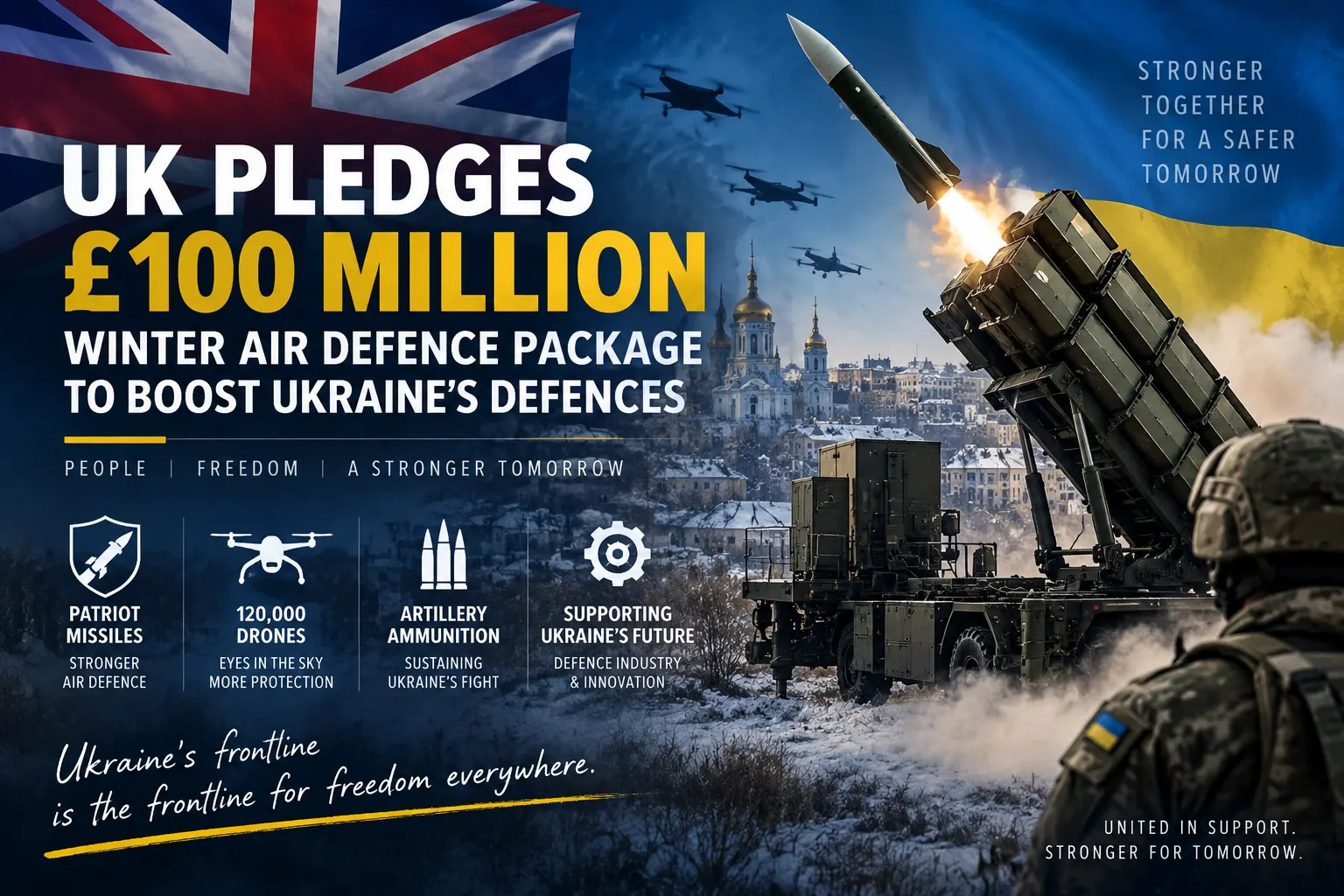
The United Kingdom is stepping up military support for Ukraine ahead of another difficult winter, announcing a £100 million contribution to NATO’s Prioritised Ukraine Requirements List (PURL) to help provide Patriot missiles and other air-defence equipment.
The package comes at a critical point in the Russia-Ukraine war. As winter approaches, protecting Ukraine’s cities, energy infrastructure, military positions and civilian population becomes even more important. Russia has repeatedly used missile and drone attacks against infrastructure, including energy facilities, making air defence one of Ukraine’s most urgent military requirements.
The latest UK commitment is not simply about sending more weapons. It is part of a broader strategy involving air defence, drones, artillery ammunition, long-range strike capabilities, defence technology, artificial intelligence and greater cooperation between Ukraine and its European allies.
The UK Government says the equipment funded through the new contribution is intended to arrive before winter. At the same time, Britain is continuing its commitment to provide more than 120,000 drones to Ukraine during 2026, while additional long-range artillery ammunition is also being funded by a group of European countries.
Here is what the announcement means, why the support is being provided now, how the different parts of the package fit together and what could change in the months ahead.
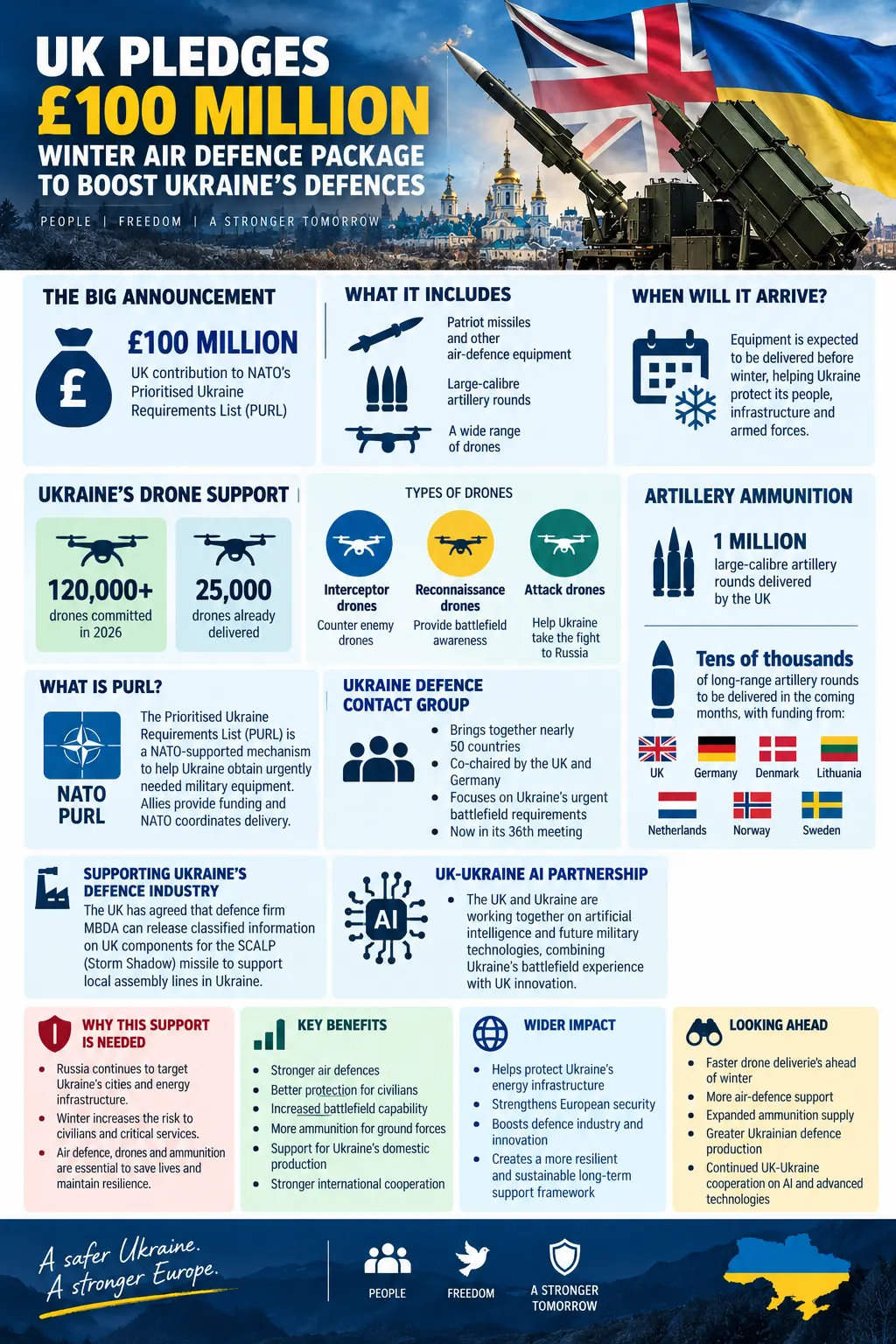
UK’s New Ukraine Defence Package: At a Glance
The latest announcement includes several connected elements:
- £100 million UK contribution to NATO’s Prioritised Ukraine Requirements List.
- Support for Patriot missiles and other air-defence equipment.
- Equipment intended to reach Ukraine before winter.
- Continued UK commitment to supply more than 120,000 drones during 2026.
- Around 25,000 drones already delivered, according to the UK Government’s latest announcement.
- Drones covering interception, reconnaissance and attack roles.
- The UK has recently delivered its millionth round of large-calibre artillery ammunition to Ukraine.
- Tens of thousands of additional long-range artillery rounds are planned in the coming months.
- Funding for those artillery rounds involves the UK, Germany, Denmark, Lithuania, the Netherlands, Norway and Sweden.
- The UK is supporting efforts to establish local production of SCALP/Storm Shadow-related capabilities in Ukraine.
- Britain and Ukraine are expanding cooperation on artificial intelligence and military technology.
- The Ukraine Defence Contact Group continues to coordinate military support involving nearly 50 countries.
The package therefore needs to be understood as part of a wider defence effort rather than as one isolated £100 million announcement.
Why Is the UK Increasing Support Before Winter?
Winter has a particular strategic importance in the Ukraine war.
Ukraine’s energy system, heating infrastructure, transport networks and other critical facilities are essential to keeping civilian life functioning during the colder months. Damage to these systems can have consequences that go far beyond the immediate military battlefield.
For Ukraine, effective air defence can therefore mean protecting much more than military installations.
It can help protect:
- Electricity generation and distribution
- Heating infrastructure
- Water systems
- Hospitals
- Transport infrastructure
- Industrial facilities
- Military positions
- Civilians in populated areas
- Critical national infrastructure
The UK Government says the latest support follows visits to Kyiv by the Prime Minister and Defence Secretary, during which Ukrainian President Volodymyr Zelenskyy stressed the importance of additional assistance ahead of winter.
This explains the timing.
The objective is not to wait until winter attacks begin and then react. The intention is to get additional defensive capability into Ukraine beforehand.
That distinction matters.
Preparation is one of the central themes of the UK’s latest approach.
What Is the £100 Million Air Defence Package?
The most prominent element of the announcement is the UK’s £100 million contribution to NATO’s Prioritised Ukraine Requirements List, known as PURL.
The funding will support Ukraine with Patriot missiles and other air-defence equipment.
The UK says the equipment funded through this contribution is expected to be delivered before winter.
The basic idea is straightforward: Ukraine needs interceptors and other air-defence capabilities, while NATO allies need an effective mechanism for identifying urgent requirements, funding them and coordinating delivery.
PURL is designed to help achieve exactly that.
NATO explains that under PURL, its Supreme Allied Commander Europe identifies equipment and munitions Ukraine needs and that the United States can provide at greater volume than European allies and Canada alone.
Allies and partners then provide funding, while NATO coordinates delivery.
This makes the UK’s £100 million contribution more than a standalone British purchase.
It plugs into a larger multinational system.
What Is PURL and Why Does It Matter?
The Prioritised Ukraine Requirements List was launched in July 2025.
Its purpose is to help Ukraine receive urgent military equipment, particularly capabilities that may be available in significant quantities from US stocks.
Instead of every country independently trying to identify equipment, negotiate purchases and organise delivery, PURL provides a coordinated framework.
That can make the support process more predictable.
NATO says that since its launch, more than two-thirds of Allies, along with partners Australia and New Zealand, have committed funding through PURL, with more than US$6 billion of military equipment funded through the mechanism.
Air defence has become one of the most important areas of the programme.
NATO has previously said PURL has supplied a substantial share of the missiles used by Ukraine’s Patriot batteries and other air-defence systems. In July 2026, NATO’s Deputy Secretary General also stressed the urgent need for air defence, drones and ammunition.
That helps explain why Britain is directing its latest contribution through PURL.
Why Are Patriot Missiles So Important?
Patriot is an advanced air-defence system designed to intercept incoming aerial threats.
For Ukraine, the importance of Patriot is not simply the missile itself. The wider value comes from having a sophisticated air-defence architecture capable of helping defend high-value areas and infrastructure against serious aerial threats.
Ukraine faces a mixture of threats, including missiles and drones.
That creates a difficult defensive problem.
A country cannot rely on one type of interceptor or one type of defence system for every threat. It needs layers of protection.
This is where the UK’s broader package becomes significant.
Patriot support is being combined with drones, reconnaissance capabilities, interceptor drones, artillery and longer-range systems.
The result is a multi-layered defence approach rather than dependence on one weapon.
Ukraine’s Air Defence Challenge Is Bigger Than Missiles
One of the most important developments in modern warfare has been the rapid expansion of drone use.
Drones can be comparatively inexpensive, flexible and difficult to deal with when deployed in large numbers.
Ukraine therefore needs to defend against both sophisticated missiles and large-scale drone attacks.
This creates a difficult economic and operational equation.
Using an expensive interceptor against every relatively inexpensive drone may not be sustainable.
That is one reason why Ukraine is increasingly developing and receiving a mixture of technologies.
The UK’s latest drone commitment reflects this changing battlefield.
UK Drone Commitment: More Than 120,000 in 2026
Britain previously announced its largest-ever drone package for Ukraine, committing to provide at least 120,000 drones during 2026.
The latest announcement says approximately 25,000 have been delivered so far, with deliveries expected to accelerate ahead of winter.
These drones are not all designed to perform the same job.
The UK Government identifies three broad categories:
1. Interceptor drones
These are designed to help counter enemy drones.
They provide another layer of defence against aerial threats and can potentially complement traditional air-defence systems.
2. Reconnaissance drones
These provide battlefield awareness.
They can help Ukrainian forces observe movements, understand battlefield conditions and gather intelligence.
Information is increasingly as important as ammunition.
A force that can identify threats earlier can potentially react faster and make better decisions.
3. Attack drones
These provide Ukraine with an offensive capability.
They can be used to strike targets and impose costs on Russian forces.
The combination of reconnaissance and attack capabilities also demonstrates how drones have become deeply integrated into modern battlefield operations.
Why the Drone Numbers Matter
The headline number — more than 120,000 drones — is significant because it illustrates the changing economics of warfare.
Traditional military platforms can be expensive and slow to manufacture.
Drones can often be developed, modified and produced much faster.
Ukraine has become one of the world’s most important testing grounds for drone warfare because battlefield conditions force rapid technological adaptation.
The UK has increasingly sought to learn from that experience.
In September 2025, Britain and Ukraine announced a technology-sharing agreement covering military equipment and drone technology. One early project involved Project OCTOPUS, an air-defence interceptor drone intended for mass production.
This suggests that the relationship is moving beyond simply supplying equipment.
It is increasingly about co-development and industrial cooperation.
The Artillery Dimension: Britain’s Millionth Round
Air defence is only one part of Ukraine’s military requirements.
Ground forces continue to require artillery ammunition.
The UK says it has recently delivered its millionth round of large-calibre artillery ammunition to Ukraine.
The Government describes artillery ammunition as vital to Ukraine’s defence.
The next step is already being planned.
Britain says it will help deliver tens of thousands of long-range artillery rounds in the coming months, with funding involving:
- United Kingdom
- Germany
- Denmark
- Lithuania
- Netherlands
- Norway
- Sweden
This is important because it demonstrates another feature of the current strategy: countries are increasingly sharing the financial burden of military support.
Instead of one country attempting to provide everything, several governments are contributing to specific capability requirements.
Why Long-Range Artillery Still Matters
The war in Ukraine is often associated with drones and missiles, but artillery remains central to ground warfare.
Artillery provides sustained fire support and can influence battlefield positions over distance.
Long-range artillery can give Ukrainian forces additional reach while supporting defensive operations.
The UK’s decision to fund tens of thousands of additional rounds therefore complements the air-defence package.
One protects against incoming aerial threats.
The other supports operations on the ground.
Together, they address different parts of Ukraine’s defence problem.
The Bigger Picture: From Emergency Aid to Defence Production
Perhaps the most important part of the UK’s latest approach is what happens beyond winter.
Britain is increasingly supporting Ukraine’s ability to produce military equipment itself.
This is a major strategic shift.
Emergency military assistance can provide immediate capability.
Domestic production can provide something different: greater resilience and sustainability.
The latest UK announcement says Britain has agreed that defence company MBDA can release classified information relating to UK components of the SCALP long-range missile, also known as Storm Shadow, to support the establishment of local assembly lines in Ukraine.
That is significant because it moves cooperation towards industrial capacity.
Why Local Assembly Could Be Important for Ukraine
A country fighting a long war cannot depend indefinitely on external deliveries for every major component of its defence capability.
Local production could potentially provide:
- Greater supply resilience
- Faster replacement of equipment
- Reduced dependence on overseas deliveries
- Expansion of Ukraine’s defence industry
- More technical expertise
- Stronger European defence-industrial cooperation
- A foundation for future Ukrainian military production
This does not mean foreign support becomes unnecessary.
Instead, it can make external support more sustainable by combining international assistance with Ukrainian production.
The UK has increasingly emphasised this model.
The UK-Ukraine AI Partnership: Preparing for the Next Battlefield
The latest package also sits alongside a growing UK-Ukraine partnership on artificial intelligence.
In August 2026, Britain and Ukraine signed a joint declaration on an AI partnership focused on defence AI, autonomous systems and network-enabled capabilities. The UK Government said Ukraine’s battlefield experience could contribute to the development of future defence technology.
Another UK Government announcement said British start-ups, researchers and engineers would gain access to insights from Ukraine’s Avengers AI platform.
This is an important part of the longer-term story.
The battlefield is changing quickly.
Artificial intelligence can potentially assist with areas such as:
- Battlefield information
- Data analysis
- Target recognition
- Decision support
- Autonomous systems
- Drone operations
- Intelligence processing
- Military planning
The UK is therefore trying to learn from Ukraine’s wartime experience while helping Ukraine develop new capabilities.
Why the UK Is Investing in Drones and AI at Home Too
The relationship works in both directions.
Ukraine has gained enormous experience operating drones and adapting technology under wartime conditions.
Britain wants to absorb some of those lessons into its own defence planning.
The UK’s 2026 Defence Investment Plan includes more than £5 billion for drones and autonomous weapons, while the Government has also announced wider programmes aimed at modernising the Armed Forces using lessons from Ukraine.
This means support for Ukraine also has a domestic defence dimension for Britain.
The UK is effectively treating the Ukraine war as an important source of lessons about the future character of warfare.
What Is the Ukraine Defence Contact Group?
The latest announcement was made alongside the Ukraine Defence Contact Group, a multinational forum that brings together nearly 50 countries.
The September 2026 meeting is the group’s 36th meeting and is co-chaired by the UK Defence Secretary and German Defence Minister Boris Pistorius.
The group exists to coordinate military assistance for Ukraine.
That coordination matters because Ukraine requires many different categories of support simultaneously.
These include:
- Air defence
- Missiles
- Artillery
- Ammunition
- Drones
- Training
- Maintenance
- Intelligence
- Logistics
- Long-term industrial capacity
The Contact Group gives participating countries a forum to discuss urgent requirements and coordinate contributions.
It also makes clear that support for Ukraine is not being treated purely as a bilateral UK-Ukraine issue.
It is part of a wider European and NATO security effort.
The Importance of Nearly 50 Countries Working Together
The scale of the Contact Group is important.
No single European country can easily provide everything Ukraine needs.
Modern military systems require large supply chains, specialised manufacturing and long-term investment.
Multinational cooperation allows countries to divide responsibilities.
One country may provide funding.
Another may provide ammunition.
Another may provide air-defence systems.
Another may contribute training or industrial capacity.
This approach spreads the burden while increasing the range of capabilities available to Ukraine.
NATO’s wider support architecture also includes the NATO Security Assistance and Training for Ukraine (NSATU), which helps coordinate military equipment and training.
What Does This Mean for Ukraine This Winter?
The immediate objective is clear: improve Ukraine’s ability to defend itself during the winter months.
The £100 million PURL contribution is expected to support air-defence equipment, including Patriot missiles, while the UK is accelerating drone deliveries.
At the same time, additional artillery ammunition is planned.
The combined effect could be greater resilience against sustained attacks.
But there is an important point to understand.
The package does not guarantee that Ukraine will be able to prevent every missile or drone attack.
No air-defence system provides complete protection.
Instead, the objective is to increase the probability that important threats can be detected, intercepted or otherwise countered.
That can reduce the damage caused by attacks.
Protecting Energy Infrastructure Will Be a Major Priority
Winter makes energy infrastructure particularly sensitive.
Electricity and heating are not simply economic concerns during cold weather. They are essential to civilian life.
If energy infrastructure is damaged, the consequences can spread quickly.
Hospitals need power.
Homes need heating.
Water systems require electricity.
Businesses depend on stable energy supplies.
Transport networks also rely on functioning infrastructure.
That is why the UK Government specifically highlights the protection of critical national infrastructure and civilians as part of the rationale for the new air-defence support.
What Could Change Over the Next Few Months?
The latest announcement points towards several developments that could become more important during late 2026 and beyond.
1. Faster drone deliveries
The UK says its drone deliveries will ramp up ahead of winter.
If the delivery programme continues at pace, Ukraine could receive substantially more drones during the final part of the year.
2. More air-defence support
The £100 million PURL contribution is part of a wider NATO effort to strengthen Ukraine’s air defence.
NATO has repeatedly identified air defence as one of Ukraine’s most urgent requirements.
3. More ammunition
Tens of thousands of long-range artillery rounds are expected to be delivered through multinational funding.
4. Greater Ukrainian defence production
The move towards local assembly of long-range missile capabilities could become an important part of Ukraine’s longer-term defence strategy.
5. Greater use of AI
The UK-Ukraine AI partnership could create new capabilities based on Ukraine’s battlefield experience and Britain’s technology sector.
6. More European defence cooperation
The latest announcement fits into a wider European effort to expand defence production and strengthen long-range and air-defence capabilities.
Is This Only About Ukraine?
No.
The UK Government increasingly links support for Ukraine with the wider security of Europe.
That thinking is visible in several recent initiatives.
In July 2026, the UK joined nine other countries in launching an initiative to develop an integrated anti-ballistic missile coalition. The participating countries said the growing ballistic-missile threat made integrated missile defence increasingly important for European security.
Separately, 12 countries committed to invest collectively more than $50 billion over the next decade in deep precision strike capabilities.
These initiatives show that European governments are thinking beyond the immediate war.
They are preparing for a security environment in which missiles, drones, autonomous systems and long-range weapons play a much larger role.
How This Could Affect Europe’s Defence Strategy
The Ukraine war has changed how European governments think about defence.
Several lessons have become increasingly difficult to ignore.
Air defence needs depth
A country cannot depend on one missile system.
It needs different layers and different types of interceptors.
Drones are now mainstream military equipment
They are no longer niche battlefield tools.
They are becoming central to reconnaissance, attack and defence.
Ammunition stockpiles matter
A sophisticated military platform is of limited value if there is insufficient ammunition to sustain operations.
Defence production needs to be scalable
Countries need industrial capacity capable of increasing production quickly during a crisis.
Technology cycles are getting shorter
A drone or electronic warfare system can evolve rapidly.
Defence organisations therefore need to adapt faster.
International cooperation is essential
No country can easily develop every capability independently.
These lessons are increasingly reflected in Britain’s defence policy.
What Are the Benefits of the UK Package?
The immediate benefits for Ukraine can be divided into several areas.
Stronger air defence
The Patriot-related support should strengthen Ukraine’s ability to counter serious aerial threats.
Better protection for civilians
Improved air defence can help reduce the impact of attacks on populated areas.
Greater protection for infrastructure
Energy and other critical facilities can receive additional protection.
More battlefield intelligence
Reconnaissance drones can improve situational awareness.
More counter-drone capability
Interceptor drones provide another option for dealing with hostile drones.
More offensive flexibility
Attack drones give Ukrainian forces additional capabilities.
Greater artillery sustainability
Additional ammunition helps maintain Ukraine’s ground-defence capacity.
Stronger domestic production
Local assembly of long-range missile capabilities could improve Ukraine’s defence-industrial resilience.
Technology transfer and innovation
The AI partnership can help develop future defence technologies based partly on Ukraine’s battlefield experience.
What Are the Challenges?
It is also important to avoid presenting the announcement as a simple solution to a complex war.
There are several challenges.
Air-defence demand remains extremely high
Ukraine has a large territory to protect and faces different types of aerial threats.
Even advanced systems cannot provide complete coverage.
Interceptor supplies are limited
Missile production takes time, and demand from Ukraine has placed significant pressure on existing stocks and production capacity.
Drones require constant adaptation
Drone technology changes quickly.
Countermeasures also evolve.
A system that works effectively today may require modification tomorrow.
Ammunition consumption is substantial
The scale of modern warfare means large quantities of artillery ammunition can be consumed.
Industrial production takes time
Establishing local assembly lines is strategically valuable, but it does not happen overnight.
Coordination remains essential
With multiple countries supplying different equipment, interoperability, logistics and training become increasingly important.
This is precisely why mechanisms such as PURL and the Ukraine Defence Contact Group matter.
What Does the UK Plan Suggest About Its Long-Term Strategy?
The UK’s latest announcements point towards a strategy with several layers.
Short term: Protect Ukraine
Get air-defence missiles, drones and ammunition into Ukraine before winter.
Medium term: Increase production
Expand drone production and support ammunition and defence manufacturing.
Longer term: Build Ukrainian capability
Support local production and technical cooperation so Ukraine can sustain more of its own defence requirements.
Future battlefield: Invest in technology
Use AI, autonomous systems and other technologies to prepare for a rapidly changing form of warfare.
This is a much broader approach than traditional military aid.
It combines equipment, money, technology, industrial capacity and international coordination.
Why the UK-Ukraine Relationship Is Becoming More Strategic
The latest package is another step in a relationship that is becoming increasingly deep.
Britain is not only supplying military equipment.
It is also working with Ukraine on:
- Drone technology
- Defence production
- Artificial intelligence
- Long-range capabilities
- Military innovation
- Training
- Industrial cooperation
The UK’s 100 Year Partnership with Ukraine provides a broader framework for this relationship.
The AI partnership announced in August 2026 is one example of how cooperation is moving into emerging technologies.
The proposed Ukrainian assembly of long-range missile capabilities is another.
Together, they indicate that Britain sees Ukraine not only as a recipient of military support but also as a source of operational knowledge and technological innovation.
What Should We Watch Next?
For anyone following developments in the UK-Ukraine relationship, several areas will be worth watching.
Delivery of Patriot-related equipment
The key question will be how quickly the equipment funded through the £100 million contribution reaches Ukraine.
Drone delivery numbers
The UK has committed to more than 120,000 drones for 2026, with deliveries expected to accelerate.
Winter attacks
The scale and nature of Russian missile and drone attacks will influence how urgently additional air-defence resources are required.
Ukrainian defence production
Progress towards local assembly of long-range missile capabilities could become a major development.
AI cooperation
The UK-Ukraine AI partnership could generate new battlefield technologies and potentially influence wider European defence innovation.
European ammunition production
The ability of European countries to increase production will be important for sustaining Ukraine over the longer term.
NATO coordination
PURL and the Ukraine Defence Contact Group will remain important mechanisms for matching Ukrainian requirements with international support.
What the Winter Package Means in Simple Terms
At its core, the announcement is about giving Ukraine more ways to survive and respond to sustained attacks.
The £100 million PURL contribution is aimed primarily at strengthening air defence.
The drone programme expands Ukraine’s ability to detect, intercept and strike.
The artillery programme helps sustain ground operations.
The missile-production cooperation aims to strengthen Ukraine’s domestic defence industry.
The AI partnership looks further ahead, towards the technologies that could shape future warfare.
These are different pieces of the same strategy.
Defend today. Produce more tomorrow. Build capabilities for the future.
Final Thoughts
The UK’s latest military support for Ukraine comes at a strategically important moment.
The announcement of a £100 million contribution through NATO’s Prioritised Ukraine Requirements List, including support for Patriot missiles and other air-defence equipment, is designed to strengthen Ukraine’s defences before winter.
But the significance of the announcement extends beyond the £100 million figure.
Britain is also continuing its commitment to provide more than 120,000 drones during 2026, while supporting the delivery of additional long-range artillery ammunition. At the same time, the UK is helping Ukraine move towards greater domestic defence production and expanding cooperation on artificial intelligence and emerging military technology.
That combination is important.
Ukraine needs immediate protection against missiles and drones. It needs ammunition for the battlefield. It needs resilient energy infrastructure. And, if the conflict continues, it needs the ability to produce more of the equipment required to defend itself.
The UK is therefore pursuing a layered approach.
Air defence provides protection.
Drones provide flexibility.
Artillery provides battlefield firepower.
Domestic production provides resilience.
AI and technology provide a path towards future capability.
The wider message from Britain and its allies is equally clear: support for Ukraine is increasingly being organised as a long-term European security effort rather than a series of isolated military aid packages.
The coming winter will test how effectively those plans translate into equipment on the ground.
For Ukraine, the immediate priority is survival and protection.
For the UK and its European allies, the longer-term challenge is making sure that support remains sustainable, technologically relevant and capable of meeting the changing nature of modern warfare.
And that is why the latest announcement matters far beyond the £100 million headline.
It is another indication that the UK is preparing not only to support Ukraine through the next winter, but also to help build the defence capabilities, industrial partnerships and technology that could shape Europe’s security for years to come.
FAQ Section
1. What is the UK’s new winter air defence package for Ukraine?
The UK has committed £100 million through NATO’s Prioritised Ukraine Requirements List (PURL) to support Ukraine with Patriot missiles and other air-defence equipment. The equipment is intended to strengthen Ukraine’s ability to protect civilians, armed forces and critical infrastructure ahead of winter.
2. How much is the UK contributing to Ukraine’s air defence?
The UK is contributing £100 million to NATO’s PURL mechanism. The funding will support the provision of Patriot missiles and other air-defence equipment for Ukraine.
3. Why is air defence important for Ukraine before winter?
Air defence is particularly important during winter because missile and drone attacks can threaten energy, heating and other critical infrastructure. Strengthening air defence can help Ukraine protect civilians and essential services against aerial attacks.
4. How many drones is the UK providing Ukraine in 2026?
The UK has committed to providing more than 120,000 drones to Ukraine during 2026. According to the latest announcement, around 25,000 drones had been delivered, with deliveries expected to increase ahead of winter.
5. What types of drones is the UK supplying Ukraine?
The UK’s drone support includes interceptor drones, reconnaissance drones and attack drones. They serve different purposes, from countering hostile drones and gathering battlefield information to supporting offensive operations.
6. What is PURL?
PURL stands for Prioritised Ukraine Requirements List. It is a NATO-supported mechanism designed to help Ukraine obtain urgently needed military equipment and capabilities. Allies provide funding, while NATO coordinates the process for delivering priority equipment to Ukraine.
7. What is the Ukraine Defence Contact Group?
The Ukraine Defence Contact Group is an international group of countries that coordinates military support for Ukraine. The latest meeting mentioned by the UK Government brings together nearly 50 nations and focuses on Ukraine’s immediate battlefield requirements and longer-term military support.
8. How much artillery ammunition has the UK delivered to Ukraine?
The UK says it has recently delivered its millionth round of large-calibre artillery ammunition to Ukraine. Britain also plans to support the delivery of tens of thousands of additional long-range artillery rounds in the coming months.
9. Is the UK helping Ukraine produce weapons domestically?
Yes. The UK has supported plans for Ukraine to develop local assembly capabilities for the SCALP/Storm Shadow long-range missile, with UK components and relevant classified information being made available to support the initiative.
10. Is the UK also working with Ukraine on artificial intelligence?
Yes. The UK and Ukraine have expanded cooperation on artificial intelligence and future military technologies. The partnership is intended to combine Ukraine’s battlefield experience with British technological expertise to develop new defence capabilities.
11. What could the UK support mean for Ukraine this winter?
The additional support could strengthen Ukraine’s ability to defend its population, energy infrastructure and military forces against missile and drone attacks. The combination of air defence, drones and artillery ammunition is intended to provide broader defensive capability during the winter period.
12. Does the £100 million package guarantee that Ukraine can stop Russian attacks?
No. The package is intended to strengthen Ukraine’s defences, not provide complete protection against every attack. Ukraine faces a large and varied range of missiles and drones, and no air-defence system can guarantee that every incoming threat will be intercepted.