

For an overseas founder, expanding into the UK can look straightforward from the outside.
Find a market. Register a company. Open a bank account. Hire people. Start trading.
In reality, the legal position can be much more complicated.
An overseas entrepreneur may be able to establish a UK company without having UK immigration permission to live and work here. An international business may be able to establish a UK presence, but that does not automatically give its founder or overseas employees the right to relocate to the UK. And once a business begins employing international workers, immigration compliance becomes an ongoing business responsibility rather than a one-off visa exercise.
That is why expanding your business to the UK in 2026 requires more than a commercial plan. It requires immigration planning, corporate planning, employment considerations and, where relevant, sponsor-licence compliance to work together.
The UK continues to offer opportunities for international businesses and entrepreneurs, but the immigration system is highly route-specific. The correct route will depend on what the business is trying to achieve, whether the founder is establishing a new venture or expanding an existing overseas company, whether the UK operation has started trading, and which employees need to come to the UK.
For founders considering a move, the important question is therefore not simply:
“How can I get a UK visa?”
It is:
“What is the right legal and immigration structure for my business and my role in the UK?”
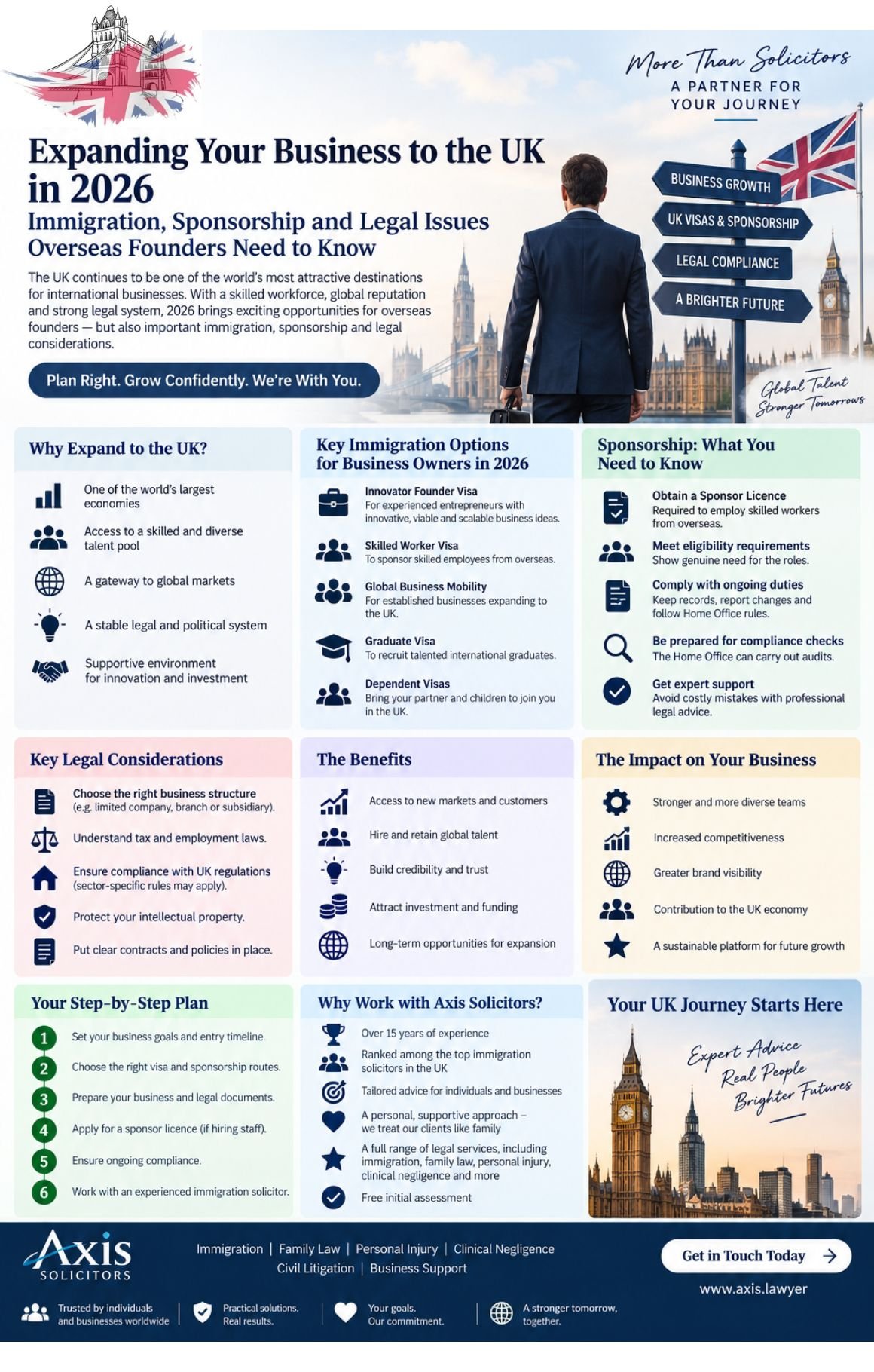
This guide explains the key issues overseas founders should consider before expanding their business into the UK in 2026.
Important: UK immigration rules, salary thresholds, eligible occupations, fees and sponsor guidance can change. This article provides general information and should not replace advice based on an individual founder’s circumstances.
Why overseas businesses are looking at the UK
The UK remains an attractive destination for international businesses because it offers access to established financial, professional, technology, creative, scientific and consumer markets.
London is an obvious destination for many international businesses, but opportunities exist throughout England, Scotland, Wales and Northern Ireland.
For an overseas company, a UK presence can provide access to:
- UK customers and commercial partners;
- Skilled workers;
- Investment and finance networks;
- Professional and financial services;
- Research and innovation ecosystems;
- European and international business connections;
- Established infrastructure and supply chains.
But entering the UK market creates legal responsibilities.
The structure chosen at the beginning can affect taxation, employment, immigration, reporting obligations, ownership, contracts and the founder’s ability to work in the UK.
This is why immigration should not be treated as something to consider after the business has already been established.
For many founders, immigration planning should begin before the UK expansion itself.
1. The first distinction: owning a UK business is not the same as having permission to work in the UK
This is one of the most important points for overseas founders to understand.
A person may be able to become a director of a UK company without living in the UK. GOV.UK confirms that directors of UK private companies do not have to live in the UK, although the company must have a UK registered office.
Similarly, registering a company does not automatically give an overseas founder immigration permission to enter the UK and carry out day-to-day work for that business.
These are separate legal questions:
Corporate question:
Can I establish or own a UK business?
Immigration question:
Do I have permission to enter, live and work in the UK in the role I intend to perform?
Employment question:
If I employ people in the UK, do I have the necessary systems and permissions to do so?
Tax question:
What UK tax and reporting obligations arise from the structure and activities of the business?
A founder who treats these as one issue can create unnecessary problems.
For example, incorporating a UK company may be commercially sensible, but if the founder intends to relocate to the UK and actively manage the company from here, their immigration position needs to be considered separately.
2. Start with the business model, not the visa form
A common mistake is to choose an immigration route first and then try to make the business fit it.
The better approach is the reverse.
Start with the commercial plan.
Ask:
- What does the overseas company actually do?
- Why does it need a UK presence?
- Will the UK operation be a new business or an expansion of an existing company?
- Has the UK business started trading?
- Who will manage the UK operation?
- Which employees need to relocate?
- Will the founder work in the UK business every day?
- Will the business recruit UK workers?
- Will overseas workers need sponsorship?
- Is the founder seeking a route that can potentially lead to settlement?
The answers can significantly affect the immigration strategy.
For example, a founder establishing a genuinely new, innovative and scalable UK business may need to consider the Innovator Founder route.
An established overseas business opening its first UK operation may instead need to consider the UK Expansion Worker route for an eligible senior manager or specialist employee.
A business already operating in the UK may have different options, including the Skilled Worker route for eligible employees or the Senior or Specialist Worker route for certain employees being transferred from a linked overseas business.
The point is simple:
There is no single “business visa” that works for every overseas founder.
3. Innovator Founder: when is it relevant?
The Innovator Founder route is designed for people seeking to establish a business in the UK based on an innovative, viable and scalable business idea.
The Home Office requires the business or business idea to be endorsed by an approved endorsing body. The business must demonstrate innovation, viability and scalability, including structured planning for growth and potential job creation.
This can make the route attractive to founders who are creating a new UK venture rather than simply transferring an existing overseas business into the country.
What does “innovative” mean?
Innovation is not simply having a successful business idea.
The applicant needs to demonstrate that the proposed business is genuinely innovative and has an original business plan capable of meeting a new or existing market need or creating a competitive advantage.
The Home Office rules also require the business to be viable and scalable.
That means a founder should think beyond the pitch.
A strong commercial proposal should explain:
- What the business sells;
- Who its customers are;
- What problem it solves;
- Why the solution is different;
- How the business will make money;
- What resources are available;
- How the business will grow;
- How jobs may be created;
- How the business could expand into national or international markets.
The immigration application and the commercial plan should tell the same story.
It is not simply an investment visa
The Innovator Founder route also requires the founder to have a genuine role in the business.
The rules require the applicant to have generated or significantly contributed to the business idea, have a day-to-day role in carrying out the business plan and be a founder or an instrumental member of the founding team.
This matters because a passive investor should not assume that the Innovator Founder route is automatically suitable simply because they have invested money into a UK company.
What about settlement?
One of the significant advantages of the Innovator Founder route is that it can lead to settlement where the relevant requirements are met.
Current GOV.UK guidance states that an Innovator Founder may be eligible for indefinite leave to remain after three years, subject to the applicable requirements.
For founders who intend to build a long-term life and business in the UK, this makes settlement planning important from the beginning.
4. What if you already have a successful business overseas?
This is where the distinction between a new UK venture and international expansion becomes particularly important.
Imagine a technology company established in India, the United States, Singapore or the Middle East.
The company already has:
- Employees;
- Customers;
- Revenue;
- Intellectual property;
- Management;
- Established contracts;
- Operating history.
The founder now wants to establish a UK presence.
The business may not need to start again from zero.
Instead, it may be looking to create a UK subsidiary, branch or other establishment and move an experienced employee into the UK to establish the operation.
This is where the Global Business Mobility routes can become relevant.
The UK Expansion Worker route is specifically designed for eligible senior managers or specialist employees of overseas businesses that are expanding into the UK and have not yet started trading in the UK.
That distinction is critical.
If the UK business is already trading, the UK Expansion Worker route may not be appropriate, and another route may need to be considered.
5. UK Expansion Worker: a route for overseas businesses entering the UK
The UK Expansion Worker route is part of the Global Business Mobility system.
It is intended for an overseas business that has not yet started trading in the UK and wants an eligible senior manager or specialist employee to come to the UK to establish its UK presence.
The worker must generally:
- Have a valid Certificate of Sponsorship;
- Have worked for the overseas employer;
- Have an eligible occupation;
- Satisfy the applicable salary requirements;
- Meet the relevant overseas employment requirement, subject to specified exceptions.
Current GOV.UK guidance states that, in the standard case, the applicant must have worked for the overseas employer outside the UK for at least 12 months, although exceptions apply, including for certain higher-paid workers.
The route is also temporary and does not itself provide a route to settlement.
That last point matters.
A founder or business executive planning to build a permanent life in the UK should not look only at whether a visa permits them to enter the country today.
They should also ask:
What happens after this visa ends?
That is why long-term immigration planning is essential.
6. What happens when the UK business is already trading?
Once an overseas business has established a genuine UK operation, other immigration routes may become relevant.
For example, the Senior or Specialist Worker route allows an eligible employee of an overseas organisation to undertake an eligible role at its UK branch or linked business.
This can be particularly relevant to international groups moving experienced personnel between overseas and UK operations.
However, the route has specific eligibility requirements.
Current guidance states that applicants must have:
- An eligible job;
- A Certificate of Sponsorship;
- An approved sponsoring employer;
- The required overseas employment history unless an exception applies;
- The applicable salary level.
The route is not simply a general relocation route for every employee of an international business.
The job, corporate relationship, salary and worker’s circumstances all need to be considered.
7. Skilled Worker sponsorship: planning for UK recruitment
As the UK operation grows, the business may need people who cannot be recruited locally.
This is where sponsorship can become part of the business strategy.
A UK employer that wants to sponsor eligible overseas workers may need a Sponsor Licence.
But obtaining the licence should not be treated as the end of the process.
Sponsorship creates continuing responsibilities.
The Home Office’s sponsor guidance, updated in September 2026, explains that licensed sponsors must understand and comply with their sponsor duties.
For an expanding company, this means building appropriate processes before the first sponsored worker arrives.
8. Sponsor Licence compliance is an ongoing responsibility
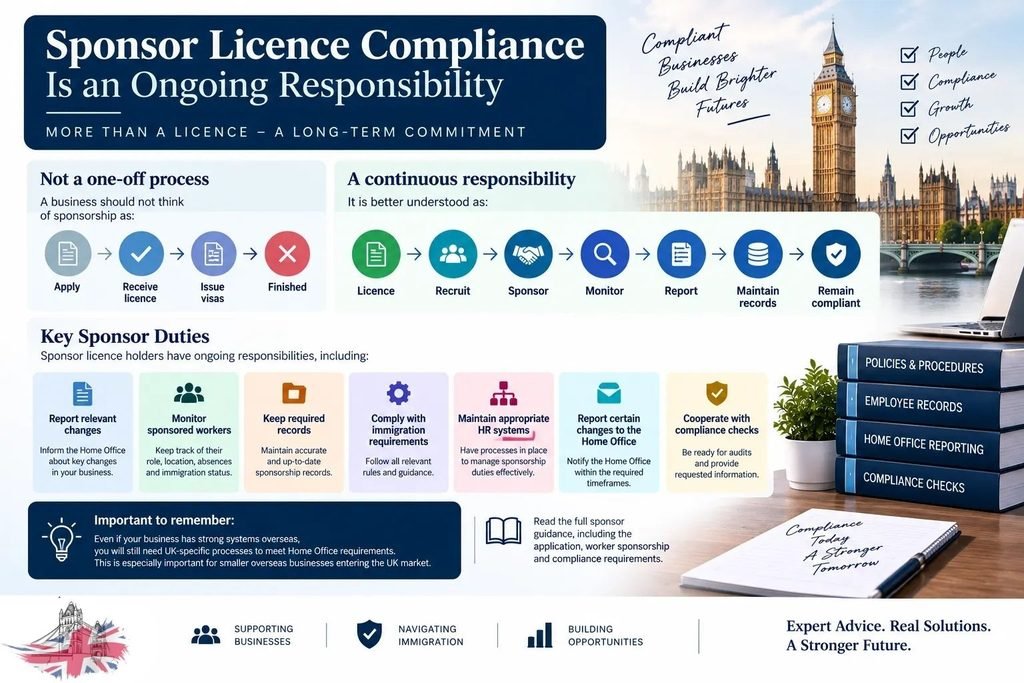
A business should not think of sponsorship as:
Apply → Receive licence → Issue visas → Finished.
It is better understood as:
Licence → Recruit → Sponsor → Monitor → Report → Maintain records → Remain compliant.
Sponsor duties can include responsibilities relating to:
- Reporting relevant changes;
- Monitoring sponsored workers;
- Keeping required records;
- Complying with immigration requirements;
- Maintaining appropriate HR systems;
- Reporting certain changes to the Home Office;
- Cooperating with compliance checks.
The current sponsor guidance makes clear that businesses must read the different parts of the sponsor guidance, including the application, worker sponsorship and compliance requirements.
This is particularly important for smaller overseas businesses entering the UK market.
A company may have excellent commercial systems in its home country but still need to establish UK-specific processes.
9. The importance of HR systems
A sponsor licence is not just an immigration document.
It affects the way the business manages employees.
Before sponsoring workers, an employer should consider whether it has appropriate systems for:
- Maintaining employee records;
- Tracking right-to-work status;
- Recording absences;
- Maintaining contact details;
- Recording job information;
- Monitoring visa expiry dates;
- Reporting relevant changes;
- Keeping sponsorship documentation.
The Home Office also publishes specific guidance on sponsor record-keeping duties.
This is one reason businesses should build their immigration compliance system before they start sponsoring multiple employees.
The larger the workforce becomes, the harder it can be to correct poor systems retrospectively.
10. Recruitment strategy and immigration strategy should work together
Imagine an overseas company plans to establish a UK office with:
- One founder;
- Two senior managers;
- Five technical employees;
- Three sales staff.
The company should not wait until the office opens to decide how these people will be employed.
Instead, it should map the workforce in advance.
For each proposed employee, ask:
Can this person work in the UK without sponsorship?
If not:
Is there an immigration route available?
If sponsorship is required:
Is the proposed job eligible?
Then:
Does the salary meet the applicable requirements?
And finally:
Does the company have the appropriate sponsor licence and compliance systems?
This simple exercise can prevent an expansion plan from being built around employees who may not actually be able to relocate.
11. Corporate structure matters too
Immigration planning cannot be separated completely from corporate structure.
An overseas founder may consider:
- Incorporating a new UK company;
- Establishing a UK subsidiary;
- Registering an overseas company establishment;
- Creating a branch;
- Restructuring an existing international group.
The appropriate structure depends on the commercial circumstances.
Companies House guidance confirms that an overseas company generally needs to register where it establishes a place of business in the UK, while a UK establishment may trigger filing and disclosure obligations.
There is another important distinction.
A UK subsidiary and an overseas company branch are not necessarily treated in the same way for legal, accounting, tax or commercial purposes.
That is why the founder should consider corporate advice alongside immigration advice.
12. Do not overlook tax
Immigration is only one part of moving a business to the UK.
Tax planning can become important where the founder or company has operations in more than one country.
Depending on the structure and circumstances, issues can include:
- Corporation Tax;
- PAYE;
- VAT;
- Employment taxes;
- Dividends;
- Director remuneration;
- Cross-border payments;
- Permanent establishment considerations;
- Double-taxation issues;
- Transfer pricing;
- Tax residence.
HMRC confirms that UK Corporation Tax can apply to UK companies and to certain foreign companies carrying on business through a UK branch or office.
A founder should therefore avoid assuming that the UK company, overseas company and founder will automatically be treated as three completely separate issues for tax purposes.
The immigration structure and tax structure should be reviewed together where appropriate.
13. The founder’s personal position matters
An international expansion can change more than the business.
It can change the founder’s personal circumstances.
A founder relocating to the UK may need to consider:
- Immigration status;
- Family members;
- Accommodation;
- Children’s education;
- Healthcare;
- Personal tax residence;
- Overseas assets;
- Property;
- Remuneration;
- Investments;
- Succession planning.
For example, an immigration route may permit a spouse or children to accompany the main applicant, but the precise rules depend on the route.
The Innovator Founder route allows eligible partners and children to apply as dependants.
The founder therefore needs to think about the family as part of the relocation plan rather than treating family immigration as an afterthought.
14. Settlement should be considered from day one
For some founders, the UK expansion is temporary.
For others, the intention is very different.
They may want to:
- Build a permanent UK headquarters;
- Develop the business over several years;
- Bring their family permanently;
- Employ a larger UK workforce;
- Eventually obtain indefinite leave to remain;
- Later consider British citizenship.
The immigration route selected at the beginning can therefore have long-term consequences.
For example, the Innovator Founder route can lead to settlement where the relevant requirements are satisfied, while the Global Business Mobility routes are generally temporary and do not themselves provide a settlement route.
This does not mean that one route is universally better.
It means the route should be chosen with the founder’s end goal in mind.
A three-year business plan and a ten-year relocation plan are not necessarily the same thing.
15. Build an immigration roadmap before launching the UK operation
A practical approach is to divide the expansion into stages.
Stage 1: Define the commercial objective
Decide why the company is entering the UK.
Is the objective:
- Selling to UK customers?
- Establishing a physical office?
- Hiring employees?
- Raising investment?
- Accessing talent?
- Moving the founder?
- Establishing a European base?
- Developing intellectual property?
- Creating a long-term UK headquarters?
The answer influences everything that follows.
Stage 2: Choose the corporate structure
Consider whether the business needs:
- A UK limited company;
- A subsidiary;
- An overseas company establishment;
- A branch;
- Another structure.
This should be considered with appropriate corporate and tax advice.
Stage 3: Map the people
Create a simple table for everyone expected to work in the UK.
| Person | Current role | Proposed UK role | Location | Immigration route | Sponsorship needed? |
|---|---|---|---|---|---|
| Founder | CEO | UK Director | Overseas | To be assessed | Depends on route |
| Manager | Senior Manager | UK Operations Director | Overseas | GBM/other route | Potentially |
| Developer | Technical Specialist | UK Developer | Overseas | Skilled Worker/other route | Potentially |
| UK hire | New employee | Sales Manager | UK | Existing right to work | No, if eligible |
This exercise can reveal immigration issues before they become recruitment problems.
16. Prepare the business evidence
For an immigration application, the business story needs to be supported by credible evidence.
Depending on the route and circumstances, this could include:
- Business plans;
- Corporate documents;
- Ownership information;
- Financial records;
- Contracts;
- Evidence of trading;
- Evidence of overseas operations;
- Job descriptions;
- Salary information;
- Organisational charts;
- Recruitment plans;
- Business premises;
- Evidence of investment;
- Evidence of market demand.
The evidence should be consistent.
If the business plan says the company will employ ten people but there is no realistic funding or commercial explanation for those hires, questions may arise.
If the company says the founder will establish the UK operation but the proposed role does not match the immigration route, the strategy may need to be reconsidered.
Good immigration planning is therefore partly about telling a coherent and evidenced business story.
17. Common mistakes overseas founders should avoid
Mistake 1: Assuming company incorporation gives immigration permission
It does not.
Company law and immigration law operate separately.
Mistake 2: Choosing a visa before understanding the business
The route should support the genuine business model.
Trying to force a business into an unsuitable route can create problems later.
Mistake 3: Treating sponsorship as a one-off process
Sponsor compliance continues after the licence is granted.
The Home Office maintains detailed guidance on sponsor duties and compliance, and those requirements can change.
Mistake 4: Ignoring salary requirements
Salary requirements can be route-specific and occupation-specific.
For example, the current Senior or Specialist Worker route requires the applicable salary level and going rate, with GOV.UK currently stating a general minimum of £52,500 or the applicable going rate, whichever is higher.
The same figure should not simply be assumed to apply to every immigration route.
Mistake 5: Hiring first and checking immigration status later
This can create avoidable delays.
Immigration eligibility should be considered during workforce planning.
Mistake 6: Forgetting that immigration rules change
UK immigration update and law is not static.
The Home Office updated sponsor guidance in August and September 2026, illustrating why businesses should use current guidance rather than relying on an old checklist or previous application.
Mistake 7: Focusing only on the founder
The founder may be eligible while a proposed employee is not.
Or the founder may have a suitable route but their family members may require separate applications.
The whole relocation should be planned.
Mistake 8: Ignoring the exit strategy
What happens if the business grows faster than expected?
What happens if the founder wants to remain permanently?
What happens if the company needs to recruit 20 international employees?
What happens if the UK business starts trading before a proposed expansion-worker application is made?
Planning for these possibilities makes the original strategy more resilient.
18. What does good planning look like in practice?
Consider a fictional example.
Aisha owns a technology company overseas.
Her company has been trading successfully for four years and wants to establish a UK operation.
She wants to move to London and eventually develop the UK business into the company’s European headquarters.
Her first instinct is to incorporate a UK company and apply for a business visa.
A more careful approach would be:
Step 1: Review the existing overseas company
Understand its ownership, trading history, employees and commercial activity.
Step 2: Define the UK operation
Determine what the UK company or establishment will actually do.
Step 3: Review Aisha’s proposed role
Is she establishing a new innovative business?
Is she transferring as an employee of an overseas business?
Is she becoming a director of a UK company?
Is she going to undertake day-to-day work?
These questions matter.
Step 4: Identify the appropriate immigration route
Only after understanding the genuine business model should the available routes be compared.
Step 5: Plan the workforce
Determine which employees need to relocate and which can be recruited in the UK.
Step 6: Consider sponsorship
If international recruitment will be required, assess whether a sponsor licence is needed and whether the business can meet its ongoing obligations.
Step 7: Review corporate and tax implications
The UK structure should be considered alongside the overseas company.
Step 8: Plan for the future
If Aisha wants to settle permanently, the long-term immigration position should be considered now rather than after several years.
That is the difference between reactive immigration and strategic immigration planning.
19. Why professional legal advice can make the expansion easier
International business expansion involves several moving parts.
The founder may understand their industry extremely well but still be unfamiliar with UK immigration rules, sponsor compliance or the relationship between immigration and corporate structures.
A professional legal review can help identify issues before they become expensive.
For a business founder, the value is not simply completing a form.
It is understanding:
- Which route may fit;
- What evidence is required;
- What the business must do before applying;
- What risks need to be addressed;
- What happens after the visa is granted;
- Whether the proposed structure supports future growth;
- Whether the founder’s family can relocate;
- Whether the route aligns with longer-term settlement plans.
The UK immigration system is detailed, and applications can turn on the specific facts.
That makes tailored advice particularly valuable where a founder has multiple companies, international employees, complex ownership, family members or plans for long-term settlement.
20. A practical checklist for overseas founders
Before committing to a UK expansion, ask:
Business
- Why are we entering the UK?
- What will the UK operation actually do?
- Who are our target customers?
- What investment will be required?
- How many employees will we need?
Corporate
- Do we need a UK company?
- Would a subsidiary or branch be more appropriate?
- Who will own the UK business?
- Who will be its directors?
- What Companies House obligations will arise?
Immigration
- Which founder route is potentially appropriate?
- Does the founder need permission to work in the UK?
- Which employees need immigration permission?
- Which route applies to each employee?
- Does the business need a Sponsor Licence?
Compliance
- Who will manage sponsorship?
- Are HR systems ready?
- Can required records be maintained?
- Can changes and reportable events be monitored?
- Are right-to-work processes in place?
Tax
- Where will the company be tax resident?
- Could the UK activities create UK tax obligations?
- What happens to the overseas company’s tax position?
- Does the founder need personal tax advice?
Family
- Can dependants accompany the founder?
- What applications will they need?
- What are the financial and documentation requirements?
Long term
- Is the founder planning to remain temporarily or permanently?
- Can the chosen route lead to settlement?
- What will happen if the business model changes?
- What happens if the founder changes role?
Looking ahead: why 2026 is the right time to plan, not improvise
For international founders, the UK opportunity can be substantial.
But the days of treating immigration as a simple final step in an international expansion are long gone.
The strongest strategy is to build immigration considerations into the business plan from the beginning.
A founder should know:
where the business is going, who needs to be in the UK, what each person will do, which immigration route may support that role, what evidence will be needed and what obligations will continue after approval.
That approach has practical benefits.
It can reduce avoidable delays.
It can make recruitment more predictable.
It can help the company prepare for sponsor compliance.
It can give founders a clearer understanding of their own immigration position.
And perhaps most importantly, it allows the commercial plan and immigration plan to support each other rather than compete with each other.
The UK immigration landscape will continue to evolve. The Home Office has already updated sponsor guidance several times during 2026, and businesses relying on international talent need to keep their processes under review.
For an overseas founder, the best time to identify an immigration problem is before the UK expansion begins, not after the office has opened, employees have been hired and contracts have been signed.
Final thoughts
Expanding a business into the UK is an exciting step, but it is also a legal project.
There may be company law questions, immigration questions, employment issues, tax considerations and family considerations running alongside the commercial work.
The most effective approach is therefore not to ask only:
“Which UK visa can I get?”
Instead, ask:
“What do I want my UK business to look like in three, five and ten years, and what immigration and legal structure can support that plan?”
For some founders, the answer may involve the Innovator Founder route. For an established overseas business entering the UK for the first time, the Global Business Mobility routes may be more relevant. For growing UK employers, Skilled Worker sponsorship may become an important part of recruitment. For international groups with established UK operations, other business immigration routes may need to be considered.
There is no universal solution.
The right strategy depends on the founder, the business, the proposed role, the workforce and the long-term objective.
That is why expanding your business to the UK in 2026 should be approached as a planned legal and commercial project rather than simply a visa application.
A well-designed plan gives the founder something valuable: clarity.
And when immigration, business structure and workforce planning are aligned from the beginning, the UK expansion has a much stronger foundation on which to grow.
This article is intended for general information only and does not constitute legal advice. Immigration rules and guidance can change, so businesses and individuals should obtain advice based on their specific circumstances before making an application or restructuring their UK operations.