
Getting a job in the UK can be an exciting opportunity, but for many overseas workers, the visa requirements are just as important as the job itself. The Skilled Worker Visa UK route allows eligible workers to come to the UK, or remain here, when they have a qualifying role with an approved sponsor.
A job offer does not automatically mean you qualify. The role, occupation code, salary, sponsor and English language requirement all need to fit the immigration rules. If you are planning an application, the Skilled Worker Visa UK service can help you understand the process and requirements before submitting your application.
What Is the Skilled Worker Visa UK?
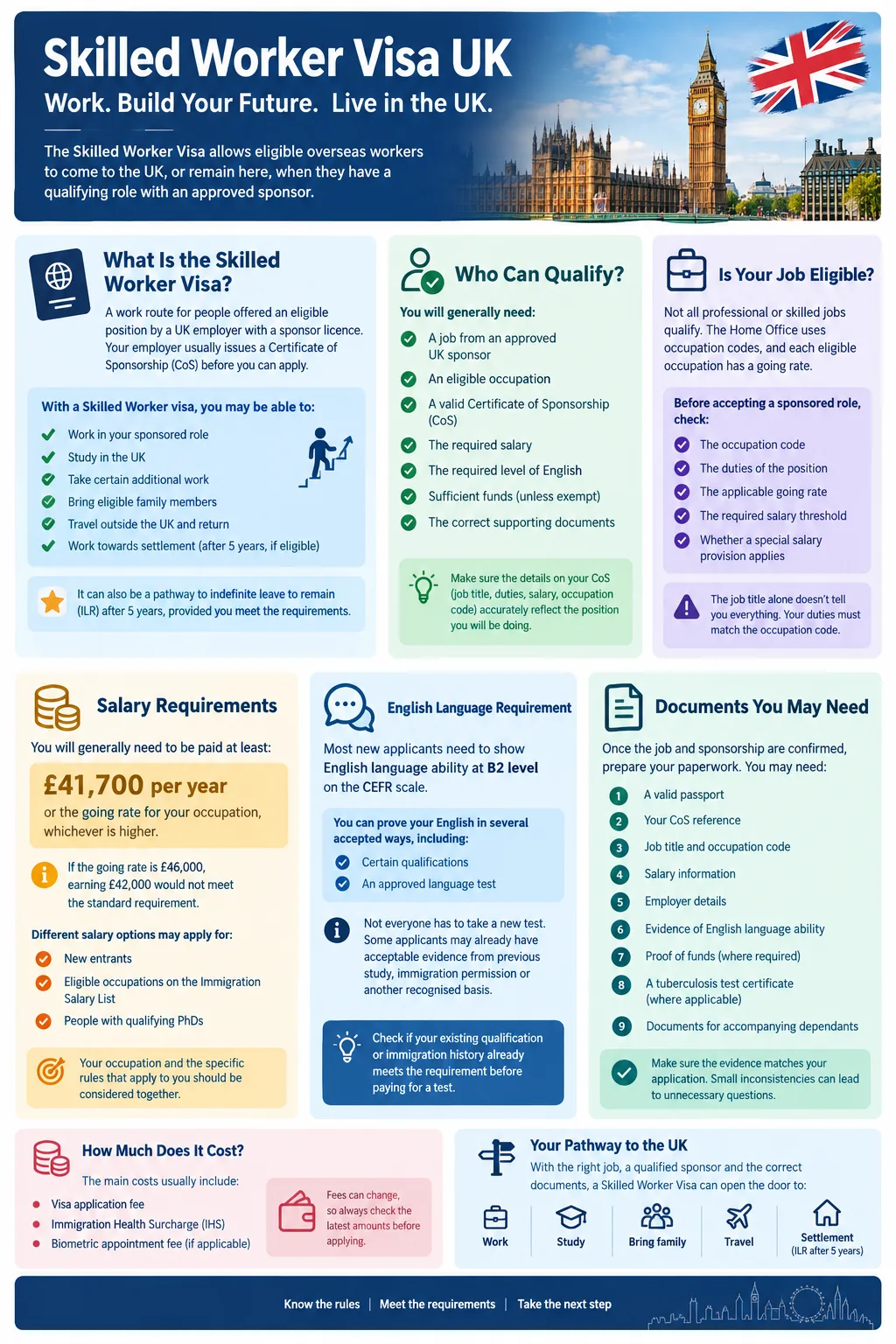
The Skilled Worker visa is a work route for people who have been offered an eligible position by a UK employer with the required sponsor licence. Your employer normally needs to issue a Certificate of Sponsorship (CoS) before you can apply.
The visa can be used by people applying from outside the UK as well as some people who are already in the country and are eligible to switch from another immigration route.
With a Skilled Worker visa, you may generally be able to:
- Work in your sponsored role
- Study in the UK
- Take certain additional work
- Bring eligible family members
- Travel outside the UK and return
- Work towards settlement if you meet the relevant requirements
The route is also a potential pathway to indefinite leave to remain. Under the current rules, eligible Skilled Workers can generally apply for settlement after five years, provided they meet the separate requirements.
Who Can Qualify for a Skilled Worker Visa?
Your eligibility starts with the job you have been offered. Several requirements must be met at the same time.
You will generally need:
- A job from an approved UK sponsor
- An eligible occupation
- A valid Certificate of Sponsorship
- The required salary
- The required level of English
- Sufficient funds, unless you are exempt
- The correct supporting documents
The details on your CoS matter. Your job title, duties, salary and occupation code should accurately reflect the position you will actually be doing.
If you want to look at the application process in more detail, the Skilled Worker Visa: Requirements, Application and Fees Guide covers the main points applicants should check.
Is Your Job Eligible?
One of the easiest mistakes to make is assuming that any professional or skilled job can qualify.
The Home Office assesses jobs according to occupation codes. Each eligible occupation has its own going rate, and the role must meet the relevant conditions under the Immigration Rules.
Some medium-skilled occupations can qualify in particular situations, including certain jobs listed under the Immigration Salary List or Temporary Shortage List.
The job title alone does not tell you everything. The actual duties should match the occupation code used for sponsorship. A mismatch can create difficulties even when the employer is a licensed sponsor.
Before accepting a sponsored position, check:
- The occupation code
- The duties of the position
- The applicable going rate
- The required salary threshold
- Whether a special salary provision applies
Skilled Worker Visa UK Salary Requirements
Salary is another major part of the application.
Under the standard rules, you will generally need to be paid at least £41,700 a year or the going rate for your occupation, whichever is higher.
For instance, if the going rate for your occupation is £46,000, earning £42,000 would normally not satisfy the standard salary requirement.
That figure is not necessarily the minimum for every applicant. The rules include different salary options for certain applicants, including some new entrants, eligible occupations on the Immigration Salary List and people with qualifying PhDs.
So, checking only the headline salary threshold can give you the wrong answer. Your occupation and the particular salary rules that apply to you should be considered together.
English Language Requirement
English language ability is another requirement for most new Skilled Worker applicants.
For a new application, the general requirement is currently B2 level on the CEFR scale. You may prove your English in several accepted ways, including certain qualifications or an approved language test.
Not everyone has to take a new test. Some applicants may already have acceptable evidence from previous study, immigration permission or another recognised basis.
Before paying for an English test, check whether your existing qualification or immigration history already provides an accepted way of meeting the requirement.
Documents You May Need
Once the job and sponsorship are confirmed, the next step is getting the paperwork together.
Depending on your circumstances, you may need:
- A valid passport
- Your Certificate of Sponsorship reference
- Job title and occupation code
- Salary information
- Employer details
- Evidence of English language ability
- Proof of funds, where required
- A tuberculosis test certificate, where applicable
- Documents for accompanying dependants
The evidence should match the information entered on your application. Small inconsistencies, such as different spellings of names, dates or employment details, can lead to unnecessary questions.
It is usually better to prepare the documents carefully and provide the evidence actually required rather than submitting a large amount of unrelated paperwork.
How Much Does a Skilled Worker Visa Cost?
The amount you pay depends on where you apply, the length of your visa and whether your job qualifies for a reduced application fee.
For applications made outside the UK, the standard fee is currently £819 for up to three years and £1,618 for more than three years. Different fees apply to some applications made from inside the UK, while eligible jobs on the Immigration Salary List may have a lower fee.
There is also the Immigration Health Surcharge, which is usually £1,035 for each year of the visa.
Most applicants must also show £1,270 in available funds, unless they qualify for an exemption.
For this reason, looking at the visa application fee alone can give you an unrealistic idea of the total cost.
What Can You Do After Getting the Visa?
Once your Skilled Worker visa has been granted, you can work in the sponsored role and may have other permitted activities.
These can include:
- Working in your sponsored job
- Studying
- Taking certain additional employment
- Volunteering
- Travelling overseas and returning to the UK
- Having eligible dependants join you
There are limits, however. You cannot simply move to a completely different employer or occupation without checking whether your immigration permission needs to be updated.
For example, someone changing employer will normally need to apply to update their visa before starting the new sponsored job.
Common Mistakes to Avoid
A sponsor licence and a job offer do not guarantee that the visa application will be approved.
Some problems seen in Skilled Worker applications include:
- Choosing an incorrect occupation code
- Using an outdated salary figure
- Failing to meet the occupation’s going rate
- Giving inconsistent information
- Not providing acceptable English evidence
- Missing required financial evidence
- Assuming every sponsored job qualifies
- Leaving the application until the last minute
Immigration rules can also change. Checking information from an old article or previous application may therefore lead to mistakes.
The UK Immigration Rules should be checked for the requirements in force when you apply.
When Is Professional Advice Useful?
Not every Skilled Worker application is complicated. Some applicants have a straightforward job, clear sponsorship and no previous immigration issues.
Professional advice can become more useful when something about the case is less certain. This might include questions about the occupation code, salary, previous visa refusals, switching routes or future settlement plans.
Getting the position reviewed before submitting the application can also be useful when you are unsure whether the documents properly support the information provided.
Summary
The Skilled Worker Visa UK route can give eligible overseas workers the opportunity to live and work in the UK. But approval depends on several parts of the application fitting together, including the sponsored job, occupation code, salary, English requirement and supporting evidence.
Do not rely on an old salary figure or assume that a job is eligible simply because the employer is licensed. Checking the current rules and your specific circumstances before applying can prevent avoidable problems.
For applicants who need guidance with their immigration options, Axis Legal Services can provide advice on the requirements relevant to their case.
FAQs
Can I get a Skilled Worker visa without a job offer?
Generally, no. You normally need an eligible job offer from a UK employer that is authorised to sponsor workers and can issue a valid Certificate of Sponsorship.
What is the salary requirement for the Skilled Worker Visa UK?
The standard requirement is generally £41,700 per year or the applicable going rate for the occupation, whichever is higher. Lower salary options can apply in certain circumstances.
Can I bring my family on a Skilled Worker visa?
Eligible partners and children can generally apply as dependants, although the rules contain specific eligibility requirements and some restrictions.
Can the Skilled Worker visa lead to permanent residence?
Yes. Skilled Worker is a settlement route. Eligible applicants can generally apply for indefinite leave to remain after five years if they meet all the applicable settlement requirements.