
You move to London. Your LLC stays registered in Delaware, or Wyoming, or wherever you formed it. Its bank account, EIN, and contracts don’t vanish because you relocated, but the move can raise new UK tax and compliance questions.
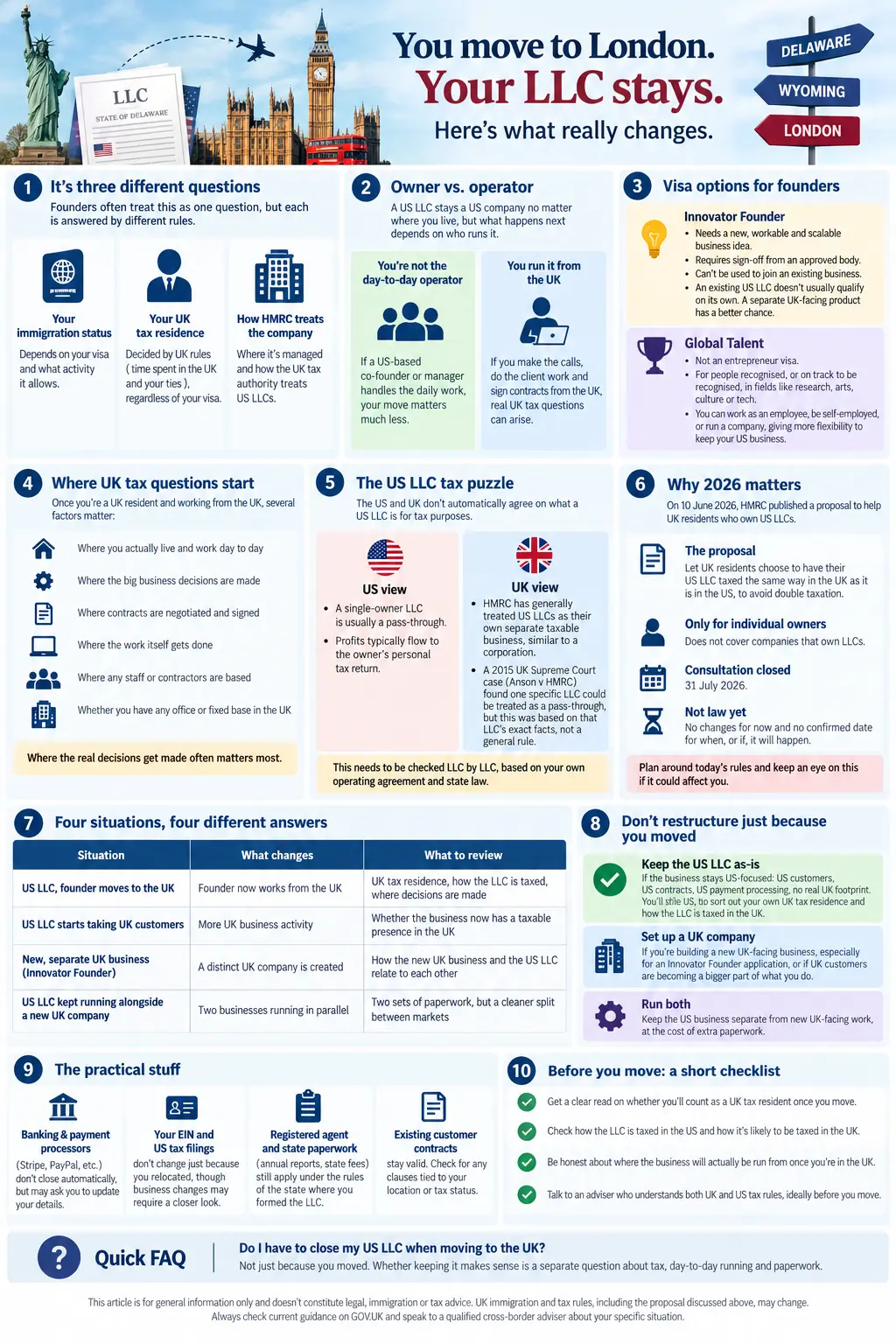
Most founders treat this as one question: can I keep the LLC? It’s actually three questions, and each one is answered by a different set of rules. Your immigration status. Your UK tax residence. How HMRC treats the company itself. Mix those up and you either overreact, winding down an LLC that was fine to keep, or underreact, assuming nothing needs to change just because the paperwork still says Delaware. The real question isn’t about the LLC. It’s about where you’re actually working from once you land.
Owner vs. operator: the distinction that matters
A US LLC stays a US company no matter where you live. But that alone doesn’t answer what happens once the person running it is based in the UK instead of the US.
That splits founders into two groups. If a US-based co-founder or manager handles the
day-to-day work, your move matters much less, since the business is still likely run from where it always has been. But if you’re the one making the calls, doing the client work, and signing the contracts, your move raises real UK tax questions, specifically about where the decisions and the work actually happen now, not where the company was originally set up.
Three questions people mix together
- What’s your immigration status? This depends on your visa and what activity it allows.
- Where are you a tax resident? A separate UK question, decided by a set of UK rules that look at how many days you spend in the UK and your ties there, regardless of your visa.
- Where is your company treated as based, and how is it taxed? This is about the LLC itself, including where it’s actually managed and how the UK tax authority treats US LLCs in general.
Your visa doesn’t decide your tax residence. Your tax residence doesn’t automatically decide how your LLC is taxed. And being registered in the US doesn’t settle where the business is taxed either.
Innovator Founder vs. Global Talent
Innovator Founder requires a business idea that’s new, workable, and able to grow, and it needs sign-off from an approved body before you apply. You also can’t use this visa to join a business that’s already up and running. An existing US LLC doesn’t, on its own, meet this bar. A Delaware LLC founder pitching a UK version of the same product would likely struggle to show it’s a genuinely new idea rather than a continuation of the existing business. A separate
UK-facing product built around a different problem has a better chance.
Global Talent isn’t an entrepreneur visa. It’s for people recognised, or on track to be recognised, as leaders in fields like research, arts and culture, or tech. The sign-off is about your track record, not a business plan. You can work as an employee, be self-employed, or run a company under this visa, without being tied to one role, which gives more room to keep running a US business alongside UK work.
Where the UK tax questions start
Once you’re a UK resident and working from the UK, several things start to matter: where you actually live and work day to day, where the big business decisions are made, where contracts are negotiated and signed, where the work itself gets done, where any staff or contractors are based, and whether you have any office or fixed base in the UK.
Where the real decisions about the business get made, not where it was originally set up, is often what matters most. A founder who negotiates contracts and makes daily decisions from London is in a very different position from one who leaves a US-based co-founder running the business day to day. Same LLC, same home state, different answer.
The US LLC tax puzzle
The US and UK don’t automatically agree on what a US LLC even is for tax purposes. UK tax authorities have generally treated US LLCs as their own separate taxable business, similar to a corporation. That can be different from how the US treats a one-owner LLC, where profits usually flow straight through to the owner’s personal tax return.
That’s not the full picture, though. In a 2015 UK Supreme Court case, Anson v HMRC, the court found that one specific LLC should be treated more like a pass-through for UK tax purposes too, based on the exact wording of that LLC’s operating agreement and the law of the US state it was formed in. UK tax authorities maintain that this ruling turned on the facts of that one case, not a general rule for all LLCs. So this needs to be checked LLC by LLC, based on your own paperwork.
Why 2026 matters: a new UK proposal
On 10 June 2026, the UK tax authority (HMRC) published a proposal covering UK residents who own US LLCs and similar setups where the business is taxed as pass-through in the US but as its own separate taxpayer in the UK. That mismatch can mean tax gets charged twice: once on the profits in the US, and again when the money is paid out in the UK.
The idea being proposed: let UK residents choose to have their US LLC taxed the same way in the UK as it already is in the US, so the tax only applies once. This would only cover individual owners, not companies that own LLCs. The consultation closed on 31 July 2026. Nothing has changed in the law yet, and there’s no confirmed date for if or when it will. Plan around today’s rules, and keep an eye on this if it could affect you.
Four situations, four different answers
| Situation | What changes | What to review |
| US LLC, founder moves to the UK | Founder now works from the UK | UK tax residence, how the LLC is taxed, where decisions are made |
| US LLC starts taking UK customers | More UK business activity | Whether the business now has a taxable presence in the UK |
| New, separate UK business (Innovator Founder) | A distinct UK company is created | How the new UK business and the US LLC relate to each other |
| US LLC kept running alongside a new UK company | Two businesses running in parallel | Two sets of paperwork, but a cleaner split between markets |
None of these is automatically the right answer. It depends on who’s actually running the business.
Don’t restructure just because you moved
- Keep the US LLC as-is if the business stays US-focused: US customers, US contracts, US payment processing, no real UK footprint. You’ll still need to sort out your own UK tax residence and how the LLC is taxed in the UK.
- Set up a UK company if you’re building a new UK-facing business, especially for an Innovator Founder application, or if UK customers are becoming a bigger part of what you do.
- Run both if you want to keep the US business separate from new UK-facing work, at the cost of extra paperwork.
Talk to a cross-border tax adviser before you commit to any of these. If you’re weighing a US company against a UK one more broadly, see this comparison of US LLC vs UK Ltd.
The practical stuff
- Banking and payment processors (Stripe, PayPal, etc.) don’t close automatically, but may ask you to update your details if your address or residency changes.
- Your EIN and US tax filings don’t change just because you relocated, though changes to the business itself can require a closer look.
- Registered agent and state paperwork (annual reports, state fees) still apply under the rules of the state where you formed the LLC, no matter where you live.
- Existing customer contracts stay valid. Check for any clauses tied to your location or tax status.
Before you move: a short checklist
- Get a clear read on whether you’ll count as a UK tax resident once you move.
- Check how the LLC is taxed in the US and how it’s likely to be taxed in the UK.
- Be honest about where the business will actually be run from once you’re in the UK.
- Talk to an adviser who understands both UK and US tax rules, ideally before you move.
FAQ
Do I have to close my US LLC when moving to the UK?
Not just because you moved. Whether keeping it makes sense is a separate question about tax, day-to-day running, and paperwork.
This article is for general information only and doesn’t constitute legal, immigration, or tax advice. UK immigration and tax rules, including the proposal discussed above, may change. Always check current guidance on GOV.UK and speak to a qualified cross-border adviser about your specific situation.