
The UK and US are deepening their partnership on fusion energy, combining artificial intelligence, advanced computing, research, regulation and industrial expertise to move fusion closer to commercial reality. Here is what the new partnership means, why it matters and how the UK’s wider fusion strategy could shape the country’s energy system, economy and jobs over the next two decades.
The race to develop practical fusion energy is entering a new phase.
For decades, fusion has been discussed as one of the most promising possibilities in clean energy. The science is extraordinarily difficult, and building a machine capable of producing fusion reactions is only part of the challenge. The bigger question is whether those reactions can eventually be turned into reliable, commercially useful power at a scale that makes economic sense.
The UK now wants to move decisively from research towards that next stage.
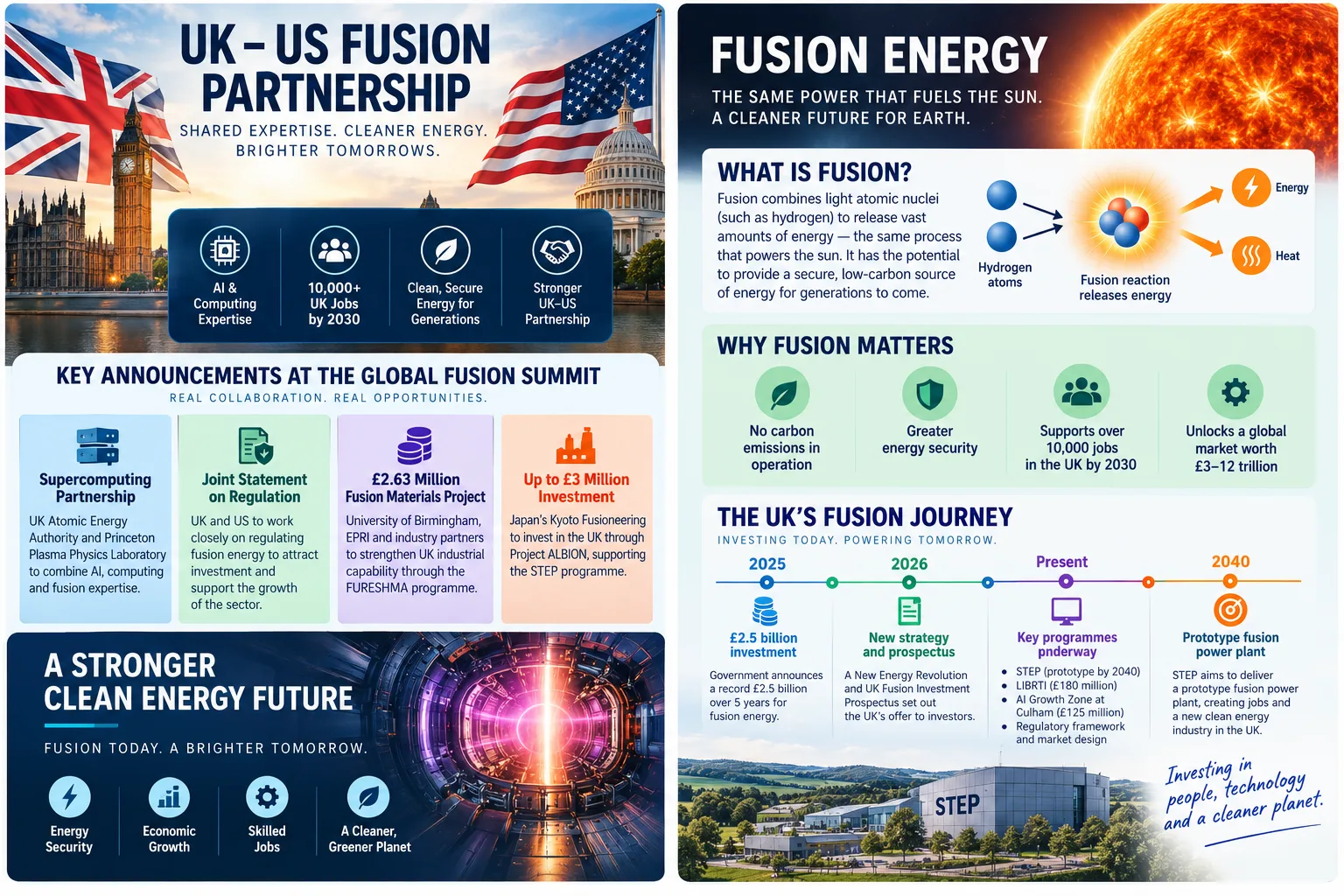
At the Global Fusion Summit in London on 14 September 2026, the UK and US are set to strengthen their cooperation through new agreements covering advanced computing, artificial intelligence and fusion regulation. A new supercomputing partnership between the UK Atomic Energy Authority (UKAEA) and the Princeton Plasma Physics Laboratory (PPPL) will bring together expertise in fusion science, AI and high-performance computing.
At the same time, the two countries are expected to issue a Joint Statement on closer cooperation in regulating fusion energy.
The message is clear: the next stage of the fusion race will not be won by physics alone.
It will require computing power, advanced materials, skilled workers, investment, industrial supply chains, sensible regulation and international cooperation.
And Britain wants to be one of the countries building that future.
What is the UK-US fusion partnership about?
The new UK-US partnership is designed to accelerate the development of commercial fusion energy by combining capabilities that each country has built over many years.
One part focuses on supercomputing and artificial intelligence.
The UKAEA and Princeton Plasma Physics Laboratory will work together to combine fusion expertise with advanced computing and AI. That matters because modern fusion research generates enormous amounts of complex scientific data. Researchers need increasingly sophisticated simulations to understand plasma behaviour, test designs and identify ways to operate fusion devices more efficiently.
Powerful computers can help researchers explore problems that would otherwise require years of physical experimentation.
AI could add another layer.
Instead of simply analysing what happened during an experiment, advanced AI systems can help identify patterns in data, optimise simulations and potentially improve the control of fusion systems. The goal is not to replace scientists. It is to give them better tools to solve problems faster.
The second part of the partnership focuses on regulation.
This is equally important.
A company can have a promising fusion design and sufficient funding, but it still needs to know how that facility will be regulated, how planning decisions will be made and what standards it will need to meet before investors commit large sums of money.
The UK has already developed a dedicated regulatory approach for fusion and is working on a specific planning framework for future fusion facilities. The government believes closer cooperation with the US can make it easier for companies and investors to understand the regulatory environment and support the growth of the sector.
The partnership therefore tackles two very different barriers at the same time:
Can we develop the technology quickly enough?
And:
Can we create the conditions needed to build it commercially?
Why is fusion energy so important?
Fusion is fundamentally different from the combustion processes used in conventional fossil-fuel power stations.
The basic idea is to reproduce, in controlled conditions, the process that powers the Sun.
Fusion occurs when light atomic nuclei combine and release energy. In many proposed fusion systems, hydrogen isotopes are used as fuel. Deuterium can be obtained from seawater, while tritium is scarce naturally but can potentially be produced within a future fusion power plant using lithium.
The attraction is obvious.
A successful fusion power plant could provide large amounts of low-carbon energy without producing carbon dioxide from the fusion reaction itself.
That could become particularly valuable as electricity demand increases.
The UK’s draft National Policy Statement for fusion says electricity demand could potentially more than double by 2050, even with major improvements in energy efficiency. The government therefore sees the development of new low-carbon generation as important not only for reaching net zero but also for maintaining energy security.
Fusion is not being presented as a replacement for every other energy source.
Instead, it is being developed as part of a much broader future energy system.
If successful, fusion could provide another source of large-scale, low-carbon power alongside renewables, nuclear fission, storage and other technologies.
Why is the UK moving so aggressively now?
The UK has been involved in fusion research for decades.
But the global fusion landscape is changing.
Governments are investing more heavily. Private companies are entering the sector. New technologies are being developed outside traditional government research programmes. And some companies are targeting commercial fusion facilities much earlier than previously expected.
That creates an opportunity but also a risk.
If the UK remains focused only on research while other countries develop manufacturing capability, supply chains and commercial projects, British scientists could contribute to the science without capturing the economic benefits.
The government’s UK Fusion Strategy 2026 is designed to prevent that.
The strategy describes fusion as a frontier industry and aims to build an ecosystem around research, investment, supply chains, skills and first-of-a-kind deployment. The government says the UK has a combination of research capability, infrastructure, public investment and policy support that can help it compete in the emerging global fusion market.
This is an important shift.
The objective is no longer simply:
“Can Britain conduct world-class fusion research?”
It is increasingly:
“Can Britain turn its fusion research into companies, factories, jobs, exports and power plants?”
More than £2.5 billion is behind the UK’s fusion programme
The scale of the government’s commitment is significant.
The UK has announced more than £2.5 billion of fusion investment over five years, covering financial years 2025–26 to 2029–30.
The funding is spread across several areas.
£1.3 billion for STEP
The largest allocation is £1.3 billion through UK Fusion Energy for the next phase of the UK’s STEP programme.
STEP stands for Spherical Tokamak for Energy Production.
The project is planned as a prototype fusion power plant at West Burton in Nottinghamshire. The ambition is not simply to conduct another scientific experiment. STEP is intended to demonstrate technologies needed for a future commercial fusion plant and help build the industrial capability required to deliver such facilities.
UK Fusion Energy says STEP is intended to demonstrate net power generation, tritium breeding and a pathway towards commercial deployment.
The project is therefore central to Britain’s broader fusion plan.
£740 million for research infrastructure
The government has also allocated £740 million for advanced research and development infrastructure and facilities, covering both magnetic and inertial confinement fusion.
This matters because fusion is not a single technology.
Different approaches are being investigated around the world, and the UK wants to maintain capabilities across the wider field while moving towards commercially relevant systems.
£180 million for fusion fuel technology
Another £180 million is being invested in the Lithium Breeding Tritium Innovation (LIBRTI) programme.
Tritium is one of the major technical challenges facing future fusion plants.
A commercial fusion power plant cannot simply depend indefinitely on naturally available tritium. Future systems will need to develop ways of producing their own fuel.
LIBRTI is intended to help address this challenge and develop technologies associated with lithium-based tritium breeding.
£125 million for AI and computing at Culham
The UK is also investing £125 million in the AI Growth Zone at Culham, including £45 million for the SUNRISE supercomputer.
That investment fits directly into the new UK-US partnership.
The future of fusion will depend heavily on computing.
Fusion involves complex plasma physics, materials science, engineering, control systems and enormous quantities of experimental data. Advanced computing can help researchers model these systems before expensive physical experiments are conducted.
The UKAEA’s strategy identifies the Culham AI Growth Zone and SUNRISE as major milestones in the country’s fusion technology programme.
The AI-fusion connection could become one of the biggest changes
Artificial intelligence is often discussed separately from energy.
Fusion shows why the two fields may increasingly become connected.
A fusion reactor is an extraordinarily complicated system. Researchers need to understand plasma turbulence, heat management, materials behaviour, magnetic fields, fuel cycles and machine performance.
Some of these problems require calculations at a scale that traditional computing approaches struggle to handle efficiently.
That is where high-performance computing becomes important.
The new UK-US partnership brings this capability together with direct fusion expertise.
The potential benefits include:
- faster scientific simulations;
- better understanding of plasma behaviour;
- improved reactor modelling;
- more efficient use of experimental data;
- optimisation of fusion machine designs;
- improved prediction of difficult operating conditions;
- faster testing of engineering concepts; and
- better tools for controlling future fusion systems.
The important point is that AI is not the fusion reactor itself.
It is an accelerator.
If researchers can use AI and advanced computing to reduce the time required to test and understand a particular engineering or physics problem, the entire development cycle could become faster.
That is precisely why the UK is investing in both fusion and AI infrastructure at the same time.
Regulation could be just as important as technology
One of the less glamorous parts of the fusion story may turn out to be one of the most important.
Regulation.
A commercial fusion industry needs predictable rules.
Investors need to understand what approvals will be required. Developers need to know how facilities will be assessed. Communities need confidence that safety and environmental impacts will be properly considered.
The UK has already taken steps to establish a dedicated regulatory framework for fusion.
The government has also been developing a specific Fusion National Policy Statement, known as EN-8, for major fusion infrastructure.
The draft policy is designed to give developers and investors greater clarity around planning decisions for future fusion facilities. It is intended to work alongside the wider energy planning framework.
The proposed framework is deliberately designed to be flexible.
The government has said the fusion planning framework should be technology-agnostic, meaning it should not lock the UK into one particular fusion design. It is also intended to recognise that future fusion facilities could have different energy outputs and technological configurations.
That flexibility is important.
Fusion technology is evolving rapidly.
A planning system written around one particular reactor design could become outdated before the industry reaches commercial scale.
What does the UK-US regulatory cooperation mean?
The UK and US are major players in fusion research.
Both countries have substantial scientific institutions, universities, national laboratories and private-sector activity.
Closer regulatory cooperation could therefore make it easier for the two countries to share experience and develop compatible approaches as the technology moves towards deployment.
The objective is not necessarily to create identical rules.
Instead, cooperation can reduce unnecessary differences and make it easier for companies operating across both markets to understand regulatory expectations.
That could help investment.
It could also help British companies looking to export fusion technology, components or services to the US and other markets.
In an emerging industry, the countries that help establish practical standards and regulatory approaches can gain an advantage because their companies become familiar with those systems early.
The UK is building an entire fusion ecosystem
The government’s plan is bigger than a single power plant.
The UK wants to build an ecosystem around fusion.
That includes:
Research
Universities and laboratories will continue working on plasma physics, materials, fuel cycles and reactor technologies.
Computing
AI and supercomputing infrastructure will support increasingly sophisticated modelling and simulation.
Engineering
Fusion machines require advanced engineering across magnets, robotics, power systems, cooling, materials and manufacturing.
Supply chains
British companies could manufacture components for domestic fusion projects and eventually export them internationally.
Skills
The industry will need engineers, physicists, technicians, software specialists, welders, materials scientists, project managers and many other professionals.
Regulation
Planning, safety and environmental frameworks need to develop alongside the technology.
Finance
Private capital will be needed as projects move from government-supported research towards commercial deployment.
This is why the UK Fusion Strategy places such emphasis on industrial growth rather than research alone.
Thousands of jobs could be created
The UK government expects fusion to support more than 10,000 jobs in the UK by 2030.
These will not all be scientists working in laboratories.
A large fusion industry would need people across the entire supply chain.
That could include:
- mechanical engineers;
- electrical engineers;
- software developers;
- AI specialists;
- data scientists;
- materials scientists;
- welders and fabricators;
- construction workers;
- robotics specialists;
- project managers;
- technicians;
- safety professionals;
- environmental specialists;
- manufacturing workers; and
- researchers and academics.
The geographical impact could also extend beyond Culham.
The STEP project in Nottinghamshire is expected to create an industrial cluster around the future plant, while other parts of the UK could benefit from supply-chain investment and specialist manufacturing.
The government has also allocated £50 million for fusion skills training, with an ambition to support more than 2,000 people in fusion-related disciplines.
That is particularly important because a technology industry cannot scale if it cannot find people with the right skills.
New opportunities for British businesses
Fusion could create an unusual economic opportunity for the UK.
The country does not need to manufacture every part of a future fusion plant to benefit from the industry.
Companies can specialise.
One business might produce advanced materials.
Another could develop robotic systems.
Another could manufacture precision components.
Another could provide specialist software.
Another could provide engineering services.
Another could work on tritium systems.
This creates opportunities for smaller companies as well as major engineering groups.
Fusion research can also generate technologies with applications beyond fusion itself.
UKAEA’s strategy highlights benefits spreading into areas including robotics, materials, medicine and artificial intelligence.
That means the economic value of fusion may appear before commercial fusion electricity does.
The global market could be enormous
The UK government and UKAEA estimate that the future global fusion opportunity could involve between £3 trillion and £12 trillion of capital investment between 2050 and 2100.
That is a long-term estimate, not a guaranteed market size.
But it demonstrates why governments are taking the sector seriously.
If fusion becomes commercially viable, countries will need power plants, components, fuel systems, robotics, materials, engineering services, digital systems and maintenance capabilities.
The companies that establish expertise now could potentially become suppliers to that global market later.
For Britain, the strategy is therefore partly about energy.
But it is also industrial policy.
The question is whether British businesses can capture enough of the future supply chain instead of importing most of the technology.
New international partnerships strengthen the strategy
The UK is not working with the US alone.
The government’s wider fusion programme includes international partnerships designed to strengthen research, industrial capability and supply chains.
A new £2.63 million collaboration involving the University of Birmingham, the Electric Power Research Institute and industry partners is focused on fusion materials through the FURESHMA programme.
Materials are a major challenge.
A future fusion reactor will expose components to extreme temperatures, radiation and particle loads. Developing materials that can survive those conditions is essential to making commercial fusion practical.
Japan is also becoming part of the UK’s industrial story.
Kyoto Fusioneering, Japan’s largest fusion company, is set to invest up to £3 million in the UK through Project ALBION to support development and testing of materials linked to the STEP programme.
These partnerships demonstrate an important point.
Fusion is too technically complex for one institution, or even one country, to solve every problem alone.
International cooperation can bring together specialised knowledge, equipment, investment and industrial experience.
STEP: the centrepiece of the UK’s long-term plan
If the UK fusion strategy has a physical centrepiece, it is STEP.
The Spherical Tokamak for Energy Production is intended to become a prototype fusion power plant at West Burton.
The target is to deliver the prototype by 2040.
That may sound far away.
But building a new type of power plant is a multi-decade process.
The work involves site development, engineering design, technology demonstration, manufacturing, construction, testing and eventually operation.
STEP is intended to do something particularly important: bridge the gap between experimental fusion research and an integrated power plant.
It is designed to demonstrate not just that fusion can happen, but that the systems surrounding the fusion reaction can work together in a power-producing environment.
That includes the ability to generate net electricity, manage fuel and integrate the plant into the wider energy system.
What happens between now and 2040?
The path is not simply:
Research → reactor → electricity.
There are several stages.
1. Improve the science
Researchers need a deeper understanding of plasma behaviour and fusion reactions.
2. Develop the technology
Engineers must solve problems involving magnets, materials, fuel systems, heat exhaust, robotics and power conversion.
3. Test components
Individual systems need to be tested under conditions that resemble those of a future fusion plant.
4. Develop the supply chain
Companies must learn how to manufacture specialised components at the required quality and scale.
5. Train workers
The workforce needs to grow before large-scale construction begins.
6. Establish planning and regulation
Developers need a clear route through planning, environmental and safety requirements.
7. Build STEP
The prototype plant will bring many of these capabilities together.
8. Learn from the prototype
The purpose of a prototype is not simply to operate. It is to demonstrate what works, identify what does not and provide information for future commercial facilities.
That learning could ultimately be more valuable than any single piece of equipment.
Why regulation is being developed now
It might seem premature to establish planning rules when commercial fusion plants are still under development.
It is not.
Commercial developers are already looking towards facilities that could be built during the 2030s.
Planning a large energy facility takes years.
Land must be assessed. Grid connections must be considered. Environmental impacts must be studied. Communities need to be engaged. Infrastructure must be designed.
The UK government’s 2025 response on fusion planning recognised that companies were beginning to consider potential sites and that a clearer planning framework would become increasingly important as the industry moved towards deployment.
The draft EN-8 framework is therefore part of preparing for a future in which fusion projects are no longer laboratory experiments.
They become infrastructure.
What are the potential environmental benefits?
The biggest environmental attraction of fusion is its potential to generate large quantities of low-carbon energy.
Unlike fossil-fuel power generation, the fusion reaction itself does not release carbon dioxide through combustion.
Fusion fuels also offer a potentially strong long-term resource base. Deuterium is abundant and can be extracted from seawater, while future reactors are expected to explore breeding tritium from lithium.
However, it is important not to describe fusion as a technology without environmental challenges.
Fusion plants will still require land, construction materials, cooling systems, electricity infrastructure and industrial supply chains.
Some fusion systems will also involve radioactive materials, particularly tritium and activated components.
That is why regulation and environmental assessment remain important.
The UK government’s proposed framework specifically considers issues such as biodiversity, water, land, flooding, seismic activity, cooling, grid connections and socioeconomic impacts.
Fusion’s environmental promise therefore depends on responsible engineering and regulation as well as the underlying physics.
Energy security is another major reason for the investment
Energy security has become a much bigger policy issue in recent years.
Countries want reliable access to energy without excessive exposure to international fuel markets or geopolitical disruption.
Fusion could eventually offer another domestic source of large-scale electricity.
It would not eliminate the need for international supply chains, because fusion plants themselves require sophisticated materials and components.
But a mature fusion industry could diversify the UK’s energy system.
That is particularly attractive as electricity demand rises from transport, heating, industry, computing and other technologies.
The UK’s draft fusion planning policy identifies fusion as potentially transformative for clean and abundant energy while also supporting long-term energy security.
What does the partnership mean for ordinary people?
For most people, fusion is not going to change their lives tomorrow.
There will not suddenly be fusion electricity flowing into British homes because of the new agreement.
The immediate impact is more likely to appear through research, jobs, investment and industrial development.
Over time, however, successful fusion could influence the electricity system itself.
A commercially viable fusion plant could provide large amounts of low-carbon electricity.
That could support industries that need dependable power.
It could also complement renewable generation, which varies with weather conditions.
The economic effects could be just as important.
New companies could emerge. Existing manufacturers could enter the supply chain. Universities could expand research programmes. Apprenticeships and specialist training could grow.
Regions hosting fusion infrastructure could attract new investment and supporting businesses.
In other words, the first phase of the fusion revolution may be industrial rather than electrical.
Why the UK-US relationship matters
The UK and US already have deep scientific and energy links.
The new fusion partnership takes that relationship into a field where both countries have significant expertise.
The US brings major national laboratory capabilities, private-sector fusion investment and extensive experience in advanced computing.
The UK brings its own strong fusion research base, UKAEA expertise, the Culham ecosystem, STEP and an increasingly developed policy and regulatory framework.
Combining these strengths could create something neither country could achieve as efficiently alone.
The UK’s earlier nuclear cooperation with the US has also already identified fusion as an area where AI, advanced simulation and experimental programmes can support the development of commercial fusion technology.
The new agreements build on that direction.
What could go wrong?
It is also important to be realistic.
Fusion is not guaranteed to become commercially successful.
Major scientific and engineering challenges remain.
Among the biggest questions are:
- Can fusion reactions be maintained efficiently?
- Can materials survive long-term exposure to fusion conditions?
- Can heat be removed reliably?
- Can tritium be bred economically?
- Can components be manufactured at commercial scale?
- Can fusion plants produce electricity at a competitive cost?
- Can construction times and costs be controlled?
- Can future plants operate reliably enough for the electricity market?
- Can supply chains scale quickly enough?
- Can governments and private investors maintain funding over decades?
These are not minor details.
They are the central challenges of the fusion industry.
The UK government’s strategy itself recognises that commercial deployment still faces significant technical and deployment challenges.
That is why the current investment should be understood as an attempt to reduce those risks rather than as proof that commercial fusion has already been achieved.
The UK’s roadmap: from research to industry
The overall UK plan can be understood as a sequence.
Today: Build capability
The government is funding research, AI, computing, materials, fuel technology and skills.
2026–2030: Accelerate commercialisation
The focus is increasingly shifting towards companies, supply chains, investment and technologies that can be deployed.
Around 2030: Grow the industrial base
The UK wants thousands of skilled workers, stronger domestic supply chains and more private-sector involvement.
2030s: Move towards commercial fusion facilities
Private developers could begin bringing forward commercial projects as fusion technologies mature.
2040: STEP prototype
The UK aims to deliver its STEP prototype fusion power plant at West Burton.
Beyond 2040: Commercial scale
The knowledge and technologies developed through STEP and other programmes could help support the deployment of commercial fusion plants in Britain and international markets.
This is a long game.
But it is also a race.
A new opportunity for the UK’s industrial strategy
The most interesting part of Britain’s fusion strategy may be that it is not treating fusion purely as an energy project.
It is treating it as an industrial opportunity.
That means thinking about what happens before a fusion plant produces electricity.
Who makes the components?
Who develops the software?
Who builds the robots?
Who supplies the materials?
Who trains the workers?
Who finances the projects?
Who designs the infrastructure?
Who exports the technology?
Those questions determine whether the UK simply becomes a customer for future fusion technology or becomes one of the countries that supplies it to the world.
The UK government clearly wants the second outcome.
Its investment prospectus is intended to present the country as a destination for fusion companies and investors, bringing together information about infrastructure, capabilities, support programmes and investment opportunities.
What the future could look like
Imagine Britain in the 2040s.
The energy system is more electrified. Cars, heating, industry and data infrastructure require far more electricity than today.
Renewable energy supplies a large share of demand.
Other low-carbon technologies provide additional capacity.
And, if the fusion programme succeeds, commercial fusion plants begin contributing dependable low-carbon power.
Around them sits an industrial ecosystem.
Engineering companies manufacture components. Universities train specialists. AI systems help optimise complex machines. Robotics handle difficult maintenance tasks. British companies export technologies developed originally for fusion.
That is the future the current strategy is trying to build.
It is ambitious.
But the point of today’s investment is to make that future technically and economically possible.
The bigger picture
The UK-US fusion agreements announced at the Global Fusion Summit are important because they address more than one part of the problem.
The supercomputing partnership tackles the need for faster and more sophisticated scientific and engineering work.
The regulatory cooperation tackles the investment and deployment environment.
The UK’s £2.5 billion-plus investment programme provides the broader financial foundation.
STEP provides a route towards a prototype power plant.
LIBRTI addresses one of the difficult fuel-cycle questions.
The Culham AI Growth Zone and SUNRISE connect fusion with the UK’s wider computing and AI ambitions.
The skills programme aims to build the people needed to operate the industry.
International projects with the US, Japan and other partners expand the research and industrial network.
And the Fusion Investment Prospectus is designed to bring private investors and companies into the ecosystem.
Taken together, these initiatives show a deliberate attempt to move fusion from the laboratory into the economy.
Final thoughts: Britain is betting on the next energy revolution
Fusion has spent decades carrying the reputation of being the energy technology of the future.
The difference now is that governments and companies are trying to define what that future will actually look like.
The UK is placing a sizeable bet on being part of it.
The new UK-US partnership will not solve fusion overnight. AI will not remove every scientific obstacle. Regulation will not make difficult engineering problems disappear. And government funding alone cannot guarantee commercial success.
But these pieces matter.
Fusion needs science.
It needs computing.
It needs materials.
It needs skilled people.
It needs investment.
It needs regulation.
And eventually, it needs factories and power plants.
The UK’s current strategy is attempting to build all of those pieces at the same time.
If the approach succeeds, the reward could extend far beyond cleaner electricity. Britain could develop a new high-value industrial sector, create thousands of skilled jobs, strengthen energy security and become a major exporter of fusion technology.
The road to commercial fusion is still long.
But with the UK and US now combining their expertise in fusion, AI, advanced computing and regulation, the next chapter is moving away from the question of whether fusion can be demonstrated in a laboratory.
The much bigger question is whether it can be engineered, financed and built at commercial scale.
For Britain, the answer is now being pursued as a national industrial and energy priority.
Official sources used for verification
- UK Fusion Strategy 2026 – GOV.UK
- A New Energy Revolution: The UK’s Plan for Delivering Fusion Energy
- Funding breakdown for fusion energy
- Draft National Policy Statement for Fusion Energy Generation – EN-8
- UK Atomic Energy Authority Strategy 2026–2030
- UK Fusion Energy Strategy