
The UK immigration system is going through another major period of change in 2026.
For people searching for the Shabana Mahmood refugee sponsorship scheme or looking for information about Shabana Mahmood UK immigration routes, the most important point is that several different changes are happening at the same time.
Some measures have already taken effect. Others have been announced by the Home Secretary but are still being developed. Some proposals are contained in legislation that is currently moving through Parliament.
That distinction matters.
A government announcement does not always mean that a new visa route is already open for applications. Likewise, a Bill introduced to Parliament is not the same thing as an Act that has received Royal Assent.
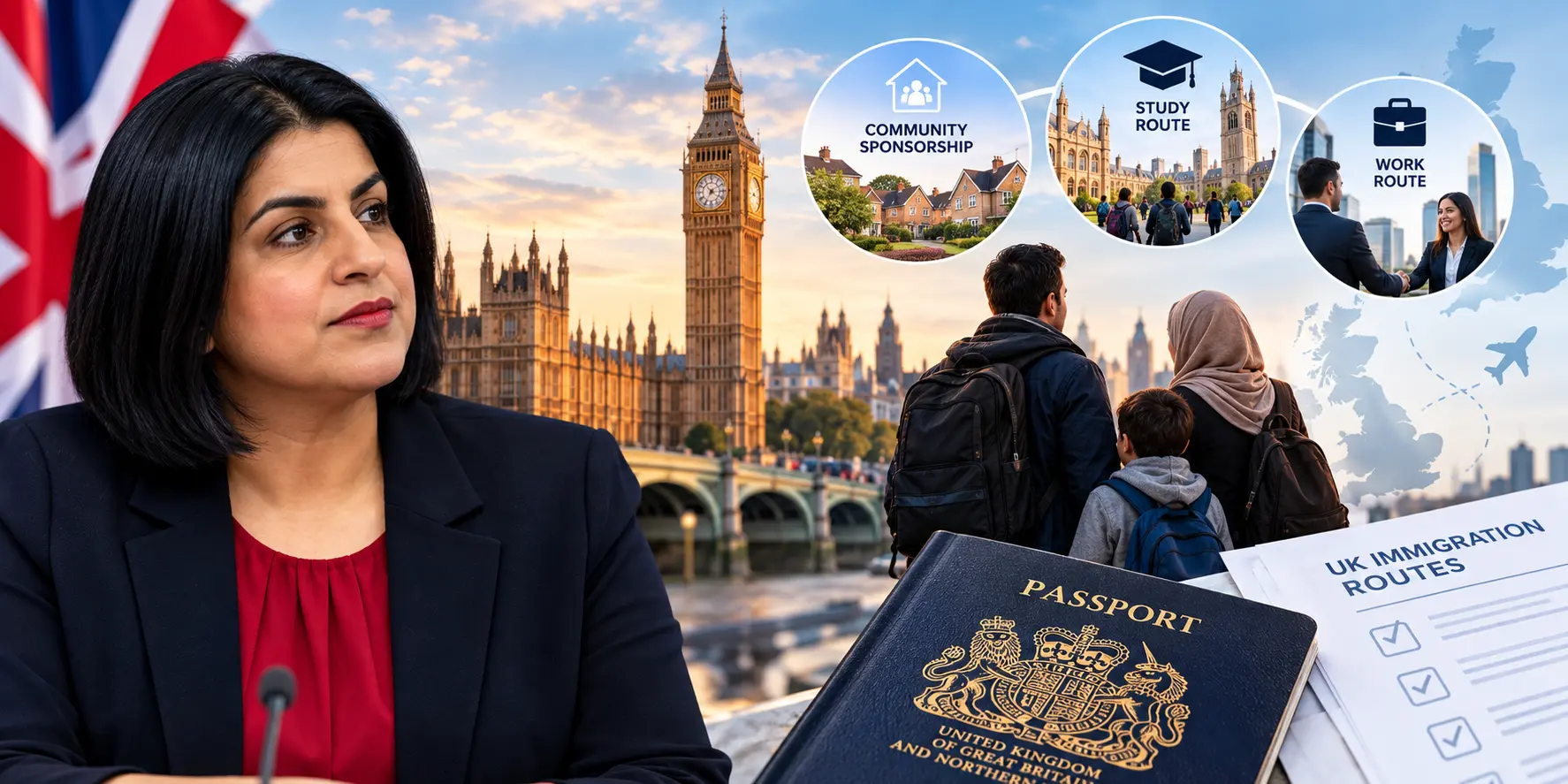
In 2026, Home Secretary Shabana Mahmood has announced a new direction for refugee resettlement based on safe and legal routes, sponsorship and greater involvement from communities, universities and employers. The Government has said the new approach will include a community sponsorship route, a study route for refugees and a future work route for skilled refugees. Applications for organisations to participate in the new community and study routes are expected to begin in autumn 2026, with first arrivals expected from autumn 2027.
At the same time, other changes have affected refugee protection, asylum support, settlement and the wider immigration system.
This guide explains what is changing, how the proposed sponsorship model works, which routes are relevant, what sponsors may need to prepare for, and what applicants should understand before making immigration plans.
What Is the Shabana Mahmood Refugee Sponsorship Scheme?
The Shabana Mahmood refugee sponsorship scheme refers to the new model of safe and legal refugee routes announced by the Home Secretary in June 2026.
The Government says the model will move more responsibility for refugee resettlement towards organisations and communities that are prepared to sponsor and support refugees.
Under the proposed community sponsorship route, approved community organisations would take responsibility for areas such as:
- Housing;
- Settlement support;
- Integration;
- Access to employment;
- Practical assistance after arrival.
The Government has described the model as being inspired by Canada’s long-established refugee sponsorship system. It also says the new model will operate separately from the existing UK Resettlement Scheme and at a higher capacity once established.
The policy is part of a wider government plan to increase the use of safe and legal routes while tightening controls around irregular migration.
Importantly, the new system is expected to be capped.
The Government’s policy statement says the Home Secretary will set an annual cap on arrivals through safe and legal routes, with numbers linked to community capacity.
That means the announcement should not be interpreted as an unlimited new refugee visa route.
It is a controlled resettlement framework.
Why Is the UK Introducing New Refugee Sponsorship Routes?
The Government has given several reasons for the proposed changes.
Its stated objective is to create controlled routes for people who need protection while reducing reliance on irregular journeys.
The Home Office says safe and legal routes can provide vulnerable refugees with a structured way to reach the UK, with security checks and sponsorship arrangements taking place before arrival.
The Government also wants communities to have a more direct role in refugee resettlement.
Under the existing model, local authorities play a significant role in supporting people arriving through resettlement programmes. The new approach is intended to give approved community groups greater responsibility for helping refugees settle and become self-sufficient.
There is also an economic and integration element.
The Government has pointed to the Canadian sponsorship model and argued that sponsored refugees can integrate into employment and communities more quickly. In a July 2026 parliamentary speech, Shabana Mahmood referred to Canadian experience and contrasted it with employment levels among refugees in the UK. These are government-presented comparisons rather than a guarantee of what the new UK routes will achieve.
For applicants, the practical message is that the new system is being designed around arrival plus integration, rather than simply permission to enter.
What Are the New Safe and Legal Refugee Routes?
The new framework is expected to develop around three main sponsorship models:
- Community sponsorship
- University or study sponsorship
- Employer or work sponsorship
The first two are expected to begin accepting sponsor applications in autumn 2026, while the work route is expected to follow in 2027. The Government says first arrivals under the new routes are expected from autumn 2027.
Each route has a different purpose.
1. Community Sponsorship Route
The community sponsorship route is likely to be the part of the Shabana Mahmood refugee sponsorship scheme that attracts the greatest public attention.
The idea is relatively simple.
Instead of refugees arriving without an established local support structure, an approved community organisation would sponsor them and help them establish a life in a particular area.
The Government says community sponsors would take responsibility for:
- Providing or arranging suitable accommodation;
- Supporting integration;
- Helping refugees access employment;
- Providing practical assistance;
- Helping refugees become self-sufficient.
The Government has said applications for organisations to sponsor refugees will begin in autumn 2026.
However, people should not confuse this new route with the existing Community Sponsorship Scheme.
The UK already has community sponsorship arrangements under existing resettlement programmes.
The current GOV.UK guidance describes community sponsorship as a way for local communities, charities, civil society organisations and faith groups to help refugees settle in the UK. Sponsors provide practical and emotional support and help families rebuild their lives.
The 2026 proposal is intended to expand this model considerably.
Who Could Become a Community Sponsor?
The new route is expected to rely on organisations rather than individual members of the public simply applying to bring a person to Britain.
This distinction is important.
The Government has said it will work with lead sponsors to accredit organisations participating in the new routes.
Potential sponsors could therefore include:
- Community organisations;
- Charities;
- Faith-based organisations;
- Universities;
- Employers;
- Other approved organisations.
The exact operational eligibility requirements should be checked once the relevant Home Office guidance is published.
Existing community sponsorship arrangements give an indication of the type of preparation that can be involved.
For example, current Community Sponsorship guidance requires sponsors to be prepared to provide structured support to refugees, rather than simply offering a spare room or informal assistance.
2. University Sponsorship Route for Refugees
The second major route is designed around education.
Under the proposed model, trusted universities will be able to sponsor refugees through a study route.
This could create an alternative pathway for refugees who have the academic background and opportunity to study in the UK.
The Government announced that universities will be able to directly sponsor refugees through a study route and said applications will open in autumn 2026, with the first arrivals expected from autumn 2027.
This route could be particularly relevant for universities that already have:
- International student systems;
- Scholarship programmes;
- Student support teams;
- Accommodation arrangements;
- Academic admissions infrastructure;
- Safeguarding procedures.
But it is important not to assume that every international student automatically qualifies.
This is a specific refugee sponsorship framework, not a replacement for the normal Student visa route.
Applicants would still need to satisfy the requirements of the relevant route and any eligibility criteria established by the Home Office.
3. Refugee Work Sponsorship Route
The third element is an employer-sponsored work route for refugees.
The Government says a refugee work route is expected to open in 2027, allowing employers to sponsor refugees.
This could become relevant to employers that need skilled workers and refugees who already have qualifications or professional experience.
The concept is different from simply granting refugee status.
It creates a pathway connecting:
Protection → Employment → Integration
For employers, that could mean preparing systems for sponsorship, recruitment and settlement support.
For refugees, it could provide a structured opportunity to use existing skills in the UK labour market.
The precise eligibility, salary, sponsorship and visa conditions should not be assumed until the Home Office publishes the final route requirements.
Shabana Mahmood UK Immigration Routes: What Is Changing?
The phrase Shabana Mahmood UK immigration routes covers a much broader subject than refugee sponsorship.
The Home Secretary’s immigration programme includes changes affecting:
- Refugee protection;
- Safe and legal routes;
- Asylum support;
- Settlement;
- English-language requirements;
- Immigration enforcement;
- Visa restrictions;
- Appeals;
- Modern slavery protections;
- Refugee resettlement.
Some changes have already entered the immigration system, while others remain proposals or are being implemented through legislation.
That is why applicants should look at each route individually.
Refugee Protection Is Becoming More Temporary
One of the most significant changes took effect on 2 March 2026.
People who claimed asylum or lodged further submissions from that date and who are granted refugee status or humanitarian protection normally receive an initial 30 months of permission to stay on the protection route. Their protection is then subject to review.
The Home Office says protection can be renewed where the person still faces danger in their home country.
If the country has become safe and protection is no longer required, the Government expects the person to return, subject to the applicable legal framework.
This is a major difference from the previous model of refugee protection.
What does this mean in practice?
A person granted protection should no longer assume that receiving refugee status automatically means they have a permanent immigration position.
For people making asylum claims from March 2026 onwards, planning needs to consider:
- The 30-month permission period;
- Future protection reviews;
- Conditions attached to the protection route;
- Family circumstances;
- Employment;
- Integration;
- Potential future settlement rules.
The current Home Office guidance confirms that people granted refugee status or humanitarian protection under the new framework receive immediate and unrestricted access to the labour market, recourse to public funds and the opportunity to apply for a refugee integration loan.
How Could the New Sponsorship Model Affect Refugees?
The practical impact could be significant, particularly during the first months after arrival.
A sponsorship-based system is designed to connect refugees with a community, university or employer before or around the time they arrive.
That can potentially provide:
Housing support
A sponsor may be responsible for helping secure suitable accommodation.
Local integration
Refugees can receive support understanding local services, schools, transport and community facilities.
Employment support
Community and employer sponsorship models can help refugees access employment opportunities.
Education
The university route creates a dedicated pathway for eligible refugees who are sponsored to study.
Social connections
Having an established organisation involved can provide a network during the difficult early period after relocation.
These are practical objectives of the sponsorship model. They should not be treated as guarantees for every applicant because the final route rules and sponsor obligations will determine what support is actually available.
What Are the Benefits for Sponsors?
For organisations considering the Shabana Mahmood refugee sponsorship scheme, preparation will be important.
Sponsorship is not simply a name on an application.
It can involve real responsibilities.
Existing community sponsorship guidance shows that sponsors may be expected to provide structured support, accommodation assistance, integration help and practical guidance.
Potential benefits for participating organisations could include:
- Building stronger community links;
- Supporting refugee integration;
- Helping fill genuine employment needs;
- Developing volunteering opportunities;
- Strengthening local partnerships;
- Supporting vulnerable people through an organised route.
For employers, a future refugee work route could also create an additional recruitment channel.
For universities, refugee sponsorship could connect humanitarian protection with higher education.
For community organisations, it could create a more direct role in resettlement.
What Should Potential Sponsors Do Now?
If your organisation is considering participating, preparation should begin before the application window opens.
Step 1: Identify your organisation’s role
Decide whether you are considering:
- Community sponsorship;
- University sponsorship;
- Employer sponsorship.
The requirements are likely to differ.
Step 2: Review accommodation capacity
Community sponsors should consider whether they can realistically support appropriate housing.
This could mean working with:
- Local authorities;
- Housing associations;
- Charities;
- Private landlords;
- Community partners.
Step 3: Build a support team
Consider who will handle:
- Housing;
- Education;
- Healthcare access;
- Employment;
- Safeguarding;
- Translation;
- Local integration.
Step 4: Review safeguarding procedures
Organisations working with vulnerable people should have appropriate safeguarding and background-check processes.
Existing Afghan community sponsorship guidance, for example, requires sponsor groups to undergo relevant checks and provide references.
The final requirements for the new routes should be confirmed once published.
Step 5: Establish local partnerships
A strong sponsorship programme is unlikely to work in isolation.
Potential partners may include:
- Councils;
- Schools;
- Colleges;
- Universities;
- NHS services;
- Employment organisations;
- Refugee charities.
What Should Refugees Do Now?
People who may benefit from the new routes should also prepare early.
However, they should avoid assuming that an announced route is already open.
The Government has announced the framework, but operational guidance and eligibility requirements remain important.
Potential applicants should prepare:
Identity documents
Keep passports, identity documents and relevant civil records together.
Refugee documentation
Keep evidence of refugee recognition or other relevant protection status where applicable.
Education records
For the study route, academic certificates, transcripts and evidence of qualifications may become important.
Employment records
For a future work route, applicants should organise:
- CV;
- Degree certificates;
- Professional qualifications;
- Employment references;
- Evidence of work experience;
- Professional licences where required.
Language evidence
Where a route requires English-language evidence, applicants should check the specific rules rather than relying on assumptions.
How Does This Fit With Existing UK Immigration Routes?
The new refugee sponsorship routes do not replace the entire UK immigration system.
The UK continues to have multiple immigration routes for different purposes.
These include routes for:
- Skilled workers;
- Students;
- Graduates;
- Global Talent;
- Innovator Founders;
- Family members;
- Visitors;
- Temporary workers;
- British National (Overseas) citizens;
- Refugees and people requiring humanitarian protection.
The correct route depends on the applicant’s circumstances.
This is why the phrase Shabana Mahmood UK immigration routes should not be interpreted as meaning that all UK visa categories are being replaced by one new system.
The Government’s reforms are changing particular parts of the system while other routes continue under their own rules.
Earned Settlement and the Future of UK Immigration
Settlement is another major part of the wider immigration reform programme.
The Government’s Immigration White Paper proposed increasing the standard qualifying period for settlement from five years to 10 years for most migrants, with the possibility of reductions for people who make particular contributions.
The Government subsequently launched a consultation on an earned settlement model.
Under the proposal, settlement would become more closely connected with factors such as:
- Contribution;
- Integration;
- Compliance with immigration rules;
- English-language ability;
- Economic participation.
However, applicants must distinguish between proposals and rules that are already in force.
The consultation and subsequent policy development do not mean every proposed settlement change automatically applies to every person currently in the UK.
Transitional arrangements are particularly important.
Anyone already on a pathway to settlement should therefore check the latest Immigration Rules and official guidance before making assumptions about their future ILR application.
Higher English Requirement for Settlement
English-language requirements have also become an important part of the wider reforms.
The Government announced in March 2026 that most foreign nationals applying for settlement would need to meet a higher English standard, described as an A-level equivalent, rather than the previous GCSE-level requirement.
The Government has presented the change as part of its broader approach to integration and earned settlement.
For people planning a long-term UK immigration route, English preparation can therefore become part of immigration planning rather than something to consider only immediately before an ILR application.
Applicants should always check the exact requirement applying to their route and application date.
What Is Happening With the Immigration and Asylum Bill?
The Immigration and Asylum Bill 2026 is an important part of the wider reforms associated with Shabana Mahmood.
But there is an important legal distinction:
The Bill is not yet an Act.
The Bill was introduced in the House of Commons on 30 June 2026 and remained in the parliamentary process in September 2026. UK Parliament records show that its next stage was committee stage as of 18 September 2026.
The Bill covers several areas, including:
- Immigration;
- Asylum;
- Modern slavery;
- Appeals;
- Refugee protection;
- Recovery of asylum support costs.
The Joint Committee on Human Rights notes that the Bill would establish a new Independent Immigration Appeals Authority and includes provisions relating to Article 8, refugee protection, asylum support and modern slavery.
Because the Bill is still progressing through Parliament, applicants should distinguish between:
Current law
and
proposed changes that may become law.
This distinction is essential when writing or relying on immigration information online.
New Immigration Appeals System
The proposed reforms also include changes to immigration appeals.
The Government has proposed creating an Independent Immigration Appeals Authority, intended to replace the existing First-tier Tribunal structure for immigration and asylum appeals.
The Government says the aim is to create a more streamlined system and reduce delays.
The Home Office reported that more than 150,000 immigration and asylum appeals were waiting to be heard and that the average time to clear cases was 61 weeks when the proposal was announced.
The exact operation of the new body depends on the legislative process and implementation arrangements.
Applicants should therefore not assume that an appeal filed today will necessarily follow the same process after the proposed reforms take effect.
Asylum Support Is Also Changing
The 2026 reforms extend beyond immigration routes.
The Government has introduced changes to asylum support.
From June 2026, support and accommodation became subject to a more conditional system, with support potentially being removed from people who illegally work, can support themselves financially, have a right to work or have broken the law.
The Government has also introduced legislation allowing recovery of asylum accommodation and support costs from adults who have sufficient funds to contribute.
The Home Office says eligible adults may be required to repay a flat-rate amount above a set financial threshold.
These measures affect people in the asylum system and should not be confused with the sponsorship routes for recognised refugees.
How Could the Reforms Affect Employers?
Employers could have an increasingly important role in the UK’s future refugee routes.
The planned work sponsorship route is expected to allow employers to sponsor refugees for employment from 2027.
For businesses, this could mean considering:
- Recruitment needs;
- Sponsor compliance;
- Suitable roles;
- Salary requirements;
- Workplace support;
- Training;
- Integration;
- Long-term workforce planning.
Employers interested in participating should avoid treating the proposed refugee work route as identical to the existing Skilled Worker route.
The Government has not yet published all final operational requirements for the new refugee work route.
How Could the Reforms Affect Universities?
Universities may become another important part of the new sponsorship structure.
Under the proposed study route, trusted universities would be able to sponsor refugees to study in the UK.
For universities, preparation could involve:
- Identifying eligible academic programmes;
- Scholarship funding;
- Accommodation;
- Student welfare;
- Immigration compliance;
- Safeguarding;
- Academic admissions;
- Local community support.
For refugees, this could create a route combining protection with higher education.
But the route should not be confused with the ordinary Student visa system.
It is being designed specifically as part of the safe and legal refugee framework.
What Does the New System Mean for Communities?
The proposed community model puts local capacity at the centre of the sponsorship process.
That means the Government’s approach is not simply:
Refugee → Visa → UK
Instead, the intended model is closer to:
Refugee → Sponsor → Housing → Local support → Integration → Education or employment
The Government’s policy statement says annual numbers through safe and legal routes will be controlled according to community capacity.
This means local organisations may have a more visible role in determining whether their communities are prepared to support new arrivals.
What Are the Potential Challenges?
The new model also raises practical questions.
Sponsor capacity
Not every community organisation will have access to suitable housing or volunteers.
Funding
Sponsorship involves real costs, including accommodation, support and integration.
Administration
Organisations may need systems for safeguarding, documentation and coordination with public bodies.
Demand
The number of people seeking safe routes could be greater than the number of places available.
Capped arrivals
Because the Government intends to control annual numbers, sponsorship does not guarantee that every eligible person will receive a place.
Changing legislation
Some parts of the wider reform programme are still moving through Parliament.
These factors make careful planning particularly important.
What Should Applicants Watch During 2026 and 2027?
If you are considering a UK immigration route, do not rely on one announcement or one news article.
Monitor:
1. Immigration Rules
The Immigration Rules determine the legal requirements for many visa and protection routes.
The Home Office published a further statement of changes on 3 September 2026, demonstrating how frequently the rules can be updated.
2. Home Office guidance
Operational guidance can explain how caseworkers apply the rules.
3. Parliamentary progress
For measures contained in Bills, check whether the legislation has progressed, been amended or received Royal Assent.
4. Sponsor guidance
Organisations considering sponsorship should wait for the relevant official guidance before accepting applications or promising sponsorship.
5. Route-specific requirements
A refugee study route, refugee work route and community sponsorship route will not necessarily have identical eligibility requirements.
A Practical Planning Checklist for Refugees
If you are considering one of the future safe and legal routes, start preparing early.
Personal documents
Keep:
- Passport;
- Identity documents;
- Birth certificate where available;
- Marriage or family documents where relevant.
Refugee documentation
Maintain evidence of your refugee or protection status where applicable.
Education
Collect:
- Degree certificates;
- Transcripts;
- Professional qualifications;
- Academic references.
Employment
Prepare:
- CV;
- Employment references;
- Work certificates;
- Professional licences;
- Evidence of skills and experience.
Family information
Keep documents for dependants organised separately.
Digital records
Maintain secure copies of important documents.
Official updates
Check GOV.UK regularly as the new sponsorship routes move from policy announcement to operational implementation.
Shabana Mahmood Refugee Sponsorship Scheme: What Is Confirmed and What Is Still Developing?
This is perhaps the most important distinction in the entire subject.
| Area | Position in September 2026 |
|---|---|
| Community sponsorship expansion | Announced |
| University refugee study route | Announced |
| Refugee work sponsorship route | Announced for expected 2027 opening |
| Sponsor applications for new community/study routes | Expected from autumn 2026 |
| First arrivals under new routes | Expected from autumn 2027 |
| Annual cap on safe and legal routes | Government policy |
| 30-month protection period for new asylum claims from 2 March 2026 | In force |
| Earned settlement reforms | Under development/consultation and implementation |
| Immigration and Asylum Bill | Still progressing through Parliament |
| New appeals authority | Proposed through legislation |
| Final operational details for all new sponsorship routes | Still developing |
The table is important because immigration websites can easily blur the line between an announcement and a legal rule.
For professional immigration content, those terms should never be treated as interchangeable.
How Should People Plan for the Future?
The future of UK immigration is likely to be more route-specific.
For refugees, the direction is towards a combination of:
Protection + sponsorship + integration
For skilled migrants, the Government is increasingly focusing on contribution, skills, English and settlement requirements.
For universities, sponsorship and compliance remain important.
For employers, sponsorship duties and immigration compliance continue to matter.
For people already in the UK, transitional arrangements could become especially important as new rules are introduced.
The safest strategy is therefore not to plan solely around headlines.
Plan around the rules that apply to your own immigration category.
Frequently Asked Questions
What is the Shabana Mahmood refugee sponsorship scheme?
The term refers to the new safe and legal refugee sponsorship framework announced by Home Secretary Shabana Mahmood in June 2026. It is intended to expand community, university and employer involvement in refugee resettlement.
When will the new refugee sponsorship routes open?
The Government says applications for organisations to sponsor refugees through the new community and study routes are expected to begin in autumn 2026, with first arrivals expected from autumn 2027. The employer-sponsored refugee work route is expected to open in 2027.
Can an individual directly sponsor any refugee under the new scheme?
The announced model is organisation-led. The Government has said it will work with accredited lead sponsors and organisations. The final eligibility and application requirements should be checked against official Home Office guidance when published.
What are the new UK refugee routes?
The proposed framework includes a community sponsorship route, a university study route and a future employer-sponsored work route for refugees.
Does the new sponsorship scheme replace the UK Resettlement Scheme?
No. The Government has stated that the new named community sponsorship model will sit outside the existing UK Resettlement Scheme. Existing resettlement programmes continue to operate under their own arrangements.
How long is refugee protection for people claiming asylum after March 2026?
People who claim asylum or make relevant further submissions from 2 March 2026 and are granted refugee status or humanitarian protection normally receive an initial 30-month period of permission to stay on the protection route.
Can refugees work in the UK under the new protection rules?
Those granted refugee status or humanitarian protection under the new protection framework receive immediate and unrestricted access to the labour market, subject to the applicable rules.
Is the Immigration and Asylum Bill already law?
No. As of September 2026, the Immigration and Asylum Bill remains in the parliamentary process. UK Parliament records show that it was introduced in June 2026 and was progressing through committee stage.
Will the new refugee work route replace the Skilled Worker visa?
There is no basis for saying that. The proposed refugee work route is a separate part of the safe and legal refugee framework. The final rules will determine how it operates alongside existing work routes.
Will the new immigration reforms affect settlement?
Potentially. The Government has proposed an earned-settlement framework that would increase the standard qualifying period for settlement for many migrants, with possible reductions based on contribution and integration. However, applicants need to distinguish between proposals, consultation outcomes and changes that have actually entered the Immigration Rules.
What should I do if I am planning a UK immigration application in 2026?
Start with the route that matches your circumstances, check the latest Immigration Rules and Home Office guidance, prepare your documents early and check whether any proposed reforms have actually taken effect before relying on them.
Final Thoughts: What the 2026 Changes Mean for UK Immigration
The UK immigration system is entering another important phase.
The Shabana Mahmood refugee sponsorship scheme is designed around a different model of refugee resettlement: communities, universities and employers are expected to play a more direct role in helping refugees establish their lives in Britain.
The Government says the new safe and legal routes will be capped, controlled and linked to sponsorship capacity. Community and study sponsor applications are expected to begin in autumn 2026, with first arrivals expected from autumn 2027. A refugee work route is expected to follow in 2027.
At the same time, the wider Shabana Mahmood UK immigration routes landscape is changing through reforms to refugee protection, asylum support, settlement, English-language requirements, appeals and immigration enforcement.
For people applying to come to the UK, the message is clear: do not plan around headlines alone.
A route can be announced without being open.
A proposal can be published without being law.
A Bill can pass one parliamentary stage and still change before final approval.
And an Immigration Rule can change after you have already started planning an application.
For refugees, sponsors, universities, employers and immigration advisers, timing and accurate information will therefore be critical.
The best preparation is to identify the correct route, understand the requirements that apply today, monitor official updates and keep your documentation ready for the next stage.
Official sources
For ongoing updates, applicants and sponsors should check the latest information from:
- GOV.UK – Home Office immigration and asylum updates
- UK Parliament – Immigration and Asylum Bill 2026
- GOV.UK – UK Resettlement Scheme funding guidance 2026–27
- GOV.UK – Community Sponsorship guidance
- GOV.UK – September 2026 Immigration Rules changes
Important: Immigration rules can change quickly. The information above reflects the official position and announced reforms available in September 2026. Individual eligibility depends on the route, nationality, immigration history and the rules in force when an application is made.
[…] Secretary Shabana Mahmood explained the decision […]
[…] The phone-seizure powers sit within a much broader overhaul announced by Shabana Mahmood. […]
[…] strategy was led by Shabana Mahmood, the UK Home Secretary, who has made border control a central pillar of Labour’s post-2024 […]
[…] Shabana Mahmood summed it up bluntly: […]
[…] Secretary Shabana Mahmood has said these changes will make Britain’s settlement system “by far the most controlled and […]