
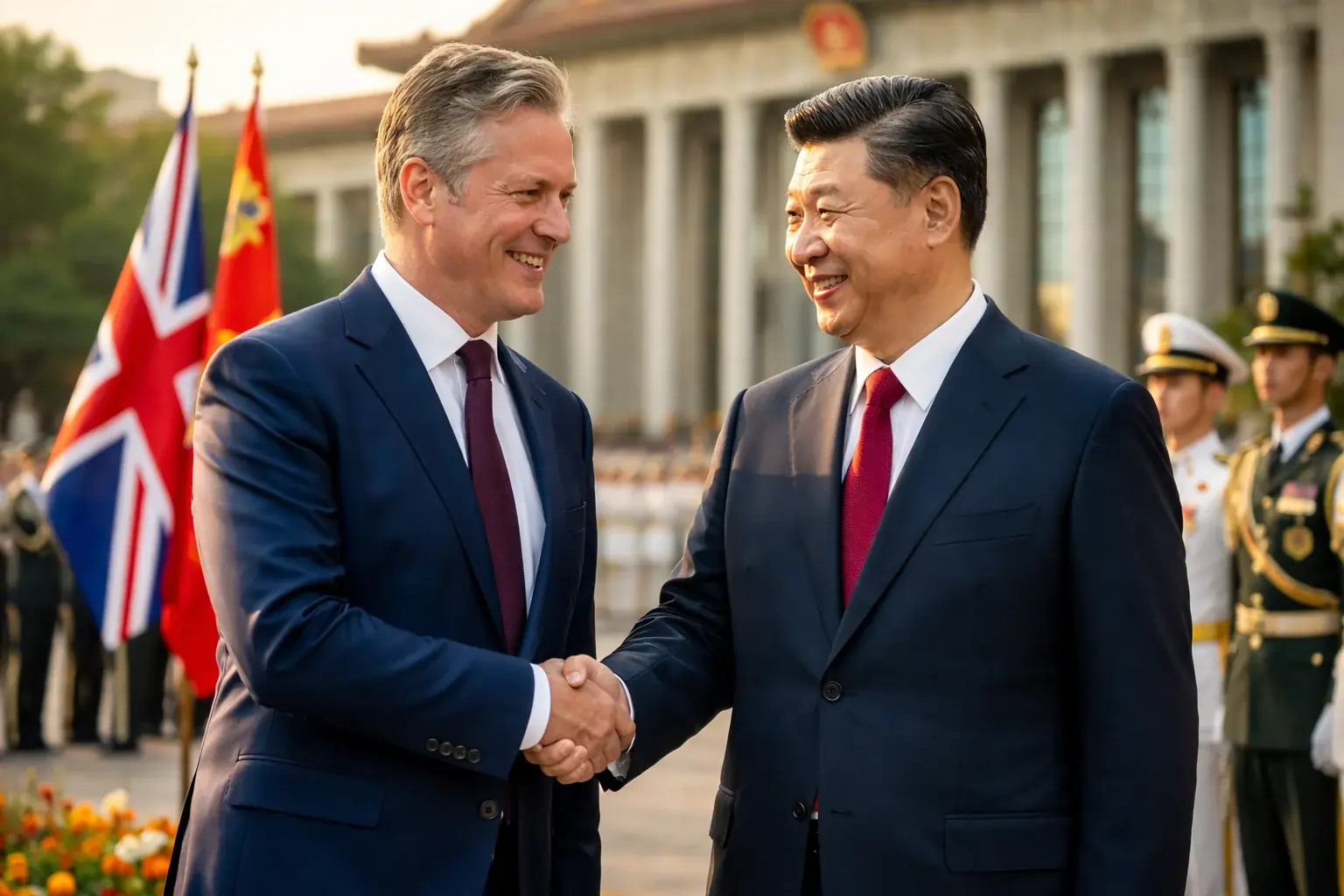
When Keir Starmer landed in China in January 2026, it marked more than the end of an eight-year diplomatic freeze. It signalled a strategic recalibration of how the United Kingdom intends to engage with the world’s second-largest economy in a far more fragmented, competitive, and uncertain global order.
This was not a return to naïve engagement.
Nor was it a softening of national security priorities.
Instead, the visit reflected a pragmatic reset one that balances economic necessity, geopolitical realism, and domestic political constraints.
From whisky tariffs and visa discussions to climate cooperation and financial integration, the trip produced tangible outcomes, not just symbolic gestures.
This blog breaks down what was agreed, why it matters, who benefits, and what this reset means for the future of UK–China relations especially for businesses, travellers, students, and policymakers.
Key Takeaways
- The UK and China have reset high-level relations after an eight-year diplomatic pause.
- A new strategic partnership framework restores structured dialogue across trade, security, and climate.
- China will cut whisky import tariffs from 10% to 5%, boosting UK exports.
- Visa facilitation talks have resumed, with potential easing for UK travellers in future.
- The reset reflects pragmatic engagement, not a shift away from national security priorities.
Part 1: Why the UK–China relationship needed a reset
A relationship on pause since 2018
Formal high-level UK–China engagement had been effectively suspended for nearly eight years. The reasons are well documented:
- Rising concerns over national security
- Human rights tensions
- Hong Kong and technology policy disputes
- A broader Western shift toward strategic caution on China
Yet during this pause, one reality did not change:
China remained one of the UK’s largest trading partners.
British businesses continued exporting. Chinese investment remained embedded in global supply chains. Climate goals remained unattainable without cooperation between major economies.
By 2026, the cost of non-engagement had become increasingly clear.
A Labour government with a different strategy
The Labour government under Starmer framed its China policy around three pillars:
- Engage where interests align
- Protect where national security is at stake
- Compete where values and systems differ
This visit was the first major test of that framework.
What This Means for You
The UK–China reset is not abstract diplomacy. It has practical implications for businesses, professionals, students, and travellers with interests in either country.
- More predictable UK–China relations reduce political risk for long-term planning.
- Improved dialogue supports smoother trade, finance, and academic cooperation.
- Future visa facilitation could make travel and mobility easier for UK nationals.
- Businesses gain clearer engagement channels with Chinese counterparts.
Part 2: Strategic partnership – what was actually agreed?
A “stable and enduring” strategic framework
At the centre of the visit was the agreement to establish a new strategic partnership framework between the UK and China.
This framework commits both governments to:
- Regular, structured dialogue
- Predictable engagement channels
- Issue-specific cooperation rather than blanket alignment
Crucially, this is not a return to unrestricted engagement. It is a managed relationship, designed to reduce volatility and miscalculation.
High-level dialogue mechanisms restored
The two sides agreed to restart and institutionalise:
- Strategic dialogue
- Economic and trade dialogue
- Financial cooperation talks
- Security discussions
These mechanisms allow disagreements to be handled through process, rather than public confrontation.
For investors and businesses, this predictability matters more than rhetoric.
Business Impact: What Companies Should Know
- Lower whisky tariffs improve competitiveness for UK exporters in the Chinese market.
- Restored trade and financial dialogues reduce regulatory uncertainty.
- London’s role as a global financial hub is reinforced through RMB clearing and insurance cooperation.
- Predictable diplomacy supports long-term investment and supply-chain planning.
While risks remain, the reset provides businesses with stability rather than sudden policy shocks.
Part 3: Trade and economic outcomes – why business paid attention
Whisky tariffs cut: small number, big signal
One of the most headline-grabbing outcomes was China’s agreement to reduce whisky import tariffs from 10% to 5%.
On paper, this is a modest change. In practice, it matters for three reasons:
- UK spirits exports are high-value and brand-sensitive
- The move signals willingness to remove non-essential trade friction
- It restores momentum after years of stagnation
For British exporters, particularly in Scotland, the tariff cut is both symbolic and commercial.
Business and financial cooperation deepened
The visit placed strong emphasis on financial services and capital markets:
Key developments included:
- UK–China Business Council engagement
- Launch of the China–UK Financial Working Group
- Expansion of RMB clearing capacity in London
- Agreement to host a China–UK Insurance Forum
London’s position as a global financial hub depends on continued relevance to Asian capital flows. This visit reinforced that positioning.
Part 4: Visas, mobility, and people-to-people ties
Visa talks: cautious but significant
One of the most closely watched areas was visa cooperation.
China confirmed it is actively discussing:
- Simplified visa processes for UK citizens
- Potential visa waiver arrangements (still under negotiation)
While no immediate visa-free regime was announced, the tone marked a clear shift from restriction to facilitation.
For:
- Business travellers
- Academics
- Students
- Cultural exchanges
this signals future easing, not tightening.
Why mobility matters strategically
Visa policy is no longer just about tourism. It affects:
- Trade facilitation
- Research collaboration
- Soft power
- Long-term diplomatic trust
At a time when many countries are tightening borders, even incremental progress matters.
Visa & Mobility Impact: What Travellers and Students Should Expect
- No immediate visa waiver has been announced, but talks signal future easing.
- Business travel and academic exchanges are likely to benefit first.
- Visa processes may become more streamlined rather than fully visa-free.
- Mobility cooperation strengthens people-to-people ties without compromising border control.
Travellers should watch for incremental policy updates rather than sudden changes.
Part 5: Climate, nature, and global responsibility
Climate cooperation as common ground
Both governments agreed to establish a high-level partnership on climate and nature.
This reflects an unavoidable truth:
- Neither the UK nor China can meet climate goals alone
- Technology transfer, financing, and coordination are essential
Areas highlighted include:
- Clean energy
- Nature protection
- Climate finance mechanisms
This cooperation exists alongside, not instead of, strategic competition.
Part 6: The 12 agreements – breadth over slogans
During the visit, leaders witnessed the signing of 12 intergovernmental cooperation documents, covering:
- Economy and trade
- Agriculture and food standards
- Culture and education
- Healthcare
- Media cooperation
- Market regulation
- Law enforcement dialogue
The breadth matters. It shows the reset is multi-layered, not limited to a single sector.
Part 7: Political context – criticism, caution, and realism
Domestic scrutiny in the UK
The reset has not gone unchallenged.
Critics argue:
- Engagement risks legitimising problematic behaviour
- Economic dependence creates leverage vulnerabilities
Supporters counter:
- Disengagement weakens influence
- Trade without dialogue increases risk
- Strategic silence benefits no one
Starmer’s approach attempts to navigate this tension by engaging selectively and transparently.
Not a blank cheque for Beijing
Importantly, UK officials have stressed:
- National security policy remains unchanged
- Sensitive sectors stay protected
- Human rights concerns are not abandoned
This is engagement with guardrails.
Part 8: What this means going forward (2026–2030)
Short-term outcomes (2026–2027)
- Increased trade activity
- Gradual easing of business travel friction
- More predictable diplomatic communication
- Stronger climate coordination
Medium-term implications (2027–2029)
- Expanded financial cooperation
- Potential visa facilitation agreements
- Deeper academic and research exchanges
- Stabilisation of bilateral risk for investors
Long-term strategic impact
The reset positions the UK as:
- Neither fully aligned nor fully detached from China
- A pragmatic middle power engaging on its own terms
- A bridge between Western systems and Asian markets
In a world of blocs, flexibility becomes leverage.
Final verdict: a calculated reset, not a gamble
Strategic Context
The UK’s China reset reflects a broader global shift toward managed engagement. It prioritises dialogue and economic cooperation while maintaining clear security boundaries.
Keir Starmer’s China visit was not about optimism it was about necessity.
The UK cannot:
- Ignore China economically
- Isolate itself diplomatically
- Or outsource engagement to allies
This reset acknowledges reality while attempting to manage risk.
For businesses, it offers predictability.
For travellers and students, cautious opportunity.
For policymakers, a framework to disagree without destabilising.
The success of this strategy will not be measured in headlines but in whether dialogue reduces friction, trade flows without dependency, and cooperation exists without complacency.
In 2026, the UK did not “pivot to China.”
It chose to re-engage on its own terms.
Frequently Asked Questions (FAQs)
1. Why did the UK reset relations with China in 2026?
The UK reset relations to restore structured dialogue after eight years of limited engagement. The government concluded that non-engagement was harming trade, climate cooperation, and diplomatic stability without improving security outcomes.
2. Does this mean the UK is softening its stance on China?
No. The UK government has stressed that national security policy remains unchanged. The reset focuses on pragmatic engagement where interests align, while maintaining safeguards in sensitive areas.
3. What trade benefits came out of Keir Starmer’s China visit?
China agreed to cut whisky import tariffs from 10% to 5%, boosting UK exports. The visit also strengthened financial cooperation, trade dialogue, and business-to-business engagement.
4. Were any visa changes agreed between the UK and China?
No immediate visa waiver was announced. However, both sides confirmed active discussions on visa facilitation and simplified travel for UK citizens, signalling potential future easing.
5. How does this affect UK businesses operating in China?
The reset provides greater predictability through restored dialogue channels, improved financial cooperation, and clearer frameworks for trade and investment planning.
6. What is the new UK–China strategic partnership?
It is a structured framework for regular dialogue covering trade, finance, security, climate, and people-to-people exchanges. It aims to stabilise relations without full political alignment.
7. What role does climate cooperation play in the agreement?
Climate and nature cooperation form a key pillar of the reset. Both countries agreed to work together on clean energy, climate finance, and environmental protection initiatives.
8. Were security issues discussed during the visit?
Yes. High-level security dialogue was resumed. While details were not made public, both sides agreed on the importance of communication to manage risks and avoid escalation.
9. How many agreements were signed during the visit?
Leaders witnessed the signing of 12 intergovernmental cooperation documents covering trade, agriculture, culture, education, healthcare, media, and regulatory cooperation.
10. How does this reset affect students and academic exchanges?
The renewed engagement is expected to support academic cooperation, research partnerships, and future mobility discussions, although no immediate policy changes were announced.
11. Is this reset permanent?
The framework is designed to be long-term, but its success depends on continued dialogue, mutual compliance, and geopolitical developments. It is a managed relationship, not an unconditional one.
12. What does this mean for the UK’s global strategy?
The reset positions the UK as a pragmatic middle power engaging economically with China while maintaining strategic independence and strong ties with allies.