
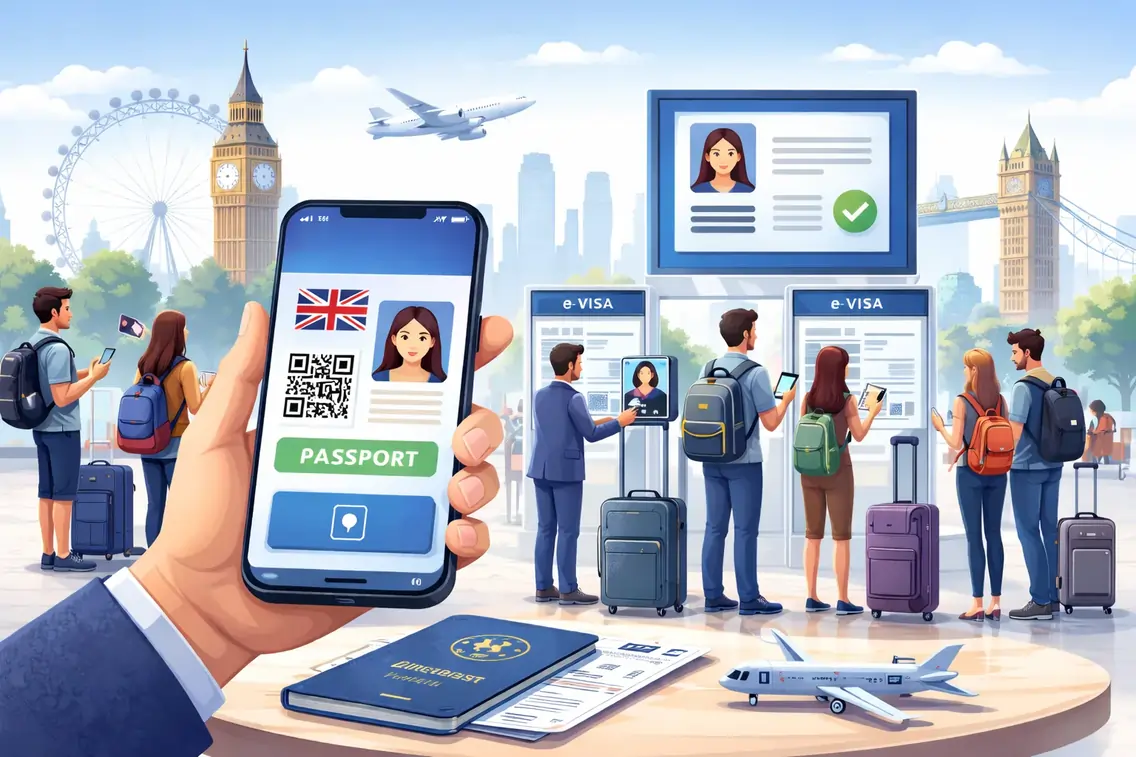
Introduction: A quiet but historic shift in UK immigration
The UK is not tweaking its visa system. It is rebuilding it from the ground up.
By the end of 2026, the United Kingdom will operate a fully digital immigration system, where eVisas replace all physical visa stickers, vignettes, and most plastic residence cards. This change affects visitors, students, workers, families, and permanent residents alike.
For decades, immigration status in the UK was something you could hold a sticker in your passport, a stamp, or a card in your wallet. From 2026 onwards, immigration status will be something the system recognises digitally.
This is not speculation. According to updated guidance from UK Visas and Immigration, the rollout is already underway, with:
Key UK eVisa Transition Dates
- 30 October 2025: Some applicants stop receiving visa stickers
- 12 January 2026: Interim phase with eVisa + limited stickers
- Late 2026: Visa stickers fully removed
1. What is an eVisa? (And what it is not)
An eVisa is a digital record of a person’s immigration status, held securely by the UK government and accessed online through a UKVI account.
It shows:
- The type of permission you hold
- How long you can stay
- Any conditions attached (work, study, no recourse to public funds, etc.)
An eVisa replaces physical proof, such as:
- Visa stickers (vignettes) in passports
- Biometric Residence Permits (BRPs)
- Biometric Residence Cards (BRCs)
- Old passport stamps used to prove settlement
What an eVisa does not do:
- It does not change your immigration rights
- It does not shorten or extend your stay
- It does not remove the need for permission
This point is emphasised repeatedly by UKVI:
Moving to an eVisa does not affect your immigration status or the conditions of your permission.
Only the format changes not the legal position.
eVisa Explained in Simple Terms
- What it is: Digital proof of your immigration permission
- What it is not: A new visa or a change to your rights
- Key takeaway: Only the format changes — not your legal status
2. Why the UK is ending visa stickers (official reasoning)
The shift to eVisas is part of a long-term border modernisation programme led by the UK Home Office.
The official reasons are clear and consistent:
2.1 Security
Physical documents can be:
- Lost
- Stolen
- Altered
- Fraudulently reproduced
Digital records are:
- Tamper-resistant
- Centrally verified
- Easier to audit
2.2 Speed and efficiency
Visa stickers require:
- Printing
- Courier delivery
- Collection delays
eVisas are issued instantly once a decision is made, reducing waiting times and administrative bottlenecks.
2.3 Border automation
Airlines, border officers, employers, and landlords are moving toward real-time digital checks.
A paper-based system cannot support:
- Automated airline boarding checks
- Digital right-to-work verification
- Seamless border processing
2.4 Global alignment
Countries such as:
- The United States (ESTA / digital records)
- Canada (eTA)
- Australia (ETA)
already rely heavily on digital immigration systems. The UK is aligning itself with this global standard.
3. The rollout timeline: when things change (official milestones)
Understanding when changes apply is critical. UKVI has set three key phases.
Phase 1: Applications from 30 October 2025
This is the earliest and most misunderstood change.
If you applied on or after 30 October 2025 for certain:
- Work visas
- Study visas
- Family visas
- Indefinite Leave to Enter (settlement)
👉 You may not receive a visa sticker at all.
Instead:
- Your immigration permission will be issued digitally only
- You must access it via your UKVI account before travelling
- Airlines will check your status electronically
Applicants are informed after a decision:
- Whether a sticker will be issued
- How to access their eVisa
This phase has already affected many main applicants on work and study routes since July 2025, according to UKVI.
Phase 2: From 12 January 2026
This marks the interim transition stage.
From this date:
- Most people granted a UK visit visa
- And some other short-term visas
will receive:
- An eVisa
- And possibly a visa sticker (temporarily)
At the same time:
- People with valid visa stickers issued before 12 January 2026 can often view their status digitally by creating or accessing a UKVI account
This phase allows travellers and airlines to adjust before the final cut-off.
Phase 3: Later in 2026 (Final transition)
This is the decisive step.
UKVI has confirmed:
Visa stickers will be completely phased out in 2026.
Once this happens:
- No visa stickers will be issued
- All successful applicants receive only an eVisa
- Digital status becomes the sole proof of permission
From this point onward, relying on physical documents will no longer be viable.
4. Who can already access an eVisa (official eligibility)
UKVI guidance confirms that millions of people have already been issued eVisas since 2018.
You can usually access an eVisa if you hold:
For stays longer than 6 months
- Skilled Worker visa
- Student visa
- Family visa
- Settlement / Indefinite Leave to Remain
For stays 6 months or less
- Visit visa
- Short-term work visa
- Short-term study visa
- Transit visa
- Most family visit visas
Applicants are generally told about eVisa access when their application is decided.
Who Should Act Immediately?
Travellers applying for UK visas from late 2025 onwards, frequent visitors, international students, skilled workers, family dependants, and ILR holders using old passport stamps or vignettes should review their digital status now to avoid future travel disruption.
5. The UKVI account: the centre of the new system
An eVisa is not something you download. It is something you view and manage through a UKVI online account.
To access your eVisa, you must:
- Have (or create) a UKVI account
- Verify your identity
- Link your passport to your status
You likely already have a UKVI account if you:
- Used the UK Immigration: ID Check app
- Applied online for a visa in recent years
- Replaced a BRP or BRC
- Applied under the EU Settlement Scheme
UKVI strongly advises:
Do not create a second account.
If unsure, try signing in before registering again.
6. What you need to create a UKVI account
According to official guidance, you need:
Mandatory
- A valid email address
- A phone number
One of the following (if available)
- Passport + visa application number (GWF or UAN)
- Passport + BRP number
- Expired BRP (usable for up to 18 months after expiry)
Identity verification usually involves:
- A smartphone app
- Or an alternative process arranged by UKVI for those without documents or devices
7. Why this matters for travel (airlines & boarding)
Important Travel Warning
Under the digital system, airlines cannot allow boarding if your eVisa or ETA cannot be verified electronically — even if your permission is legally valid. Airport staff cannot fix these issues on the day of travel.
This is where many travellers underestimate the change.
Airlines are now legally required to:
- Check immigration permission digitally
- Confirm ETA or eVisa status before boarding
If your eVisa:
- Cannot be found
- Is not linked to your passport
- Shows outdated details
👉 You may be denied boarding, even if your permission is valid.
This is why airlines such as Emirates have issued repeated warnings to passengers travelling to the UK.
In the digital system, airport staff cannot override missing status.
8. Who does NOT need an eVisa
You generally do not need an eVisa if you:
- Travel using a UK Electronic Travel Authorisation (ETA)
- Are exempt from immigration control (e.g. diplomats)
- Have the right of abode
- Hold permission for the Channel Islands or Isle of Man
However, most travellers will now need either an ETA or an eVisa very few need neither.
9. Why this change matters more than it seems
This is not just a technical update.
It changes:
- How travel eligibility is checked
- How employers verify status
- How landlords conduct right-to-rent checks
- How mistakes are handled (or not handled) at airports
In a digital system:
- Preparation replaces discretion
- Errors are detected earlier
- Responsibility shifts more heavily to the traveller
10. How travel works in a fully digital visa system
Pre-Flight Digital Visa Checklist
- Confirm whether you need an ETA or an eVisa
- Log in to your UKVI account weeks before travel
- Check passport details are correctly linked
- Ensure dependants have separate UKVI accounts
- Recheck status 48–72 hours before departure
Under the new model, airlines are the first immigration checkpoint.
Before you board a flight to the UK:
- The airline checks your passport digitally
- Your passport is matched against UK immigration systems
- The system confirms:
- eVisa or
- ETA (Electronic Travel Authorisation)
If the system returns “no permission found”, boarding is refused.
This process is mandated by the UK Home Office and enforced across carriers.
Airlines cannot override:
- Missing eVisa links
- Incorrect passport details
- Unupdated UKVI accounts
This is why carriers like Emirates now warn passengers weeks in advance.
11. The biggest risks travellers face (and why they happen)
Most problems are not visa refusals they are digital mismatches.
11.1 Passport not linked to eVisa
This is the most common issue.
If you:
- Renew your passport
- Change nationality documents
- Use a different passport to travel
…but do not update your UKVI account, the system cannot match you.
Result: Valid visa, denied boarding.
11.2 Assuming physical documents still work
Many travellers still rely on:
- Old visa stickers
- Passport stamps
- Expired BRP cards
In 2026, these no longer function as proof.
Airlines are instructed to rely on digital confirmation only.
11.3 Duplicate UKVI accounts
Creating multiple accounts causes:
- Split records
- Verification errors
- Status not displaying correctly
UKVI has been explicit: do not create a second account unless instructed.
11.4 Dependants not set up correctly
Each dependant including children must have:
- Their own UKVI account
- Their own eVisa access
Parents cannot “carry” a child’s status digitally.
12. How to plan travel safely under the eVisa system
Planning now replaces problem-solving later.
Step 1: Confirm what you need
Before booking travel, confirm whether you need:
- An ETA
- An eVisa
- Neither (rare)
Do not assume based on past travel.
Step 2: Access your UKVI account early
Log in and check:
- Your visa type
- Expiry date
- Conditions
- Linked passport details
Do this weeks before travel, not days.
Step 3: Update passport details immediately
If you renew your passport:
- Update your UKVI account before booking flights
- Recheck status after updating
Step 4: Recheck before flying
A final check 48–72 hours before departure ensures:
- No system errors
- No outdated details
- No last-minute surprises
13. Who is most affected by the digital shift
13.1 Visitors from visa-free countries
Visitors who previously travelled freely now need:
- An ETA
- Or confirmation they are exempt
The system will not allow travel “on arrival”.
13.2 International students
Students must ensure:
- Their eVisa is active
- Their term dates align
- Dependants have separate access
Travel during holidays without checking status is a rising risk.
13.3 Skilled workers & professionals
Workers changing employers or visas must ensure:
- Their current status is visible
- Old permissions are not mistakenly relied upon
Employers will use digital right-to-work checks only.
13.4 ILR holders with old documents
Those relying on:
- Passport stamps
- No-expiry vignettes
are strongly advised to convert status via the No Time Limit (NTL) route to avoid future issues.
14. Benefits of the eVisa system (when used correctly)
Benefits
- No lost or damaged documents
- Faster visa issuance
- Instant status sharing
- Stronger fraud prevention
Risks
- No discretion at check-in
- Technical errors stop travel
- Greater responsibility on travellers
Despite the risks, the system has clear advantages.
14.1 No lost documents
You cannot lose an eVisa.
14.2 Faster immigration processing
No waiting for courier deliveries or document collection.
14.3 Easier status sharing
You can share status instantly with:
- Employers
- Landlords
- Universities
14.4 Better fraud protection
Reduced identity theft and document misuse.
For compliant users, the system is simpler and faster than before.
15. Why the UK is committed to this model (long-term view)
The UK government has been clear through UK Visas and Immigration statements:
This is not a temporary experiment.
The long-term goals include:
- Fully automated borders
- Integrated airline checks
- Reduced overstays
- Faster removals where permission lapses
- Real-time immigration compliance
Once complete, the system allows the UK to:
- Track legal status accurately
- Reduce administrative burden
- Improve border security without increasing manpower
16. What happens if you ignore the changes
What Should You Do Now?
Treat digital immigration status as essential travel preparation. Access your UKVI account early, keep passport details updated, and never assume physical documents will be accepted in future.
The consequences are practical, not theoretical.
You may face:
- Denied boarding
- Missed flights
- Financial losses
- Delayed employment or study
- Travel disruption for dependants
Importantly:
- Airlines are not liable
- Airports cannot “fix it on the day”
- Border officers cannot override airline refusals
Responsibility now sits squarely with the traveller.
17. Looking beyond 2026: what the future holds
Expect further developments:
- Broader use of biometric verification
- Increased reliance on airline pre-clearance
- Expansion of ETA-style systems
- More automated compliance checks
Physical immigration proof will become obsolete, much like paper boarding passes already are.
Final verdict: adapt early, travel smoothly
The UK’s move to eVisas is not about making travel harder it’s about making it system-driven.
That comes with a trade-off:
- Less paperwork
- Less flexibility
Travellers who:
- Check early
- Update details
- Understand the system
will experience faster, cleaner travel.
Those who rely on old habits risk being stopped not at the border, but before they ever leave.
In the digital UK immigration era, permission exists only if the system can see it.
Frequently Asked Questions (FAQs) – UK eVisa 2026
1. What is an eVisa in the UK?
An eVisa is a digital record of your immigration status, stored online by UK Visas and Immigration. It replaces physical visa stickers, BRP cards, and passport stamps as proof of permission to enter or stay in the UK.
2. When will visa stickers be fully removed?
UKVI has confirmed that all visa stickers will be phased out during 2026. From that point, all successful applicants will receive only an eVisa.
3. Are eVisas already in use?
Yes. Millions of people have already been issued eVisas since 2018. From 30 October 2025, many work, study, family, and settlement applicants may not receive a visa sticker at all.
4. Will my immigration rights change if I move to an eVisa?
No. UKVI has confirmed that moving to an eVisa does not change your immigration status, length of stay, or visa conditions. Only the format of proof changes.
5. Do visitors also need an eVisa?
Most visitors with a visa will receive an eVisa.
Visa-free travellers will usually need an Electronic Travel Authorisation (ETA) instead of an eVisa.
6. How do airlines check my UK visa now?
Airlines verify permission digitally before boarding. If your passport is not linked to your eVisa or ETA, you may be denied boarding, even if your visa is valid.
7. What is a UKVI account and why do I need one?
A UKVI account lets you:
- View your eVisa
- Update passport details
- Share immigration status with employers or landlords
Without a UKVI account, you cannot access or manage your eVisa.
8. What happens if I renew my passport?
You must update your UKVI account immediately.
If your new passport is not linked, the system may not recognise your visa, leading to boarding refusal.
9. Do dependants need separate UKVI accounts?
Yes. Each dependant including children must have their own UKVI account to access their individual eVisa.
10. I have Indefinite Leave to Remain with an old passport stamp. What should I do?
You should apply for a free “No Time Limit” (NTL) application to convert your settlement status into a digital eVisa. This is strongly recommended to avoid future travel or employment issues.
11. What are the biggest risks under the digital system?
The most common risks include:
- Passport not linked to eVisa
- Relying on physical documents
- Duplicate UKVI accounts
- Dependants not properly registered
Most issues are technical, not legal but still stop travel.
12. Is the digital visa system permanent?
Yes. The UK government has confirmed that the move to eVisas is permanent and part of long-term border modernisation.
13. What should travellers do now?
Travellers should:
- Check whether they need an ETA or eVisa
- Create or access their UKVI account early
- Link and verify passport details
- Recheck status before flying
14. Can issues be fixed at the airport?
Usually no. Airlines cannot override missing or incorrect digital status. Problems must be resolved before travel.
15. Where can I get help if I’m unsure?
If you are unsure about your status, passport linking, or eligibility, it’s advisable to seek professional immigration advice before travelling.
[…] Fully digital eVisas […]
[…] for the average UK traveller, the real question is […]