

Thailand is changing its visa rules for British and Irish travellers.
From 15 September 2026, ordinary passport holders from the United Kingdom and Ireland will be able to enter Thailand under the country’s revised visa-exemption scheme for up to 30 days per visit, rather than the current 60-day visa-free period.
The change marks a significant reversal of Thailand’s 2024 decision to double the visa-exemption period from 30 to 60 days. It does not mean that British or Irish travellers will need a visa for every holiday. Most short holidays will continue to be visa-free. The main difference is the amount of time visitors can stay without obtaining permission through another visa route.
Thailand’s Department of Consular Affairs has confirmed that the revised visa-exemption and Visa on Arrival framework will take effect on 15 September 2026. The Tourism Authority of Thailand (TAT) says the new system is intended to simplify entry categories, strengthen screening and reduce overlapping visa privileges.
For travellers planning a two- or three-week holiday, the practical effect may be minimal. For people planning six- to eight-week holidays, extended island trips, slow travel, family visits or longer stays, however, the change needs to be considered before booking flights and accommodation.
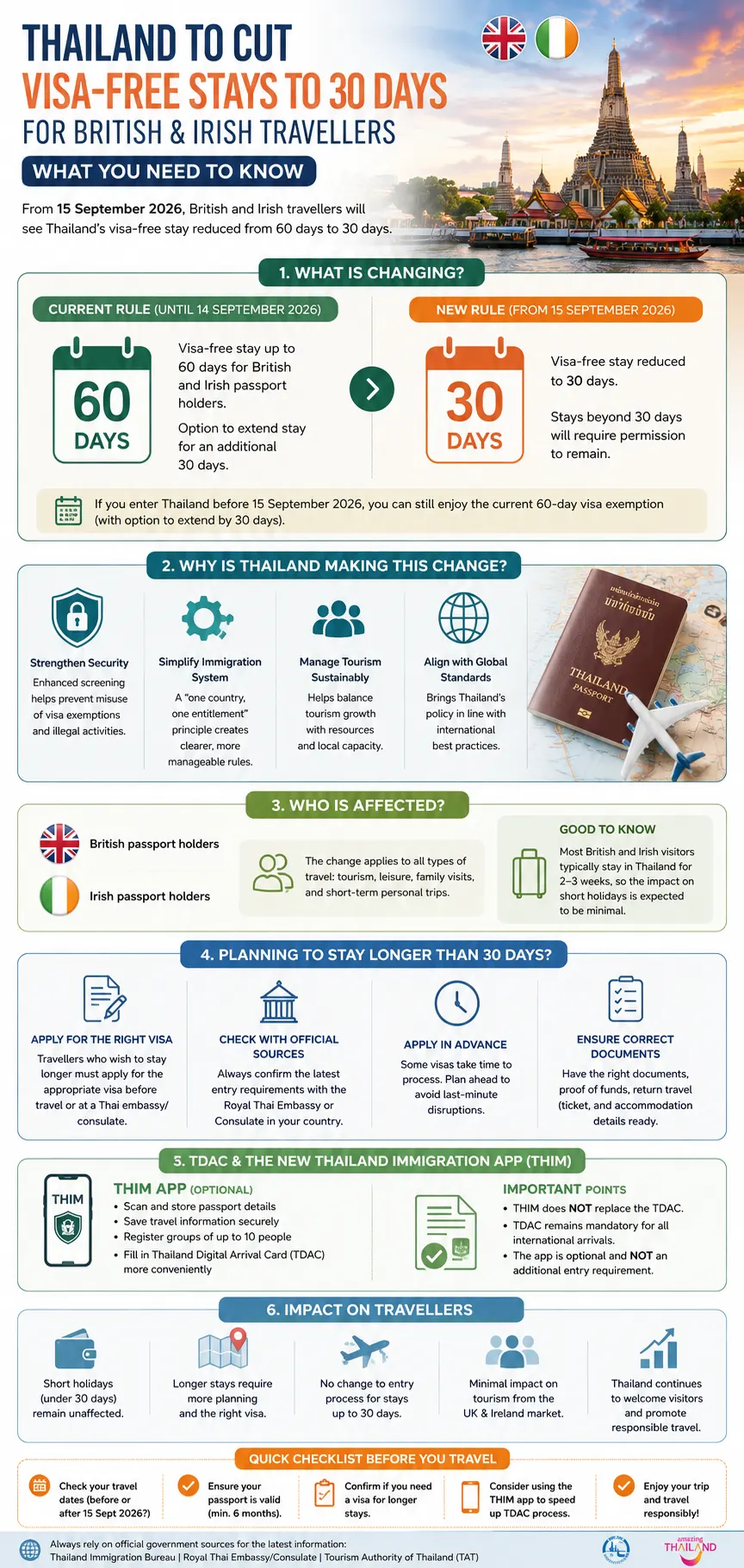
Thailand’s New 30-Day Visa Rule: What Is Changing?
The most important change is straightforward:
From 15 September 2026, the visa exemption available to eligible British and Irish ordinary passport holders will provide up to 30 days per visit.
Both the United Kingdom and Ireland remain on Thailand’s new 30-day visa-exemption list. They have not been removed from visa-free travel altogether.
Thailand’s revised framework covers 60 countries and territories under the principal 30-day visa-exemption arrangement. The official list includes the UK and Ireland, as well as countries such as Australia, Canada, France, Germany, India, Japan, New Zealand, Singapore, Spain, Sweden, Switzerland and the United States.
The key point is therefore not that British and Irish travellers suddenly need a visa to visit Thailand. Instead, the maximum visa-free stay is being reduced from 60 days to 30 days.
The change applies to ordinary passport holders and remains subject to Thailand’s immigration requirements.
The important date: 15 September 2026
Timing matters.
Travellers entering Thailand before the new measures take effect can remain under the permitted period granted under the existing rules. Thailand’s Ministry of Foreign Affairs has specifically stated that people already in Thailand under the current exemption arrangements, and travellers entering before the revised rules take effect, may stay until the expiry of their permitted period.
That means travellers should look at their date of entry, not simply the date on which they book their flight.
A traveller entering Thailand on 14 September 2026 is in a different position from someone entering on 15 September 2026.
The safest approach is to plan around the new rules if the trip begins on or after 15 September.
What British Travellers Need to Know
British citizens travelling on a full British citizen passport should pay particular attention to the new 30-day limit.
The Royal Thai Embassy in London currently states that British ordinary passport holders can enter Thailand without a visa under the visa-exemption scheme. The embassy’s current page reflects the previous 60-day arrangement, but Thailand’s revised framework confirms that the entitlement changes to 30 days from 15 September 2026.
The UK government’s Thailand travel advice also currently reflects the 60-day arrangement, but notes that Thai authorities control and enforce the entry rules. Travellers are advised to check with the Thai Embassy if they are uncertain about how the rules apply to their circumstances.
British travellers should therefore avoid relying on older webpages, travel blogs or booking websites that still show the previous 60-day exemption after the September change.
Passport requirements
British travellers should also make sure their passport meets Thailand’s entry requirements.
The UK government advises that a British passport should have an expiry date at least six months after the date of arrival in Thailand and contain at least one blank page.
This is an important pre-travel check because a traveller can have the correct visa status but still encounter an entry problem if their travel document does not meet the requirements.
What Irish Travellers Need to Know
Irish ordinary passport holders are also included in Thailand’s revised 30-day visa-exemption scheme.
The official Thai list published for the September 2026 changes includes Ireland alongside the United Kingdom in the countries eligible for visa-free stays of up to 30 days.
For Irish travellers, the practical planning principle is the same:
- A holiday of up to 30 days can continue to fall under visa exemption.
- A stay longer than 30 days should be planned using an appropriate visa or another legally available immigration option.
- The traveller should check the latest requirements before departure.
- Entry remains subject to the decision of Thai immigration authorities.
This is particularly important for people combining Thailand with other destinations in Southeast Asia. A traveller who previously built a 45- or 60-day itinerary around Thailand’s generous visa-free allowance will now need to reconsider the length and structure of the trip.
Why Is Thailand Changing the 60-Day Visa Exemption?
The decision is not simply about reducing the amount of time tourists can spend in Thailand.
Thailand’s government has described the broader reform as an attempt to make the country’s immigration framework more consistent and easier to manage.
In May 2026, Thailand’s Cabinet approved a revision of its visa-exemption and Visa on Arrival arrangements. The Ministry of Foreign Affairs identified several reasons for the reform:
- National security
- Tourism and economic interests
- Reciprocity
- Reducing overlapping visa privileges
- Making use of the convenience offered by Thailand’s e-Visa system
The previous 60-day exemption applied across a large group of countries. Thailand’s new approach is based on the principle of one country or territory, one entry category, with countries placed into different entry arrangements depending on factors including economic considerations, security assessments, international relations and reciprocity.
This is therefore a broader restructuring of Thailand’s immigration system rather than a rule aimed specifically at British or Irish visitors.
The security argument
Thailand has also said that the new framework is intended to improve screening.
TAT has explained that the revised system is designed to reduce overlapping categories and help ensure that visa privileges are being used for their intended purposes. Thailand also plans stronger use of traveller information and immigration records for screening and verification.
For ordinary tourists, this may not create a noticeable difference at the airport. The change is mainly administrative and regulatory.
But it shows an important direction for the future: Thailand is moving towards a more structured immigration system in which nationality, purpose of travel and length of stay are more closely connected.
What Happened to the 60-Day Rule Introduced in 2024?
Thailand’s decision is effectively a reversal of the major visa relaxation introduced in 2024.
In July 2024, Thailand expanded its visa-exemption arrangements and increased the permitted visa-free stay for eligible nationalities from 30 days to 60 days. The policy was designed partly to support tourism recovery and encourage visitors to spend more time in the country.
The longer stay also created opportunities for travellers to build more ambitious itineraries.
Instead of spending two weeks in Bangkok and Phuket, for example, a visitor could travel more slowly through:
Bangkok → Chiang Mai → Chiang Rai → Krabi → Phuket → Koh Samui
A 60-day allowance made extended regional travel much easier.
Thailand’s tourism authorities had previously promoted the longer stay as an opportunity for travel agents and visitors to create longer itineraries and experience more of the country’s destinations.
The 2026 reform takes the policy in the opposite direction.
The 60-day visa-exemption scheme covering 93 countries and territories is being revoked, with new country-specific arrangements introduced from 15 September.
Will British and Irish Travellers Still Be Able to Visit Thailand Without a Visa?
Yes.
This is one of the most important points to understand.
The September reform does not remove the UK and Ireland from Thailand’s visa-exemption framework.
Instead, British and Irish ordinary passport holders remain eligible for visa-free entry for up to 30 days per visit under the revised arrangement.
For most traditional holidays, this should be more than enough.
Thailand’s tourism authority has said that the impact on the UK and Irish market is expected to be limited because many British and Irish visitors typically travel to Thailand for around two to three weeks.
That means the majority of conventional holidays should fit comfortably within the new limit.
The people most affected will be those who previously relied on the 60-day exemption for longer stays.
What Happens If You Want to Stay for More Than 30 Days?
This is where travellers need to start planning earlier.
If your intended stay exceeds the visa-exempt period, you should investigate an appropriate Thai visa before travelling.
Thailand’s official e-Visa system provides an online route for a number of visa categories. The official Thai e-Visa portal allows applicants to check requirements based on nationality, travel purpose and intended length of stay.
One established option is the Tourist Visa.
Thailand’s Department of Consular Affairs lists the Tourist Visa as a visa category for people travelling for tourism. The traditional Tourist Visa provides a stay of up to 60 days per entry, subject to the applicable conditions.
The Royal Thai Embassy in London also states that its Tourist Single Entry Visa is available to eligible applicants residing in the UK, Ireland and UK territories. Under the embassy’s published conditions, the visa allows a stay of up to 60 days, with the possibility of an additional 30-day extension under Thai immigration rules.
The exact visa that makes sense depends on the purpose and length of the trip.
Common planning scenarios
14–21 day holiday
Usually straightforward. The traveller can generally use the 30-day visa exemption, assuming all other entry conditions are satisfied.
25–30 day holiday
Still within the new visa-free period, but travellers should be careful when calculating their dates.
31–45 day holiday
Do not assume that the previous 60-day visa exemption still applies. Investigate a suitable visa or permitted extension arrangement before travelling.
60-day holiday
Plan around a Tourist Visa or another appropriate immigration route rather than relying on visa exemption.
Repeated or extended visits
Take extra care. Thailand has indicated that repeated entries under visa exemption can be scrutinised, particularly where immigration authorities believe the exemption is being used in a way inconsistent with its intended purpose.
Can the New 30-Day Visa Exemption Be Extended?
Yes, Thailand’s updated official embassy information states that the new 30-day visa-exemption category can be extended for another period not exceeding 30 days, with the extension remaining at the discretion of an immigration officer.
That means the theoretical maximum can reach 60 days when an extension is granted.
However, this is an important distinction:
The initial visa exemption is 30 days. A further stay is not automatic.
Travellers should not build an itinerary that assumes an extension will definitely be granted.
The official Thai Embassy information specifically says that extension is at the discretion of the immigration officer.
For someone who already knows that their trip will last more than 30 days, applying for the appropriate visa before travelling is generally a more predictable approach than arriving in Thailand and assuming an extension will be approved.
Financial Requirements: How Much Money May You Need?
Thailand’s visa-exemption conditions also include a financial requirement.
Official Thai embassy guidance states that travellers entering under the Tourist Visa Exemption Scheme should have adequate funds equivalent to at least:
- 20,000 Thai baht per person
- 40,000 Thai baht per family
Immigration officers may ask travellers to demonstrate that they have sufficient funds.
This is not necessarily something every tourist will be asked to demonstrate, but it is a requirement travellers should be prepared to satisfy.
The broader lesson is simple: visa-free does not mean requirement-free.
A traveller still needs to satisfy Thailand’s immigration conditions.
Do You Need an Onward or Return Ticket?
Travellers entering Thailand under visa exemption may also be required to show evidence that they plan to leave Thailand within the permitted period.
Thai embassy guidance states that travellers using the 30-day exemption should possess fully paid travel arrangements leaving Thailand within the relevant 30-day period.
This is particularly important for independent travellers.
Suppose someone books:
London → Bangkok
and plans to decide later when they will leave.
Under the new rules, this could create unnecessary uncertainty at check-in or immigration.
A better approach is to have a clear onward or return journey that fits within the permitted stay.
Thailand Digital Arrival Card: A Separate Requirement
The visa change should not be confused with another major development in Thailand’s entry system: the Thailand Digital Arrival Card (TDAC).
The TDAC is not a visa.
It is an online arrival registration system used for immigration purposes.
Since 1 May 2025, foreign nationals entering Thailand by air, land or sea have been required to submit the TDAC before arrival.
This requirement continues even if a traveller enters Thailand without a visa.
In other words:
Visa exemption and TDAC are two different things.
A British traveller staying for 10 days still needs to complete the TDAC.
An Irish traveller staying for 28 days also needs to complete the TDAC.
A traveller entering Thailand with a visa must also complete the TDAC.
When Should You Complete the TDAC?
The official Immigration Bureau’s TDAC guidance says that the form should be submitted within three days before arrival, including the date of arrival.
Travellers will need information such as:
- Passport details
- Flight or travel information
- Arrival date
- Accommodation address in Thailand
- Purpose of travel
- Email address
- Required health declaration information
The TDAC is valid for the particular arrival and must be completed again for subsequent entries.
Children and infants are also required to have a TDAC when applicable under the system’s rules.
Is TDAC free?
Yes.
Thailand’s Royal Thai Embassy in London warns that the TDAC is free and travellers should use the official Immigration Bureau website rather than websites that ask for payment.
This is worth remembering because online arrival-card systems can attract unofficial websites offering paid “assistance”.
Use the official Thai Immigration channel.
What Is the New Thailand Immigration Management App?
Thailand is also developing a digital immigration platform known as the Thailand Immigration Management application, or THIM.
The application is intended to make registration and future immigration services more convenient.
According to TAT, THIM can help travellers record passport information, accommodation details and travel information. It also supports group registration for up to 10 travellers.
But there is an important point:
THIM does not replace the TDAC.
Thailand has described THIM as an optional application while the system is being developed and rolled out. Travellers must continue to complete the TDAC through the required official channel.
For families and group travellers, the ability to handle information together could eventually make arrival preparation easier.
What Does the Change Mean for Long-Haul British and Irish Travellers?
The biggest impact will probably be felt by travellers who treat Thailand as a long-haul destination worth exploring slowly.
For a couple travelling from the UK, a 60-day visa-free period created considerable flexibility.
They could spend:
- A week in Bangkok
- A week in Chiang Mai
- Several days in Chiang Rai
- Two weeks in southern Thailand
- Time on multiple islands
- A few days in another Thai region
- Additional time for rest and unplanned travel
The 30-day exemption makes that style of trip more compressed.
Travellers can still do it, but the immigration planning becomes more important.
The change may also affect people travelling during the winter season, long-stay holidaymakers, remote workers whose travel arrangements do not fit ordinary tourism rules, and visitors combining Thailand with family or regional travel.
The solution is not necessarily to cancel a longer trip.
It is to choose the correct immigration route before booking a non-refundable itinerary.
What Does It Mean for Families?
For families taking a normal two- or three-week holiday, there should be little practical change.
A 30-day visa exemption comfortably covers most school-holiday trips.
But families travelling for six weeks or longer need to review the rules carefully.
This becomes even more important when children have different passport nationalities from their parents.
Visa rules are generally determined by the travel document and nationality of the traveller, not simply by the nationality of the person making the booking.
Families should therefore check each traveller individually.
The TDAC process can be completed for groups of up to 10 people, which may make the administrative side easier.
What Does It Mean for Backpackers and Slow Travellers?
This group may notice the change more than conventional holidaymakers.
Backpacking around Thailand and neighbouring countries often involves flexible dates.
A traveller might enter Thailand without a fixed plan, move between islands, cross into another country and return later.
The revised system means travellers should pay more attention to their permitted stay each time they enter Thailand.
The days of assuming that a 60-day visa-free allowance will automatically be available are coming to an end.
Thailand’s authorities have also said that repeated entries under visa exemption can be scrutinised.
The safest strategy is to treat each entry as a genuine immigration event and ensure that the travel purpose, documentation and length of stay make sense.
What Does It Mean for Travel Agents?
The change creates both a challenge and an opportunity for travel professionals.
For standard packages of one to three weeks, very little changes.
But agents selling longer Thailand itineraries will need to make visa planning part of the booking conversation.
A 45-day itinerary should no longer be sold on the assumption that a British or Irish passport automatically provides 60 visa-free days.
Agents may need to ask:
How long will the client stay?
What is the purpose of the trip?
Will the traveller leave Thailand within 30 days?
Does the traveller require a Tourist Visa or another category?
Does the itinerary involve multiple Thai entries?
This could actually make travel advice more valuable.
Rather than treating visa arrangements as an afterthought, agents can build immigration planning into the itinerary from the beginning.
What Should Travellers Do Before Booking Their Trip?
A simple planning process can prevent most problems.
Step 1: Check your passport
Make sure your passport satisfies Thailand’s validity requirements.
British travellers should have at least six months’ validity after arrival and a blank page, according to current UK government guidance.
Step 2: Count your days carefully
Do not simply estimate “about a month”.
Work out your exact arrival and departure dates.
If your trip extends beyond 30 days, investigate the appropriate visa route.
Step 3: Check the official Thai visa system
Thailand’s official e-Visa portal provides a country and travel-purpose based system for determining applicable visa categories.
Step 4: Book appropriate onward travel
If travelling under visa exemption, ensure your onward or return arrangements satisfy the applicable requirements.
Step 5: Prepare proof of funds
Be prepared to demonstrate sufficient funds if requested by immigration.
Step 6: Complete TDAC
Submit the Thailand Digital Arrival Card within the permitted three-day window before arrival.
Step 7: Check again before departure
Thailand’s immigration rules can change.
The safest habit is to check the official Thai Embassy, Ministry of Foreign Affairs, Immigration Bureau and e-Visa information shortly before departure.
The Difference Between Visa-Free Entry and a Tourist Visa
It is useful to understand the terminology.
Visa exemption
You do not obtain a visa before travelling.
If eligible, you arrive in Thailand and request entry under the exemption scheme.
From 15 September 2026, eligible British and Irish ordinary passport holders will have an initial permitted stay of up to 30 days under the revised scheme.
Tourist Visa
You apply for a visa before travelling.
Thailand’s Tourist Visa is designed for tourism and can provide a longer permitted stay than the basic visa exemption, subject to the visa’s terms. The official Thai e-Visa system is the appropriate starting point for checking current requirements.
TDAC
The TDAC is neither of these.
It is a mandatory digital arrival registration for foreign travellers and applies regardless of whether the traveller is entering under a visa, visa exemption or another applicable entry category.
Keeping these three concepts separate makes Thailand’s new system much easier to understand.
Will the New Rule Make Thailand Less Attractive?
Probably not for the majority of British and Irish holidaymakers.
Thailand remains a destination where a two- or three-week holiday can cover a substantial amount of ground.
Bangkok, Chiang Mai, Phuket, Krabi, Koh Samui and many other destinations remain accessible without the need for a traditional tourist visa for eligible British and Irish ordinary passport holders, provided the trip fits within the visa-exempt period.
The bigger question is whether the change affects the market for longer stays.
That could include:
- Long winter holidays
- Extended family visits
- Backpacking
- Slow travel
- Multi-region itineraries
- Longer island stays
- Repeat travellers
- People combining tourism with other activities
For these travellers, Thailand’s immigration system now requires more planning.
The Wider Future of Thailand’s Immigration System
The September 2026 reform should be viewed as part of a larger shift.
Thailand is not abandoning visa-free tourism.
Instead, it is moving towards a more segmented system.
The government has explicitly linked the reform to security, economic interests, reciprocity and reducing overlapping immigration categories.
At the same time, Thailand is investing in digital immigration infrastructure.
TDAC has already replaced the traditional paper arrival card.
THIM is being developed to connect travellers with additional immigration services.
The e-Visa platform provides a digital route for visa applications.
These changes point towards an immigration system that is increasingly digital, data-driven and nationality-specific.
For travellers, that means one thing above all:
Checking the rules before travelling is becoming more important than relying on what worked on the previous trip.
A Practical Example: How the Rule Changes a Holiday
Imagine a British couple wants to visit Thailand.
Their original plan was:
Arrival: 1 November 2026
Departure: 20 December 2026
That is roughly seven weeks.
Under the old 60-day exemption, they could have expected the trip to fit within the visa-free period, assuming all other requirements were satisfied.
Under the new system, their initial visa exemption is only 30 days.
Their original itinerary therefore needs to be reconsidered.
They could:
Option 1: Shorten the Thailand portion to 30 days.
Option 2: Apply for an appropriate tourist visa before travelling.
Option 3: Investigate whether an extension is available and suitable, understanding that approval is discretionary.
Option 4: Restructure the wider Southeast Asian itinerary and spend part of the trip outside Thailand.
The important point is that they should make this decision before departure, rather than discovering the problem after arriving in Bangkok.
What Travellers Should Not Assume
Several assumptions could create problems after the new rules take effect.
Don’t assume 60 days is still automatic
The old 60-day exemption is being replaced.
Don’t assume visa-free means no paperwork
The TDAC remains mandatory for foreign travellers.
Don’t assume an extension is guaranteed
Any extension is subject to Thai immigration approval.
Don’t assume all passports have identical rules
Thailand uses nationality-specific arrangements.
Don’t rely on old travel information
Many websites will continue to display the previous 60-day rules until they are updated.
Don’t confuse TDAC with a visa
TDAC is an arrival registration system, not immigration permission to stay.
Don’t leave visa planning until the airport
If you already know that your stay will exceed 30 days, investigate the correct visa route before travelling.
Thailand Visa Change 2026: Quick Summary for British and Irish Travellers
| Question | Rule from 15 September 2026 |
|---|---|
| Can British citizens still enter Thailand visa-free? | Yes, if travelling on an eligible ordinary passport and meeting the requirements |
| Can Irish citizens still enter Thailand visa-free? | Yes |
| New visa-exempt stay | Up to 30 days per visit |
| Previous exemption | Up to 60 days |
| Effective date | 15 September 2026 |
| Can a 30-day exemption be extended? | An extension of up to 30 additional days may be possible, subject to immigration approval |
| Is extension automatic? | No |
| Is TDAC still required? | Yes |
| Is TDAC a visa? | No |
| When should TDAC be completed? | Within 3 days before arrival, including the arrival date |
| Should travellers carry proof of funds? | Yes, travellers should be prepared to demonstrate sufficient funds if requested |
| Should travellers have onward travel evidence? | Travellers entering under visa exemption should be prepared to show travel leaving Thailand within the permitted period |
| Where should longer-stay travellers check visa options? | Official Thai e-Visa and Thai Embassy/Consular channels |
The official Thai authorities should always be treated as the final reference because entry decisions and immigration requirements can change.
Final Takeaway: Thailand Is Still Open, But Longer Trips Need Better Planning
Thailand’s decision to reduce visa-free stays for British and Irish travellers from 60 days to 30 days from 15 September 2026 is a meaningful immigration change, but it should not be mistaken for a major restriction on ordinary holidays.
For the typical visitor spending 10, 14 or 21 days in Thailand, little is likely to change.
For longer-stay travellers, the difference is much more significant.
The old assumption was simple: arrive in Thailand with an eligible British or Irish passport and potentially have up to 60 days available under the visa-exemption scheme.
The new system is different.
From 15 September, the starting point becomes 30 days.
If your trip is longer, you need to think about the appropriate visa or permitted extension before you travel. If you are travelling under the visa exemption, you should also be ready to meet Thailand’s immigration conditions, including financial and onward-travel requirements where applicable.
There is another lesson in the change.
Thailand’s immigration system is becoming increasingly digital and structured. The TDAC is already part of the arrival process, while the THIM application is being developed to support additional immigration services. At the same time, Thailand’s e-Visa system gives longer-stay and purpose-specific travellers a digital route to apply for the appropriate visa.
For British and Irish travellers, the message is therefore not “Thailand is becoming difficult to visit.”
It is simpler:
Short holiday? The 30-day visa exemption should continue to make Thailand easy to visit.
Longer holiday? Plan your immigration status before you fly.
And for every traveller, regardless of how long the holiday lasts, check the latest official requirements shortly before departure.
Thailand remains open to British and Irish visitors. The rules governing how long they can stay without a visa are simply changing.
Official sources for readers
- Thailand Ministry of Foreign Affairs – revised visa-exemption measures
- Tourism Authority of Thailand – updated visa measures
- Royal Thai Embassy, London – visa exemption information
- Royal Thai Embassy – updated 30-day visa exemption scheme
- Thailand official e-Visa portal
- Thailand Digital Arrival Card – official Immigration Bureau guidance
- UK Government – Thailand entry requirements