
If you are planning a holiday in the UK, visiting family, attending a business meeting or travelling for another permitted reason, you may be wondering whether you need to prove your English-language ability before applying for a visitor visa.
This is a common concern, particularly among applicants who have heard that the UK requires English-language tests for certain immigration routes.
The good news is that there is no general English-language test requirement for the UK Standard Visitor visa. You do not normally need to take IELTS, book a Secure English Language Test (SELT) or achieve a particular English-language score simply to visit the UK.
However, that does not mean every visitor visa application will be approved automatically. The Home Office still needs to be satisfied that you are travelling for a permitted purpose, intend to leave the UK at the end of your visit, have sufficient funds for your trip and meet the relevant immigration requirements.
There is also an important distinction between speaking English and submitting documents in English. Although applicants do not normally have to pass an English test for a Standard Visitor visa, supporting documents that are not in English or Welsh generally need to be accompanied by an appropriate translation.
This guide explains the UK Standard Visitor visa English language requirement, the latest official guidance, the documents you may need, how to apply, common refusal risks and how to prepare a stronger application.
Latest update: October 2026. Check the current GOV.UK guidance before submitting your application, as immigration rules, fees and supporting-document requirements can change.
1. Does the UK Standard Visitor Visa Have an English Language Requirement?
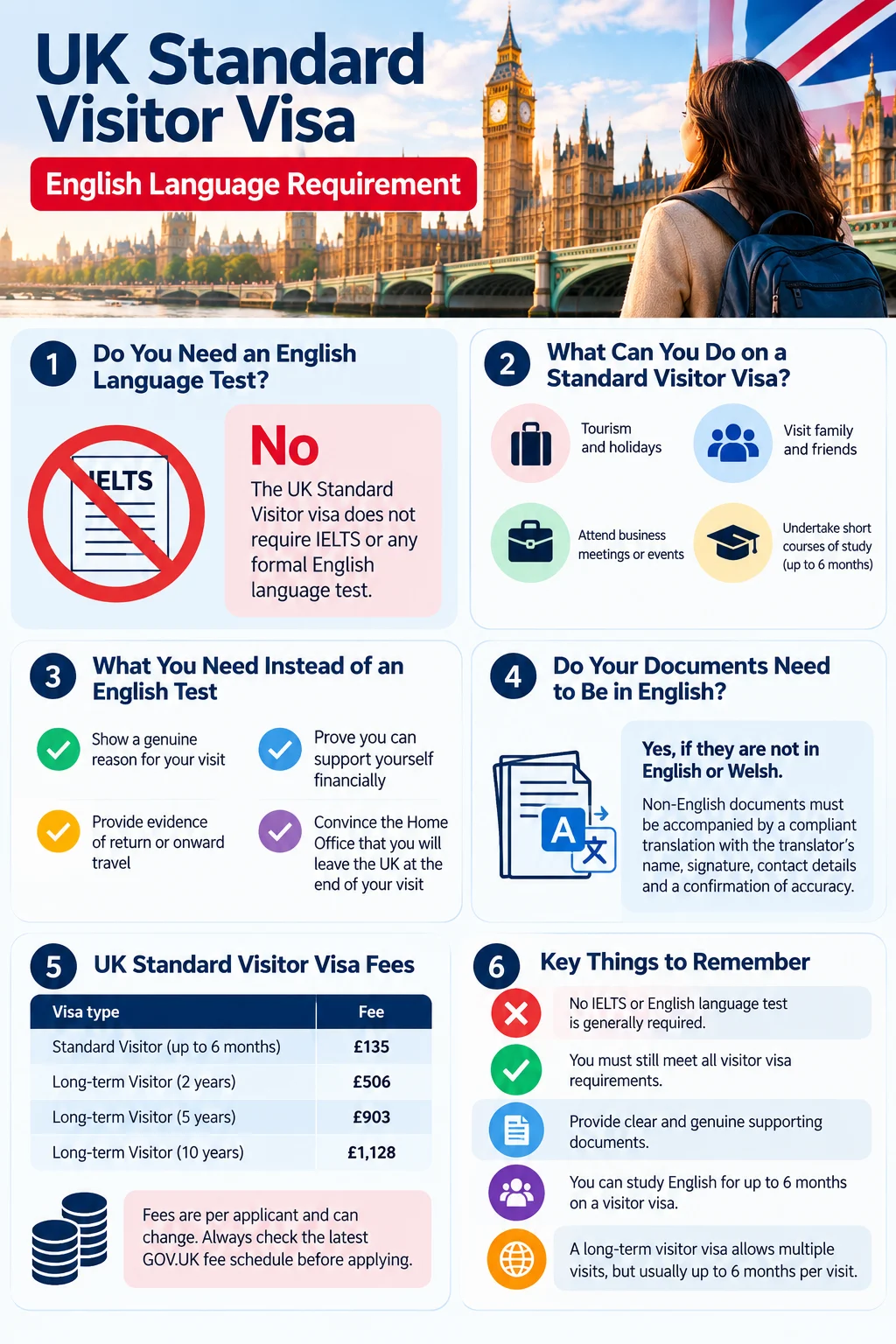
No. The UK Standard Visitor visa does not generally require applicants to demonstrate a particular level of English.
Unlike some work, family, student and settlement routes, the Standard Visitor route does not normally require an applicant to pass an approved English-language test as part of the visa eligibility criteria.
This means that, for a typical visit to see relatives, enjoy a holiday or attend a permitted business event, you do not need to obtain an IELTS certificate simply to satisfy the visitor visa rules.
The important question is not whether you speak fluent English. It is whether you meet the requirements of the Visitor route.
Under the official guidance, visitors must be able to demonstrate that their intended activities are permitted, that they will leave the UK at the end of their visit and that they can support themselves financially or have suitable funding from another person. They must also be able to pay for their return or onward journey, unless someone else will cover the cost.
Official guidance: GOV.UK – Visit the UK as a Standard Visitor.
Do you need IELTS for a UK visitor visa?
No, IELTS is not normally required for a Standard Visitor visa.
You do not generally need to:
- Take IELTS Academic or IELTS General Training.
- Pass a UKVI-approved English-language test.
- Achieve a specific CEFR level, such as A1, B1 or B2.
- Submit an English-language certificate solely to qualify as a visitor.
You may encounter English-language requirements when researching other UK immigration categories. Those requirements should not be confused with the Standard Visitor route.
For example, a person applying for a Skilled Worker visa, a family visa or settlement may need to satisfy a specific English-language requirement, depending on the route and circumstances.
A visitor applying to enter the UK for a short holiday is in a different position.
Does this mean English ability is irrelevant?
Not entirely in practical terms. You should understand the purpose of your trip and be able to provide accurate information about your plans. You may also need to communicate with airline staff, border officials or other service providers.
However, these practical considerations do not create a general IELTS or formal English-language test requirement under the Standard Visitor route.
2. Latest News Update: What Do the Current Visitor Visa Rules Say?
The latest official guidance available in October 2026 continues to distinguish the Standard Visitor route from immigration categories that require formal English-language evidence.
The government’s Standard Visitor overview sets out the permitted activities, eligibility conditions, application process and visa requirements. The supporting-document guidance was also updated on 8 October 2026, including an update relating to documents for certain Erasmus+ placements.
These updates reinforce the importance of checking the current rules for your specific purpose of travel. They do not introduce a general IELTS requirement for ordinary Standard Visitor visa applicants.
Official sources:
What should applicants take from this update?
If you are preparing an application, focus on the requirements that actually apply to the Visitor route.
First, establish that your planned activities are permitted. Next, prepare evidence explaining the purpose of your visit, your financial circumstances and your intention to leave the UK when your visit ends.
Finally, check that the documents you submit meet the relevant evidence and translation requirements.
Taking an English-language test that is not required will not, by itself, make an otherwise weak visitor visa application stronger. It is generally more useful to prepare clear, relevant evidence that addresses the Home Office’s eligibility concerns.
3. What Is the UK Standard Visitor Visa?
The Standard Visitor visa is a UK immigration route for people who want to visit temporarily for permitted purposes.
It is commonly used for tourism, visiting family and friends, certain business activities and some short courses of study.
Depending on the applicant’s nationality, a person may need to obtain a Standard Visitor visa before travelling. Others may be able to visit using an Electronic Travel Authorisation (ETA), while some travellers may not need either, depending on their circumstances and the applicable rules.
The fact that a traveller does not need a visa does not necessarily mean they are exempt from the Visitor route’s eligibility requirements.
How long can you stay in the UK?
A Standard Visitor can usually stay for up to six months on a visit.
Some specific circumstances have different arrangements. For example, certain academic visits and medical visits may qualify for longer periods under the relevant rules.
A long-term Standard Visitor visa may also be available for people who travel regularly. Such visas can be issued for two, five or ten years, but the maximum permitted stay is generally six months on each visit.
A long-term visa does not give you permission to live in the UK continuously or use repeated visits to make the UK your main home.
Official guidance: Standard Visitor visa application and fees.
4. Who Can Apply for a UK Standard Visitor Visa?
The Standard Visitor route is designed for people who intend to visit the UK temporarily and undertake permitted activities.
You may be eligible if you plan to:
- Take a holiday in the UK.
- Visit family members or friends.
- Attend permitted business meetings or events.
- Undertake certain short courses of study.
- Participate in other activities expressly allowed under the Visitor route.
- Transit through the UK where the relevant visitor arrangements apply.
Your nationality determines whether you need a visitor visa, an ETA or neither before travelling.
What does the Home Office assess?
The Home Office generally considers whether you:
- Intend to undertake a permitted activity.
- Will leave the UK at the end of your visit.
- Have sufficient funds to cover the visit and your dependants, if applicable, or have appropriate financial support.
- Can pay for your return or onward journey, or have suitable funding for it.
- Will not use frequent or successive visits to live in the UK for extended periods or make it your main home.
The precise evidence needed depends on your personal circumstances and the reason for your visit.
5. What Documents Do You Need if You Do Not Need IELTS?
Because there is no general English-language test requirement, your preparation should focus on the documents that support your visit.
The correct evidence will depend on your purpose of travel, employment, financial position, family circumstances and travel history.
A. Valid passport or travel document
You need a passport or travel document that remains valid for the whole of your intended stay.
Check that your personal details are accurate and that the document is in suitable condition for travel.
B. Evidence of the purpose of your visit
Explain why you want to travel to the UK and what you plan to do during your stay.
Depending on your circumstances, relevant evidence might include:
- A proposed travel itinerary.
- Hotel or accommodation details.
- An invitation from family or friends.
- Details of a business meeting or event.
- Evidence of enrolment or acceptance for an eligible short course.
- Other documents relevant to the permitted activity.
You do not need to submit every possible document. Choose evidence that supports your actual circumstances and proposed visit.
C. Evidence of financial circumstances
You must be able to explain how the trip will be funded.
Depending on your situation, evidence may include bank statements, payslips, employment letters, business records or documents showing savings and other sources of income.
The Home Office does not apply one universal minimum bank balance to every Standard Visitor applicant. The amount required depends on the expected cost of the visit, the applicant’s circumstances and whether another person will provide financial support.
A bank balance should therefore be considered in context. A large deposit without an understandable explanation may raise questions, while a realistic travel budget supported by consistent financial evidence may provide a clearer picture of affordability.
D. Evidence of employment or other commitments
Where relevant, documents showing employment, business activity, education or family responsibilities may help explain your circumstances outside the UK.
For example, an employment letter might confirm your role, salary and approved leave. A self-employed applicant might provide business registration documents or evidence of ongoing business activity.
These documents do not automatically prove that an applicant will return home, but they may help demonstrate the wider circumstances surrounding the visit.
E. Evidence of accommodation and sponsorship
If you will stay with relatives or friends, you may provide details of your accommodation and the person hosting you.
If another person will pay for your trip, explain who that person is, what they will cover and whether they have the means to provide that support.
A sponsor’s invitation letter is not a guarantee of approval. The Home Office still needs to assess the applicant’s own circumstances and the overall credibility of the visit.
Official guidance: Visiting the UK – supporting documents.
6. Do Your Supporting Documents Have to Be in English?
This is where many applicants confuse an English-language test requirement with a document requirement.
Although you do not normally need IELTS for a Standard Visitor visa, documents that are not in English or Welsh generally need to be accompanied by a translation that meets Home Office requirements.
For example, an applicant might have a bank statement in Hindi, an employment certificate in Punjabi or a civil document issued in another language. If that document is submitted as evidence, an appropriate translation may be necessary.
What should a translation contain?
The official supporting-document guidance states that a translation must be capable of independent verification by the Home Office.
It should include:
- Confirmation from the translator that the translation is accurate.
- The date of the translation.
- The translator’s full name and signature.
- The translator’s contact details.
Check the latest official guidance before arranging translations, particularly if your application contains several documents in different languages.
Does every document need to be translated?
Not necessarily. The requirement concerns documents you submit as evidence. You should identify which documents are relevant to your application and ensure that any supporting evidence not in English or Welsh is accompanied by the required translation.
Do not assume that a document will be accepted simply because you have provided an informal English summary of it.
Can you translate the documents yourself?
You should follow the official translation requirements rather than assume that a self-prepared translation will be accepted. Use a translation arrangement that meets the published requirements and allows the Home Office to verify the translation independently.
Official source: Visitor visa supporting-document guidance.
7. Can You Visit the UK to Study English Without IELTS?
Yes. Certain short courses of study, including English-language courses, are permitted under the Standard Visitor route.
This is an important distinction: you may be able to travel to the UK to study English without having to prove your English ability through IELTS for the purpose of obtaining a Standard Visitor visa.
However, the course must fit the rules for the Visitor route.
Studying for up to six months
A Standard Visitor can generally study for up to six months at an accredited institution, including an English-language course, provided the applicable requirements are met.
You should check that the institution is accredited for the purpose of the route and that the course meets the relevant conditions.
Studying English for longer than six months
If you intend to study an English-language course for more than six months but no more than 11 months, you may need to apply for a Short-term Study visa instead.
If you intend to study a different course for longer than six months, a Student visa or another appropriate immigration route may be required, depending on the course and institution.
The correct route depends on the nature and duration of your studies. Do not assume that a Standard Visitor visa permits you to undertake any course simply because you do not need IELTS for the visitor route.
Official source: Visit the UK as a Standard Visitor – study.
8. Do You Need to Speak English at the UK Visa Application Centre?
Applicants may need to attend an appointment to establish their identity, provide biometrics and submit the required documents.
The application process can include instructions, appointment information and other practical communications. Applicants should read these carefully and arrange appropriate assistance where permitted if they have difficulty understanding them.
However, an appointment for biometrics is not the same as a formal English-language examination.
There is no general requirement to pass an English test merely because you are applying for a Standard Visitor visa.
If you have a specific concern about an appointment, check the instructions from the relevant visa application centre and the official application guidance.
9. How Much Does a UK Standard Visitor Visa Cost?
The published fee for a standard visit of up to six months is £135, according to the official GOV.UK application guidance available in October 2026.
Long-term Standard Visitor visas have higher fees.
| Visitor visa type | Published fee |
|---|---|
| Standard Visitor visa, up to six months | £135 |
| Long-term Standard Visitor visa, two years | £506 |
| Long-term Standard Visitor visa, five years | £903 |
| Long-term Standard Visitor visa, ten years | £1,128 |
These fees relate to the visa application and should be checked against the current official fee schedule before applying.
Long-term visitor visas permit visits of up to six months at a time, not continuous residence for the full validity period. UKVI may issue a shorter visa than the one requested if it is not satisfied that the applicant meets the requirements for the requested duration.
Each family member generally needs their own application and must pay the applicable fee.
Official source: Apply for a Standard Visitor visa.
10. How to Apply for a UK Standard Visitor Visa
The process is straightforward when you prepare your application carefully, but the evidence should reflect your individual circumstances.
Step 1: Check whether you need a visa
Use the official GOV.UK guidance to establish whether your nationality requires a Standard Visitor visa, an ETA or another arrangement.
Do not assume that every international traveller must apply for a visa.
Step 2: Confirm that your activities are permitted
Identify the main purpose of your trip and check the permitted activities under the Visitor route.
If your purpose involves study, medical treatment, an academic visit or a permitted paid engagement, additional conditions may apply.
Step 3: Prepare your supporting evidence
Collect your passport, travel details, financial evidence and documents explaining the purpose of your visit.
If another person will fund the trip, prepare evidence explaining the arrangement and the sponsor’s circumstances.
Step 4: Arrange translations where necessary
Review each document you intend to submit. Documents not in English or Welsh generally need an appropriate translation that satisfies the official requirements.
Step 5: Complete the online application
Provide accurate information about your intended travel dates, accommodation, finances, employment and immigration history.
Your answers should be consistent with your supporting documents.
Step 6: Pay the application fee
Check the correct fee for the type of visitor visa you need.
Step 7: Attend your appointment
Follow the application instructions for providing your identity documents and biometrics. Submit the required supporting evidence as directed.
Step 8: Wait for a decision
Processing times can vary. Check the latest published processing guidance for your application location and circumstances.
Do not make non-refundable travel arrangements solely on the assumption that your visa will be granted by a particular date.
11. Common Reasons a UK Standard Visitor Visa May Be Refused
Not needing IELTS does not mean that a visitor visa is easy to obtain in every case.
The Home Office assesses whether the applicant meets the visitor requirements. Problems with the evidence or concerns about the purpose of travel may result in refusal.
Unclear purpose of travel
If the application does not explain why you are visiting or what you intend to do, the Home Office may have difficulty assessing whether the visit is genuine and permitted.
Financial evidence that does not make sense
Your stated income, bank statements, travel budget and funding arrangements should be consistent.
If a third party is paying for the visit, explain the relationship and the financial arrangement rather than relying on a general invitation letter.
Insufficient evidence of the intention to leave
Applicants should explain their circumstances outside the UK and provide relevant evidence where appropriate.
Employment, business activity, family responsibilities and ongoing commitments may all be relevant, depending on the individual case. No single document guarantees that the Home Office will be satisfied.
Inconsistent application information
Differences between the application form and supporting documents can raise questions.
Review names, dates, income figures, travel plans and previous immigration information carefully before submission.
Unexplained documents or deposits
If your financial evidence contains unusual transactions or large deposits, be prepared to explain their source where relevant.
A statement showing a large balance does not necessarily establish that the funds are genuinely available to cover the trip.
Incorrect use of the Visitor route
The Standard Visitor route is for temporary visits and permitted activities. It is not a general route for taking employment, living permanently in the UK or undertaking activities outside the permitted rules.
Applicants should confirm that the intended activity is allowed before applying.
12. Practical Tips for a Stronger Visitor Visa Application
If you want to improve the quality of your application, focus on clarity, consistency and relevant evidence.
Explain your trip clearly. Your proposed activities, travel dates and accommodation should make sense together.
Prepare a realistic budget. Consider flights, accommodation, food, local transport and planned activities. Explain who will pay for each major expense.
Use relevant financial evidence. Provide documents that reflect your actual financial circumstances rather than relying on a single bank balance.
Translate documents properly. If you submit documents in another language, check the official translation requirements.
Be accurate about your immigration history. Disclose relevant information as required by the application form. Do not omit a previous refusal or other relevant history simply because you are concerned it may affect the outcome.
Choose the correct immigration route. If your intended activity is not permitted under the Standard Visitor rules, investigate the appropriate visa instead.
Do not take an unnecessary English test. IELTS is not generally required for a Standard Visitor visa. Spend your preparation time on the requirements that actually apply to your application.
13. Frequently Asked Questions
1. Is IELTS required for a UK Standard Visitor visa?
No. IELTS is not generally required for a UK Standard Visitor visa. Applicants must meet the Visitor route’s eligibility conditions, but there is no general English-language test requirement for ordinary visits.
2. What is the English-language requirement for a UK visitor visa?
There is no general minimum English-language level for the Standard Visitor route. Applicants do not normally need to demonstrate A1, B1 or B2 English proficiency to obtain this visa.
3. Can I apply for a UK visitor visa if I do not speak English?
Yes, lack of English proficiency does not automatically prevent you from applying for a Standard Visitor visa. You must still meet the eligibility requirements and provide the necessary supporting evidence.
4. Do I need an English-language certificate for a family visit?
No, an English-language certificate is not generally required simply because you are visiting family in the UK. Your application should instead explain the purpose of your visit and demonstrate that you meet the Visitor route requirements.
5. Do my documents need to be in English?
Supporting documents that are not in English or Welsh generally need to be accompanied by a translation that meets the Home Office requirements. This is separate from the question of whether you personally need to pass an English test.
6. Can I study English in the UK on a Standard Visitor visa?
Yes, you can generally study at an accredited institution for up to six months under the Standard Visitor route if you meet the relevant requirements. English-language courses lasting longer than six months may require a Short-term Study visa, subject to the applicable rules.
7. What is the current UK Standard Visitor visa fee?
The published fee for a standard visit of up to six months is £135 as of October 2026. Check the official GOV.UK fee page before applying because fees can change.
8. Can I work in the UK on a Standard Visitor visa?
The Standard Visitor route does not generally permit employment in the UK. Certain specific business activities are permitted, but they must fall within the rules. Check the permitted activities before travelling.
9. Can I stay in the UK for more than six months on a visitor visa?
Most Standard Visitors can stay for up to six months per visit. Specific exceptions apply to certain visitors, such as eligible academic visitors and people visiting for qualifying medical treatment. The rules depend on the circumstances.
10. Will a visitor visa be refused if I cannot answer questions in English?
There is no general English-language test for the Standard Visitor route. However, you should provide accurate information and follow the application and appointment instructions. If you need assistance, check what arrangements are permitted by the relevant service provider.
11. Does a long-term visitor visa let me live in the UK?
No. A two-, five- or ten-year Standard Visitor visa does not grant permission to live continuously in the UK. Visits are generally limited to six months at a time, and repeated visits must not be used to make the UK your main home.
12. Where can I check the latest official visitor visa rules?
Use the official GOV.UK Standard Visitor guidance, the Visitor Immigration Rules and the official supporting-document guidance.
Conclusion
The UK Standard Visitor visa English language requirement is simpler than many applicants expect. For an ordinary visit, you do not generally need IELTS, a Secure English Language Test or proof of a particular English-language level.
Your attention should instead be on the requirements that matter: the purpose of your visit, the activities you intend to undertake, your finances, your intention to leave the UK and the supporting documents that explain your circumstances.
Remember that document translations are a separate issue. If you submit evidence in a language other than English or Welsh, make sure it meets the Home Office’s published translation requirements.
Before applying, review the latest official guidance and ensure that you have chosen the correct immigration route. If your circumstances are complicated, or you have previously been refused a UK visa, consider seeking advice from a qualified UK immigration solicitor before submitting a new application.