
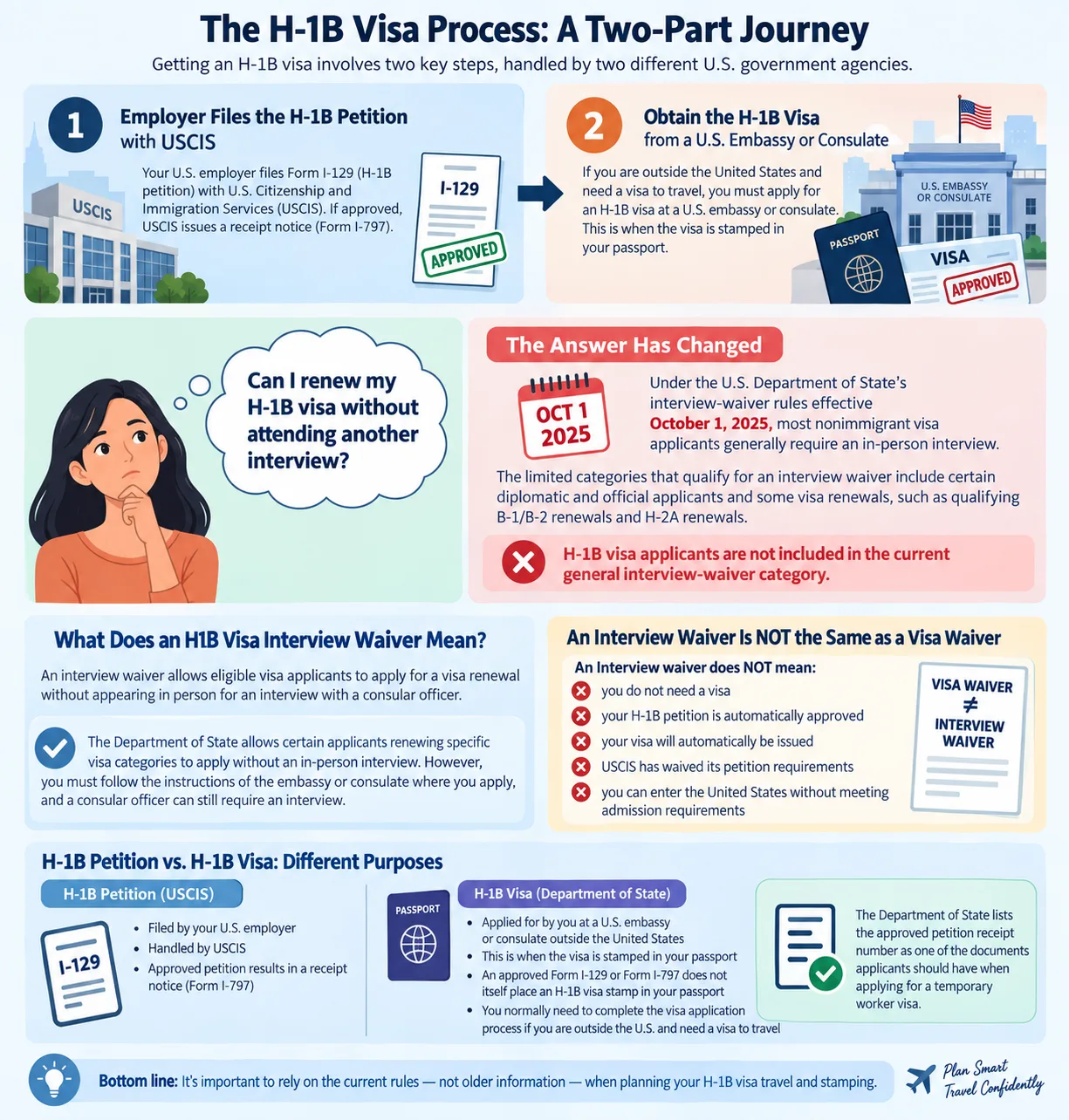
Getting an H-1B visa is often described as a two-part process: first, the employer gets the H-1B petition approved by U.S. Citizenship and Immigration Services (USCIS), and then the worker obtains a visa from a U.S. embassy or consulate if a visa is required for travel to the United States.
For many applicants, the second stage has traditionally raised one practical question:
Can I renew my H-1B visa without attending another interview?
The answer has changed.
Under the U.S. Department of State’s interview-waiver rules effective October 1, 2025, most nonimmigrant visa applicants generally require an in-person interview. The limited categories listed by the Department of State include certain diplomatic and official applicants and some visa renewals, such as qualifying B-1/B-2 renewals and H-2A renewals. H-1B visa applicants are not included in the current general interview-waiver category.
That makes it important to distinguish between older information about the H1B visa interview waiver and the rules that apply today.
This guide explains what the H1B visa interview waiver means, who may qualify under current rules, what changed, how H-1B visa stamping works, which documents applicants should prepare, how an H-1B transfer affects visa stamping, and how workers can plan their travel without relying on outdated waiver information.
H1B Visa Interview Waiver: What Does It Mean?
An interview waiver is a process under which an eligible visa applicant can apply for a visa renewal without appearing personally for an interview with a consular officer.
It is important to understand that an interview waiver is not the same as a visa waiver.
An interview waiver does not mean:
- you do not need a visa;
- your H-1B petition is automatically approved;
- your visa will automatically be issued;
- USCIS has waived its petition requirements;
- you can enter the United States without meeting admission requirements.
The waiver only concerns the in-person visa interview requirement.
The Department of State explains that some applicants renewing certain visa categories may be eligible to apply without an in-person interview. However, applicants must follow the instructions of the embassy or consulate where they apply, and a consular officer can still require an interview.
This distinction matters because an H-1B petition and an H-1B visa serve different purposes.
H-1B petition vs H-1B visa
The H-1B petition is generally handled through USCIS by the U.S. employer.
The visa application is handled by the Department of State through a U.S. embassy or consulate outside the United States.
An approved Form I-129 or Form I-797 does not itself place an H-1B visa stamp in your passport.
If you are outside the United States and need an H-1B visa to travel, you normally need to complete the visa application process.
The Department of State lists the approved petition receipt number as one of the documents applicants should have when applying for a temporary worker visa.
What Is the Current H1B Visa Interview Waiver Rule?
This is the most important section for anyone searching for an H1B visa interview waiver in 2026.
The Department of State announced a major change to nonimmigrant visa interview-waiver eligibility in September 2025.
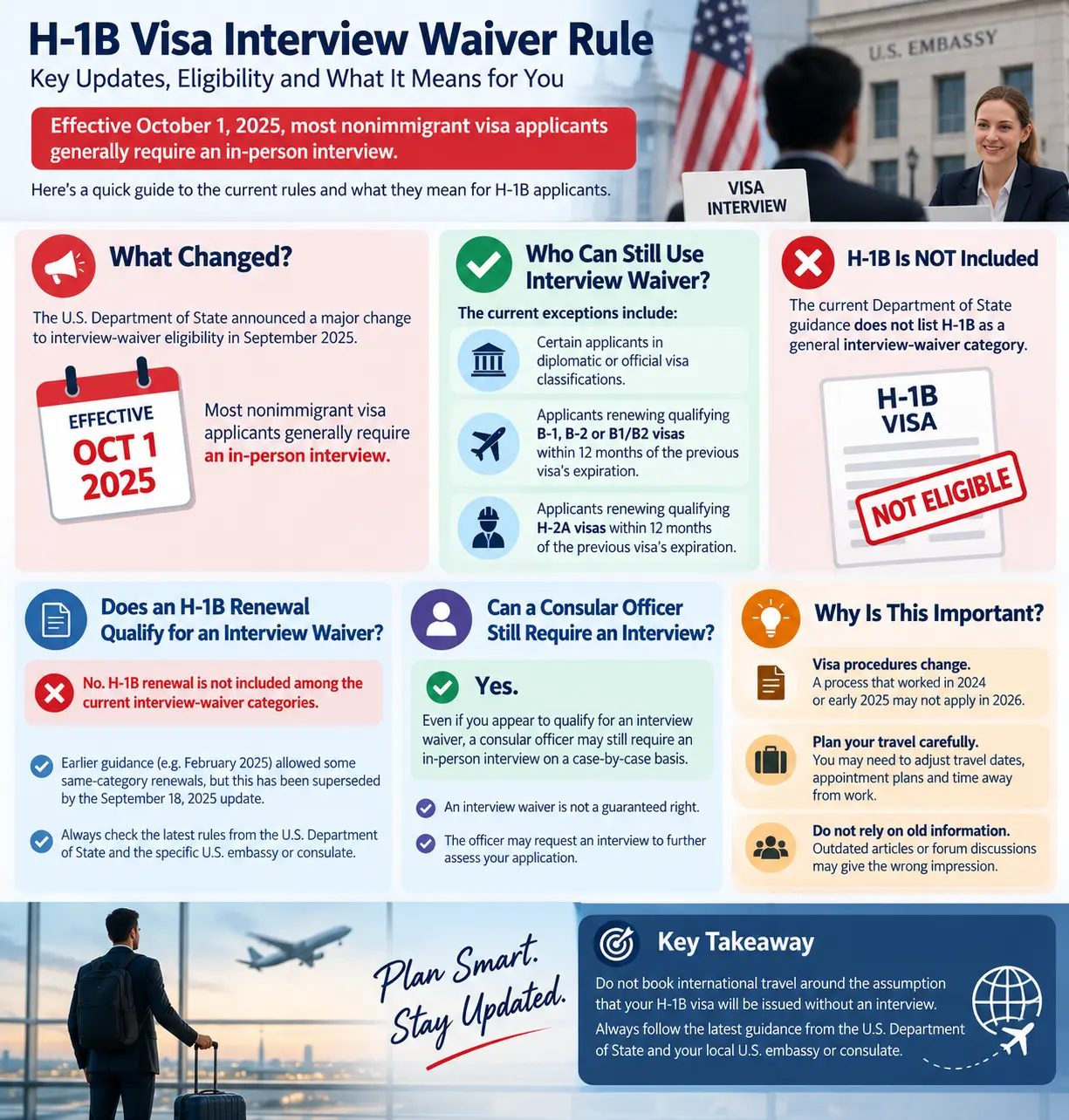
Effective October 1, 2025, most nonimmigrant visa applicants generally require an in-person interview.
The listed exceptions include:
- Certain applicants in diplomatic or official visa classifications;
- Applicants renewing qualifying B-1, B-2 or B1/B2 visas within 12 months of the previous visa’s expiration, subject to the stated conditions;
- Applicants renewing qualifying H-2A visas within 12 months of the previous visa’s expiration, subject to the stated conditions.
The current Department of State guidance does not list H-1B as a general interview-waiver category.
So, if you are an H-1B worker planning to renew an expired H-1B visa, you should not assume that you qualify for an interview waiver simply because your previous H-1B visa was issued successfully.
That assumption may come from older articles, forum discussions or experiences from previous years.
Why did this become important?
Visa procedures change.
A process that worked for an H-1B applicant in 2024 or early 2025 cannot automatically be treated as the process for an applicant in 2026.
This is particularly important when planning international travel. An applicant who expects to submit documents through an interview-waiver process but is instead required to attend an interview may need to reorganise travel dates, appointment plans and time away from work.
Does an H-1B Renewal Qualify for an Interview Waiver?
Under the current general Department of State policy, H-1B renewal is not included among the listed interview-waiver categories.
This is one of the biggest differences between current rules and some older H-1B visa information available online.
Previously, certain applicants renewing a visa in the same category could potentially qualify for an interview waiver if they met specific conditions. The Department of State’s February 2025 guidance, for example, included applicants who previously held a visa in the same category that expired less than 12 months before the new application.
That guidance was subsequently superseded.
The September 18, 2025 update narrowed the categories considerably and specifically states that it supersedes the earlier guidance.
Therefore, applicants should always check the current rules of the Department of State and the specific U.S. embassy or consulate instead of relying on an old eligibility checklist.
Can a Consular Officer Still Require an Interview?
Yes.
Even in categories where an applicant may appear eligible for an interview waiver, the Department of State states that consular officers may require an in-person interview on a case-by-case basis.
This means an interview waiver should never be treated as a guaranteed right.
The officer may determine that an interview is necessary to assess the application.
For H-1B applicants, this is particularly relevant because the current general waiver categories do not include ordinary H-1B renewals.
The practical lesson is simple:
Do not book international travel around the assumption that your visa will be issued without an interview.
Plan around the actual process available at the consular post where you are applying.
H1B Visa Stamping: How Does the Process Work?
“H-1B visa stamping” generally refers to obtaining the H-1B visa in your passport so that you can seek admission to the United States in H-1B classification.
The process is separate from obtaining H-1B status inside the United States.
A typical overseas process involves several stages.
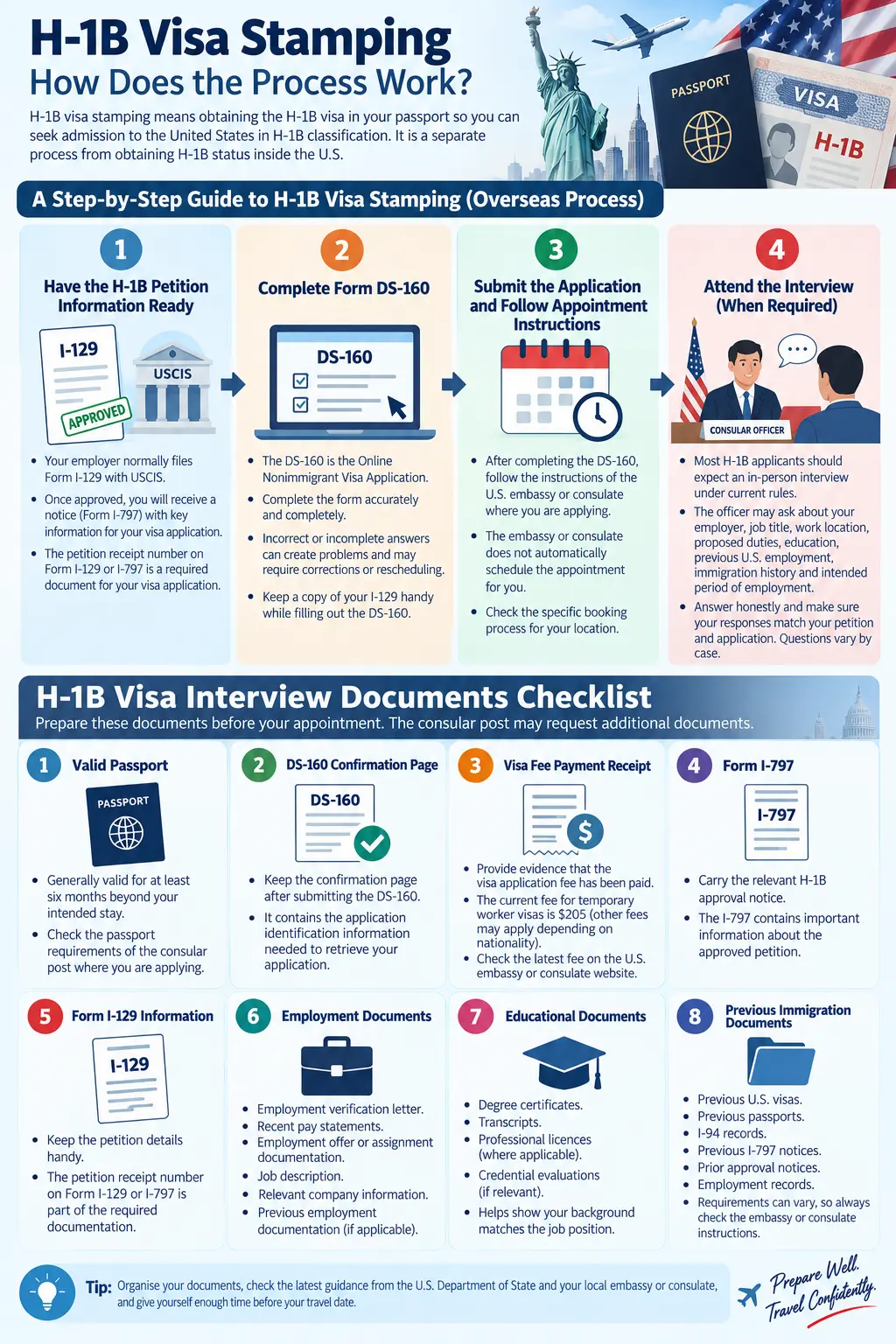
Step 1: Have the H-1B petition information ready
Your employer normally files Form I-129 with USCIS.
Once the petition is approved, the approval notice provides information used during the visa application process.
The Department of State specifically identifies the petition receipt number shown on Form I-129 or Form I-797 as a required document for temporary worker visa applications.
Step 2: Complete Form DS-160
The DS-160 is the Online Nonimmigrant Visa Application.
Applicants must complete the form accurately and completely.
The Department of State warns that incorrect or incomplete answers can create problems and may require corrections or rescheduling.
For petition-based temporary workers such as H-1B applicants, the Department of State recommends having a copy of the I-129 available while completing the DS-160.
Step 3: Submit the application and follow local appointment instructions
After completing the DS-160, applicants must follow the instructions of the embassy or consulate where they are applying.
The Department of State notes that the embassy or consulate does not automatically schedule the appointment for the applicant.
Step 4: Attend the interview when required
Under the current rules, most H-1B applicants should expect an in-person interview.
The officer may ask questions about:
- Your employer;
- Your job title;
- Your work location;
- Your proposed duties;
- Your educational background;
- Your H-1B petition;
- Your previous U.S. employment;
- Your immigration history;
- Your intended period of employment.
The exact questions vary from case to case.
The goal is not to memorise a script. It is to make sure your answers accurately reflect the information contained in your petition and visa application.
H1B Visa Interview Documents Checklist
Preparing documents properly can make the process much easier.
The Department of State identifies several core documents for temporary worker visa applicants. These include the following.
1. Valid passport
Your passport should generally be valid for at least six months beyond your intended period of stay in the United States, unless a country-specific exception applies.
Check the passport requirements of the consular post where you are applying.
2. DS-160 confirmation page
After completing the DS-160, keep the confirmation page.
The Department of State states that applicants should bring the confirmation page because it contains the application identification information needed to retrieve the application.
3. Visa fee payment receipt
You may need to provide evidence that the required visa application fee has been paid.
The Department of State currently lists the temporary worker visa application fee at $205, while noting that other fees can depend on nationality and circumstances.
Because fees and local procedures can change, applicants should verify the amount applicable to them before submitting payment.
4. Form I-797
Carry the relevant H-1B approval notice where applicable.
The I-797 contains important information about the approved petition.
5. Form I-129 information
The petition details should match the information presented in your visa application.
The Department of State specifically identifies the petition receipt number on Form I-129 or I-797 as part of the temporary worker visa documentation.
6. Employment documents
It is sensible to carry supporting employment documents, such as:
- Current employment verification letter;
- Recent pay statements;
- Employment offer or assignment documentation;
- Job description;
- Relevant company information;
- Previous employment documentation where applicable.
The consular post may request additional evidence.
7. Educational documents
Keep copies of relevant:
- Degree certificates;
- Transcripts;
- Professional licences, where applicable;
- Credential evaluations, if relevant.
These can help demonstrate that your background corresponds with the position described in the petition.
8. Previous immigration documents
Depending on your history, you may also want to organise:
- Previous U.S. visas;
- Previous passports;
- I-94 records;
- Previous I-797 notices;
- Prior approval notices;
- Employment records.
The exact documents required can vary.
The Department of State specifically advises applicants to review the instructions of the embassy or consulate where they will apply because additional documentation may be requested.
How Should You Prepare for an H1B Visa Interview?
The strongest preparation is usually straightforward preparation.
Know your own case.
You should be able to explain, in simple terms:
Who is your employer?
Know the legal name of the company and what it does.
What is your job?
Explain your role without using complicated technical language unless the officer asks for more detail.
Where will you work?
Know your primary work location and whether your petition involves client-site work or another arrangement.
What will you do?
Your explanation should broadly match the duties described in your petition.
What are your qualifications?
Be ready to explain your degree, experience and professional background.
How long have you worked for your employer?
Know your employment history and relevant dates.
What is the purpose of your trip?
Your answer should be direct and consistent with your H-1B application.
The best approach is not to create elaborate answers.
It is to provide truthful, concise and consistent information.
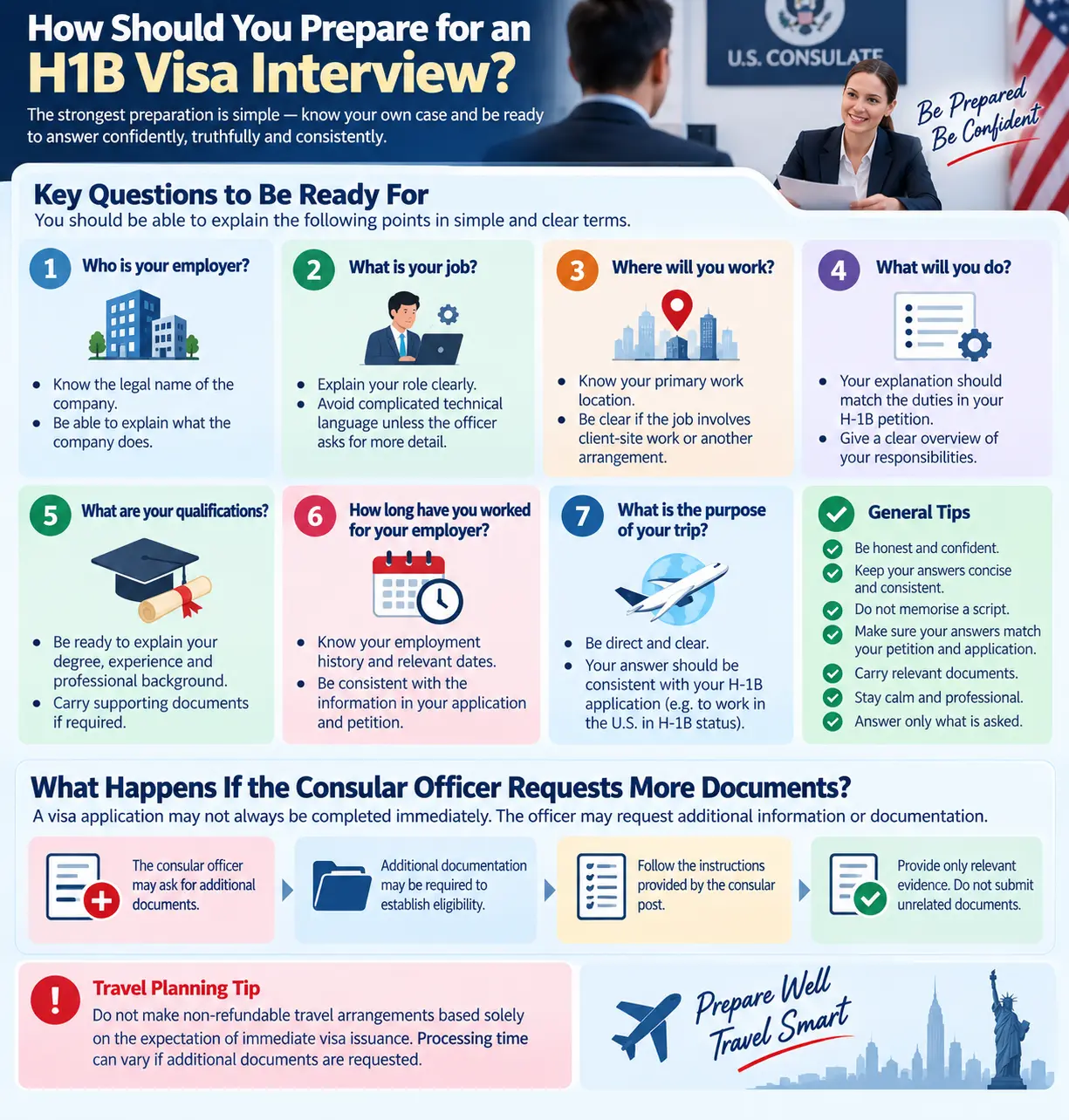
What Happens If the Consular Officer Requests More Documents?
A visa application may not always be completed immediately.
The consular officer may request additional information or documentation.
This is one reason applicants should not make non-refundable travel arrangements based solely on the expectation of immediate visa issuance.
The Department of State states that additional documentation may be required to establish eligibility.
If additional processing or documentation is requested, follow the instructions provided by the consular post.
Do not submit unrelated documents simply because you have them.
The goal is to provide relevant evidence that addresses the request.
H1B Transfer and Visa Stamping: What Is the Connection?
H-1B transfer is another area that creates confusion.
An H-1B transfer generally involves an H-1B worker moving from one employer to another employer that files the required petition.
This is different from visa stamping.
A change of employer does not automatically mean that you need a new visa stamp every time you change jobs.
However, if your visa stamp has expired and you travel outside the United States, you may need to apply for a new H-1B visa before returning, assuming you require a visa for entry.
USCIS recognises H-1B portability provisions that can allow certain H-1B workers to begin working for a new employer once the new Form I-129 has been properly filed, subject to the applicable requirements.
That means the following concepts should be kept separate:
H-1B transfer:
Changing or adding an H-1B employer through the appropriate USCIS process.
H-1B extension:
Continuing H-1B employment with the same employer or otherwise extending authorised H-1B status.
H-1B visa stamping:
Obtaining the visa in your passport for travel to the United States.
H-1B status:
Your authorised immigration status while you are in the United States.
Understanding these differences can prevent expensive mistakes.
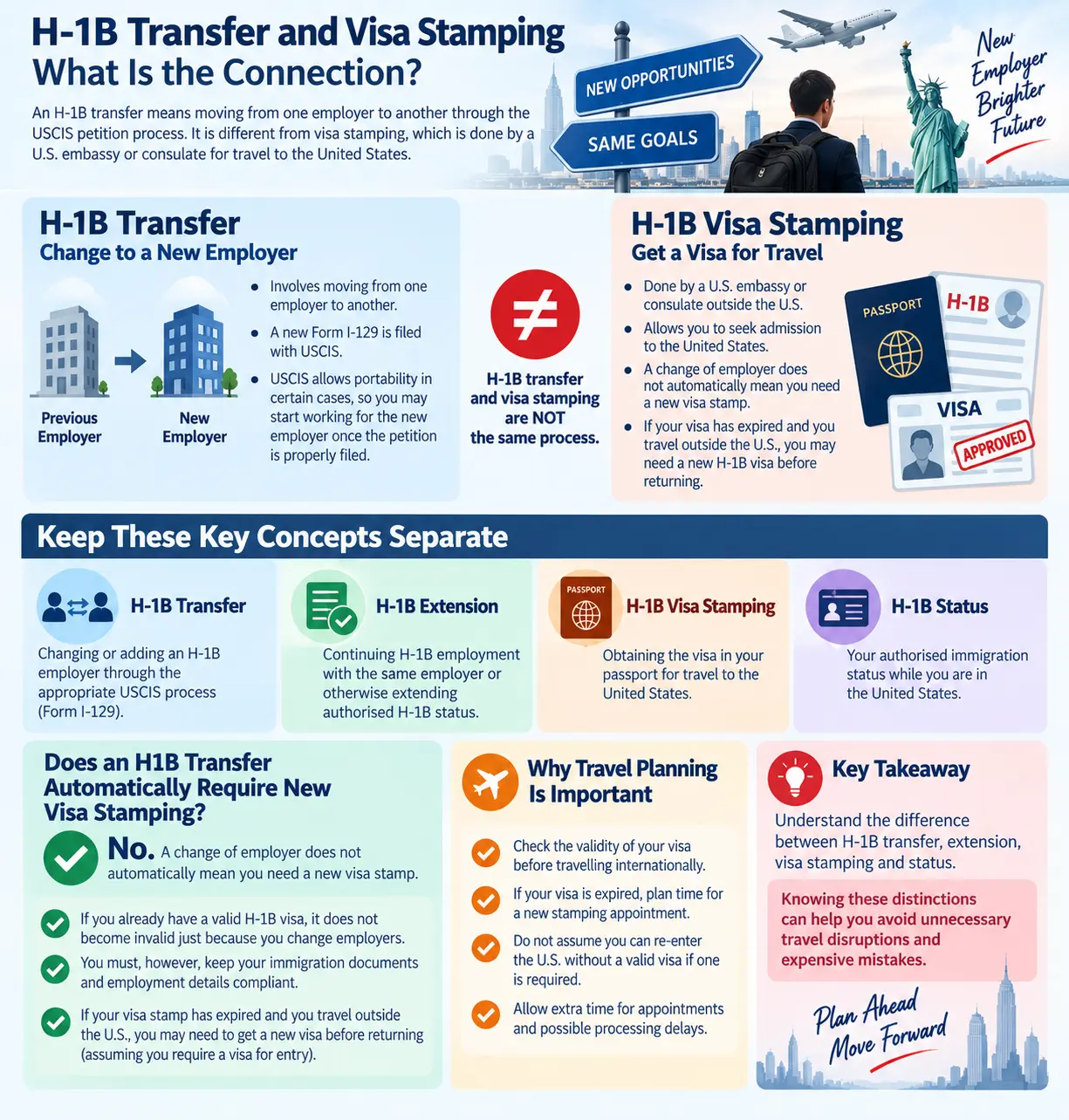
Does an H1B Transfer Automatically Require New Visa Stamping?
No.
An H-1B transfer and visa stamping are not the same process.
Suppose you are already in the United States in valid H-1B status and move to a new employer through an appropriate H-1B petition.
The USCIS petition process concerns your employment and immigration status.
Your passport visa is a separate document issued by the Department of State.
If you already have a valid H-1B visa, the visa does not necessarily become invalid simply because you change employers. However, you must ensure that your immigration documentation and employment situation remain compliant with the applicable requirements.
If you later travel internationally after your visa expires, you may need to obtain a new visa before returning.
This is why H-1B workers should think about travel plans before leaving the United States.
Planning International Travel With an H1B Visa
Travel planning becomes particularly important when your visa is expired or close to expiration.
Before leaving the United States, check:
- Is your passport valid?
- Is your H-1B visa still valid?
- Is your H-1B petition approved?
- Is your employment information current?
- Do you have the relevant I-797?
- Do you have a valid I-94?
- Will your current employer and job information match your immigration documents?
- Will you need visa stamping before returning?
Do not assume that an approved H-1B petition means you can automatically board a flight to the United States without a valid visa when a visa is required.
Similarly, do not assume that an expired visa means your H-1B status inside the United States has automatically expired.
These are separate concepts.
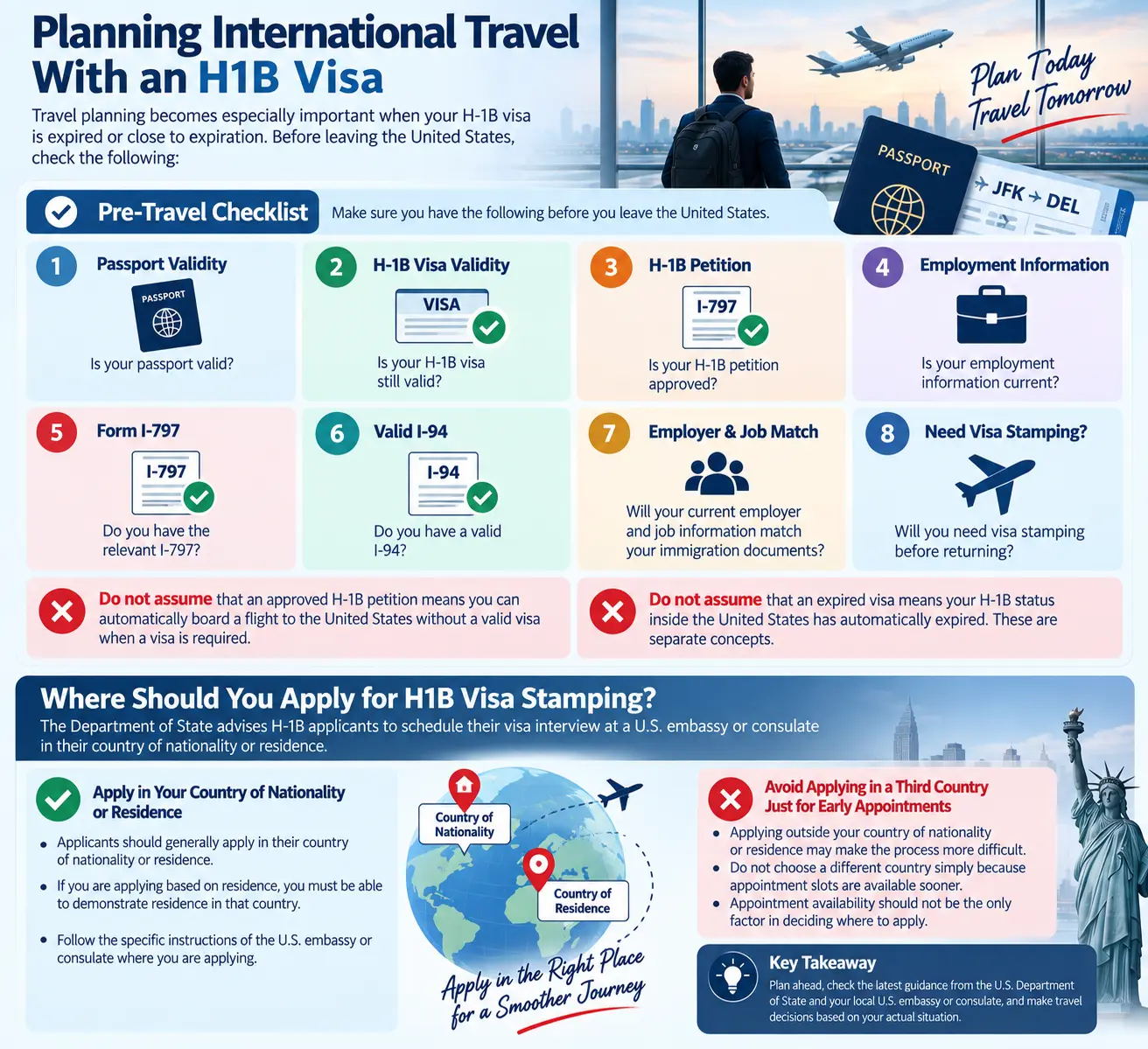
Where Should You Apply for H1B Visa Stamping?
The Department of State updated its guidance in July 2026 regarding where nonimmigrant visa applicants should schedule interviews.
Applicants should generally schedule their visa interview at a U.S. embassy or consulate in their country of nationality or residence. Applicants relying on residence should be able to demonstrate residence in the country where they are applying.
This is important for H-1B workers who previously considered applying in a third country simply because an appointment appeared available sooner.
Applying outside your country of nationality or residence may make the process more difficult, and the Department of State specifically warns applicants about this possibility.
Therefore, appointment availability should not be the only factor in deciding where to apply.
H1B Visa Interview Waiver vs H1B Visa Interview
The difference can be summarised simply:
| Issue | Interview Waiver | Regular H-1B Visa Process |
|---|---|---|
| In-person interview | Generally not required if genuinely eligible | Generally required under current rules |
| DS-160 | Required | Required |
| H-1B petition | Still relevant | Still relevant |
| Passport | Required | Required |
| Visa fee | Generally applicable | Generally applicable |
| Additional documents | May be requested | May be requested |
| Consular review | Yes | Yes |
| Guaranteed visa approval | No | No |
The critical point is that an interview waiver does not remove the underlying visa eligibility requirements.
Why Applicants Should Not Rely on Old H1B Interview Waiver Information
Search results can be misleading on immigration topics.
An article published before October 2025 may accurately describe the rules that existed when it was written but no longer describe the current process.
This is particularly relevant for:
- H-1B visa renewals;
- Interview-waiver eligibility;
- Appointment procedures;
- Visa fees;
- Embassy-specific processes;
- Where applicants should apply.
The Department of State itself states that its September 18, 2025 update superseded the earlier July 25, 2025 interview-waiver guidance.
For that reason, anyone planning H-1B stamping should check current official information before making travel arrangements.
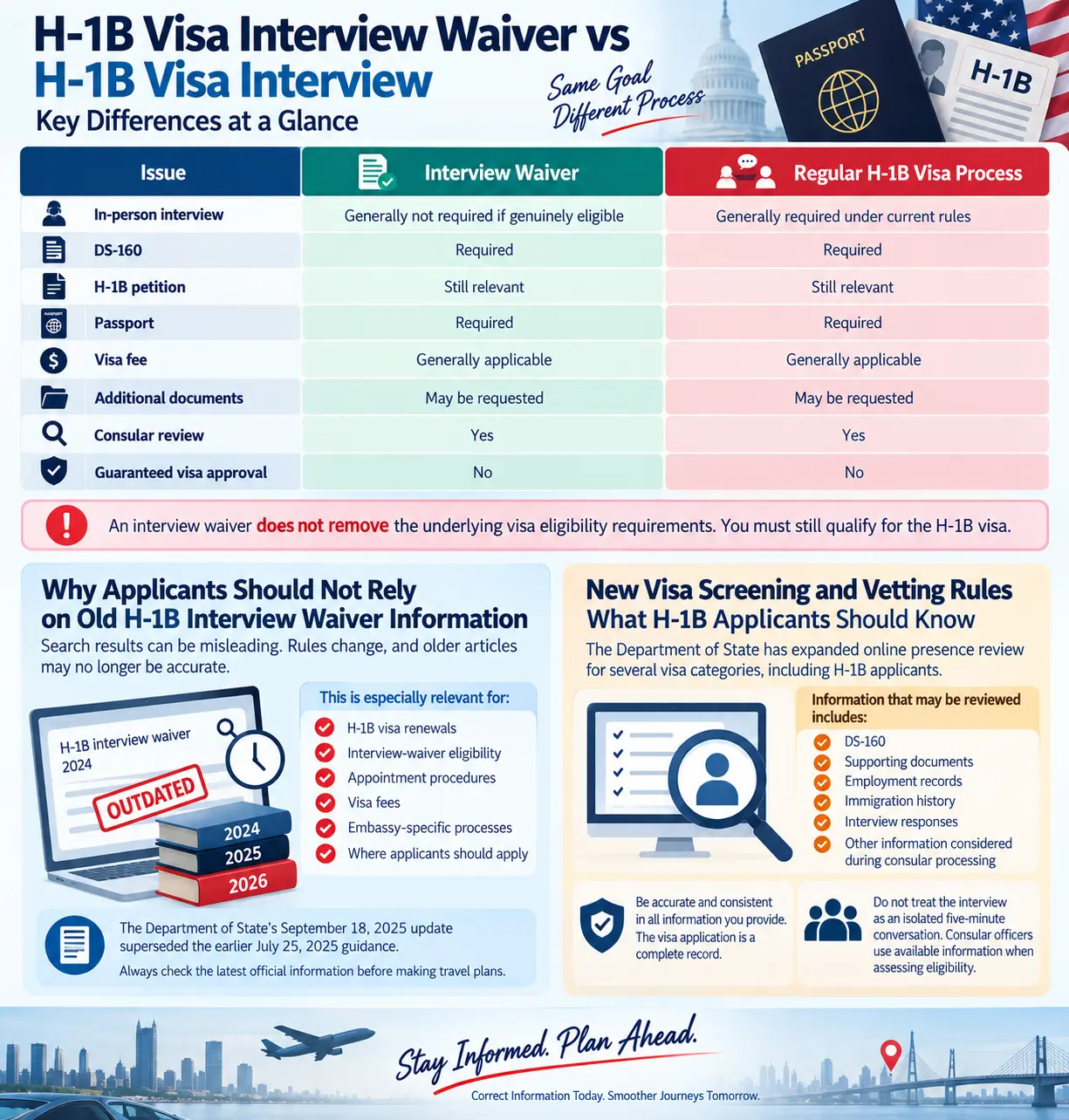
New Visa Screening and Vetting Rules: What H-1B Applicants Should Know
There is another current development H-1B applicants should be aware of.
The Department of State has expanded online presence review for several visa categories.
Its September 18, 2026 announcement confirms that H-1B applicants are among the temporary-worker categories already subject to this vetting process. The announcement states that the Department uses available information during visa screening and vetting when assessing visa eligibility.
This means applicants should take the visa application process seriously from the beginning.
The information provided in:
- DS-160;
- Supporting documents;
- Employment records;
- Immigration history;
- Interview responses;
- Other information considered during consular processing
should be accurate and consistent.
Applicants should not treat the interview as an isolated five-minute conversation. The visa application is a complete record.
Common H1B Interview Waiver Mistakes
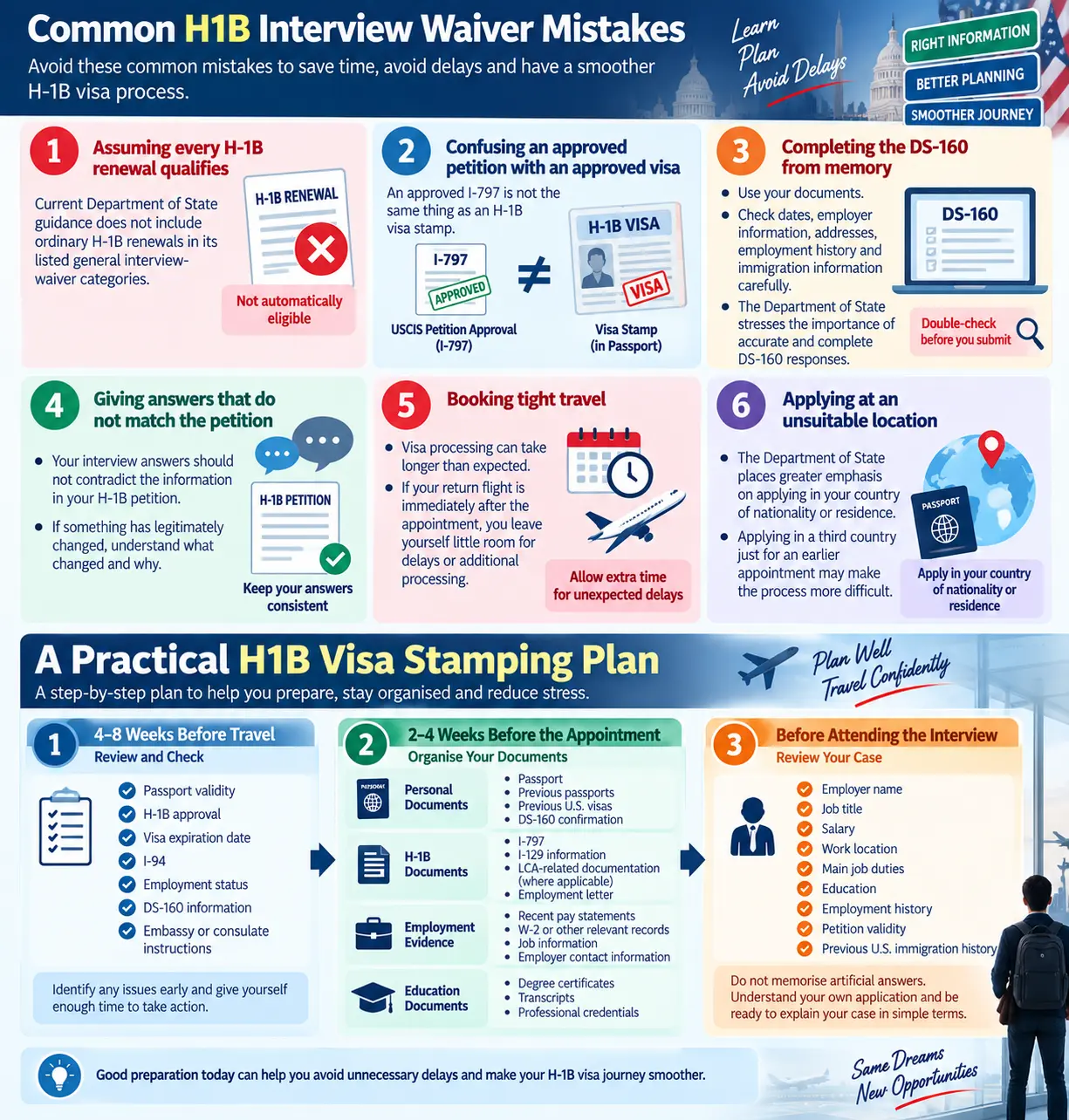
Mistake 1: Assuming every H-1B renewal qualifies
This is one of the biggest problems created by outdated online information.
Current Department of State guidance does not include ordinary H-1B renewals in its listed general interview-waiver categories.
Mistake 2: Confusing an approved petition with an approved visa
An approved I-797 is not the same thing as an H-1B visa stamp.
Mistake 3: Completing the DS-160 from memory
Use your documents.
Dates, employer information, addresses, employment history and immigration information should be checked carefully.
The Department of State specifically stresses the importance of accurate and complete DS-160 responses.
Mistake 4: Giving answers that do not match the petition
Your interview answers should not contradict the information in your H-1B petition.
If something has legitimately changed, understand what changed and why.
Mistake 5: Booking tight travel
Visa processing can take longer than expected.
If your return flight is immediately after the appointment, you leave yourself little room for delays or additional processing.
Mistake 6: Applying at an unsuitable location
Current Department of State guidance places greater emphasis on applying in the applicant’s country of nationality or residence.
A Practical H1B Visa Stamping Plan
A simple preparation plan can reduce unnecessary stress.
Four to eight weeks before travel
Review:
- Passport validity;
- H-1B approval;
- Visa expiration date;
- I-94;
- Employment status;
- DS-160 information;
- Embassy or consulate instructions.
Two to four weeks before the appointment
Organise your document file.
Create separate sections for:
Personal documents
- Passport;
- Previous passports;
- Previous U.S. visas;
- DS-160 confirmation.
H-1B documents
- I-797;
- I-129 information;
- LCA-related documentation where appropriate;
- Employment letter.
Employment evidence
- Recent pay statements;
- W-2 or other relevant records;
- Job information;
- Employer contact information.
Education
- Degree;
- Transcripts;
- Professional credentials.
Before attending the interview
Review your case.
You should know:
- Employer name;
- Job title;
- Salary;
- Work location;
- Main job duties;
- Education;
- Employment history;
- Petition validity;
- Previous U.S. immigration history.
Do not memorise artificial answers.
Understand your own application.
What Are the Benefits of Understanding the Current H1B Interview Rules?
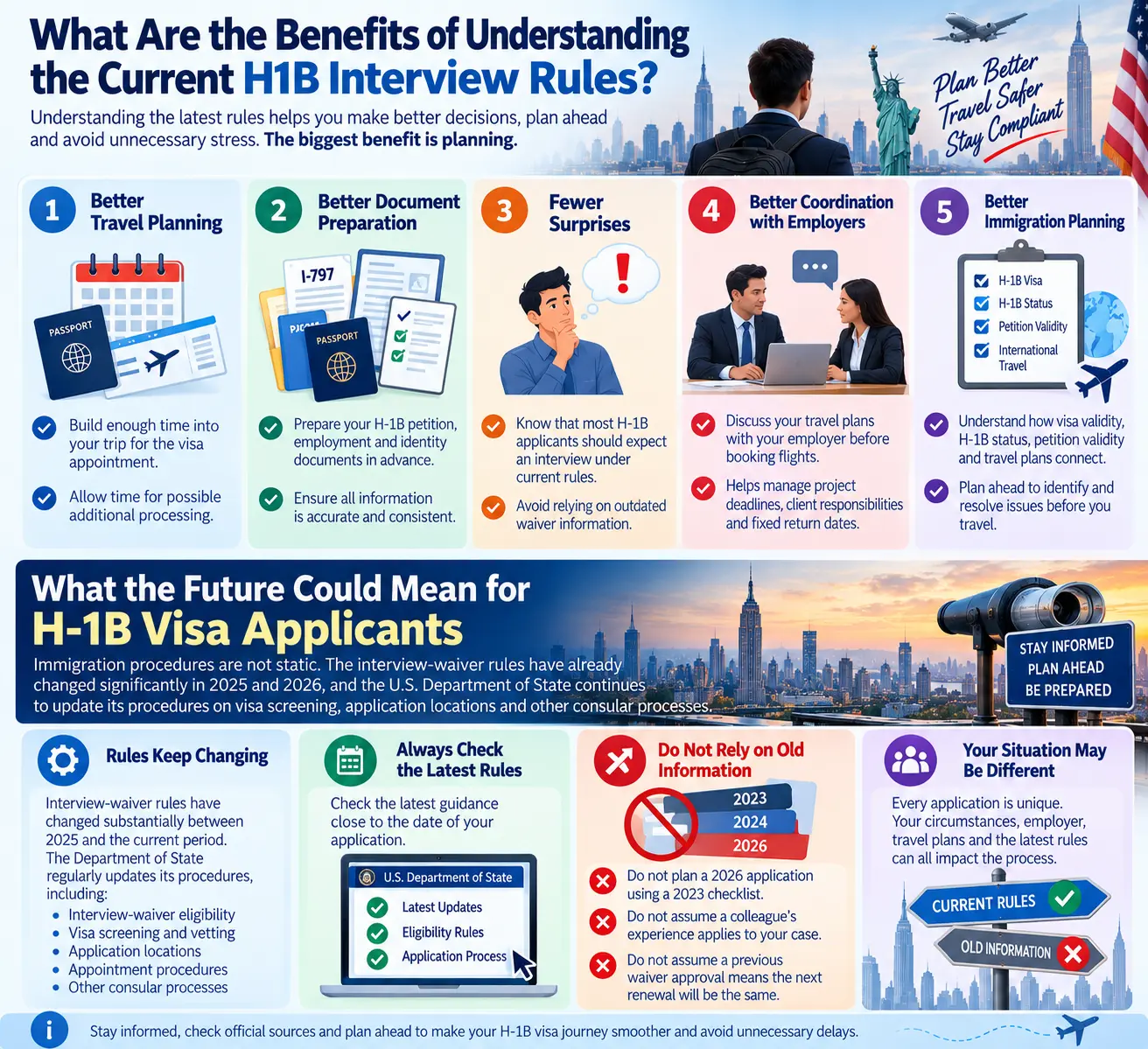
The biggest benefit is planning.
When applicants understand the difference between an interview waiver and the standard visa process, they can make better practical decisions.
Better travel planning
You can build enough time into your trip for the appointment and possible additional processing.
Better document preparation
You can prepare the relevant petition, employment and identity documents before the appointment.
Fewer surprises
Knowing that H-1B applicants generally should expect an interview under current rules avoids relying on an outdated waiver assumption.
Better coordination with employers
Employees can discuss planned travel with their employers before booking flights.
This can be particularly important for workers with project deadlines, client responsibilities or fixed return dates.
Better immigration planning
Visa validity, H-1B status, petition validity and international travel can interact in complicated ways.
Planning ahead gives you time to identify issues rather than discovering them at the airport.
What the Future Could Mean for H-1B Visa Applicants
Immigration procedures are not static.
The interview-waiver rules changed substantially between 2025 and the current period. The Department of State also continues to update its procedures concerning visa screening, application locations and other consular processes.
For H-1B workers, this means one thing matters more than ever:
Check the rules close to the date of your application.
Do not plan a 2026 visa application using a 2023 checklist.
Do not assume your colleague’s experience automatically applies to your case.
And do not assume that because a previous H-1B renewal was processed without an interview, the next renewal will follow the same procedure.
Your circumstances may be different. The rules may also be different.
Frequently Asked Questions About H1B Visa Interview Waiver
1. Is there an H1B visa interview waiver in 2026?
The current Department of State rules effective October 1, 2025 generally require in-person interviews for nonimmigrant visa applicants. The listed general interview-waiver categories do not include ordinary H-1B visa renewals.
2. Can an H-1B renewal be completed without an interview?
Generally, H-1B applicants should not assume they qualify for an interview waiver under the current rules. The Department of State’s current listed exceptions do not include ordinary H-1B renewals.
3. Does an approved H-1B petition guarantee visa approval?
No. An approved USCIS petition and a visa issued by a U.S. consulate are separate parts of the immigration process.
4. Do I need a DS-160 for H-1B stamping?
Yes. The DS-160 is the Online Nonimmigrant Visa Application used for nonimmigrant visa applications, including H-1B applications.
5. What documents are required for H-1B visa stamping?
Core documents generally include a valid passport, DS-160 confirmation page, applicable fee receipt, and H-1B petition receipt information. Additional evidence may be requested by the consular post.
6. Does an H-1B transfer mean I automatically need a new visa stamp?
No. An H-1B transfer concerns the employment/petition process. Visa stamping is a separate consular process. Whether you need a new visa for travel depends on your circumstances, including the validity of your existing visa.
7. Can I apply for an H-1B visa in another country?
Current Department of State guidance says nonimmigrant visa applicants should generally apply in their country of nationality or residence, subject to the applicable exceptions and designated processing-post rules.
8. Can the consular officer ask for additional documents?
Yes. The Department of State states that additional documentation may be requested to establish eligibility.
9. Should I book my flight before receiving the visa?
Applicants should plan carefully and avoid assuming that visa issuance will happen immediately after an interview. Processing times can vary, and additional processing or documentation may be required.
10. Where can I check the latest H-1B visa interview rules?
The safest starting point is the U.S. Department of State and the website of the specific U.S. embassy or consulate where you intend to apply. Embassy-specific instructions can contain important procedural details.
Final Takeaway
The phrase H1B visa interview waiver can be misleading if it is read without the date attached to the information.
The rules have changed.
Under the Department of State’s current policy, effective October 1, 2025, most nonimmigrant visa applicants generally require an in-person interview, and ordinary H-1B visa applicants are not among the listed general interview-waiver categories.
For an H-1B worker, the sensible approach is therefore to plan for the standard visa process unless the relevant U.S. embassy or consulate confirms that a different procedure applies to your particular case.
Prepare your DS-160 carefully. Keep your H-1B petition and employment documents organised. Understand the difference between H-1B status, an approved petition, an H-1B transfer and visa stamping. Check the current appointment and application instructions before travelling.
Most importantly, do not build your travel plans around an old H-1B interview-waiver rule.
Immigration procedures can change. Your preparation should change with them.
Official sources to check before applying
- U.S. Department of State – Interview Waiver Update
- U.S. Department of State – Temporary Worker Visas
- U.S. Department of State – DS-160 Information
- USCIS – Form I-129
- U.S. Department of State – Visa Application Location Guidance