
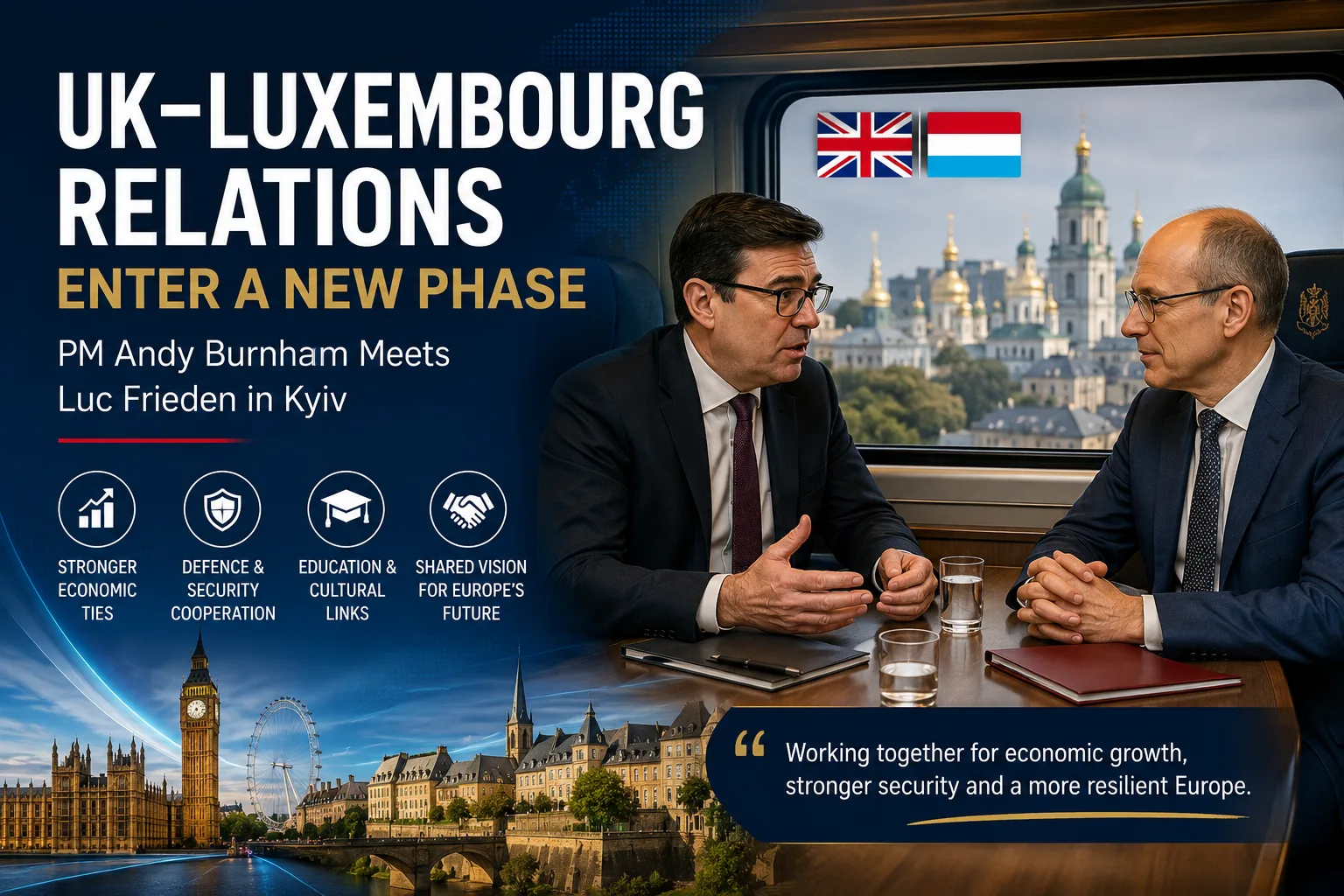
The relationship between the United Kingdom and Luxembourg is entering a more strategic phase.
What may look at first like a short diplomatic conversation between two European prime ministers actually touches several issues that are likely to shape the UK’s relationship with Europe in the years ahead: financial services, economic growth, employment, education, defence investment, supply-chain resilience and closer cooperation with the European Union.
On 23 August 2026, Prime Minister Andy Burnham spoke with Luxembourg Prime Minister Luc Frieden while travelling by train towards Kyiv. Their discussion brought together two countries with very different sizes but significant economic and strategic links. Financial services remain an important part of the relationship, while both governments are also increasingly focused on European security and the need to build stronger economic and defence capabilities.
The conversation also comes at an important moment for the UK. The government has been pursuing a closer relationship with the European Union while maintaining its wider international partnerships. Recent UK-EU developments have included deeper cooperation on defence, Ukraine, technology, trade and economic policy.
The meeting with Luxembourg therefore matters beyond the bilateral relationship. It offers another indication of how Britain may attempt to work with European partners in a period defined by economic uncertainty, geopolitical tension and rapidly changing security requirements.
What happened during the UK–Luxembourg meeting?
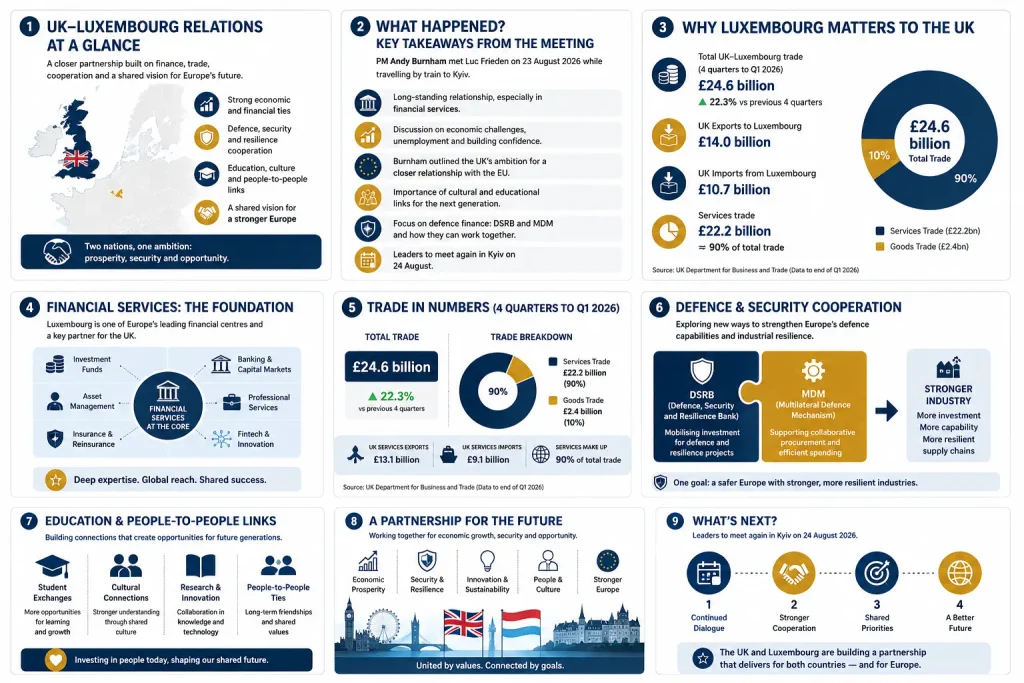
According to the official UK government account, Prime Minister Andy Burnham spoke to Luxembourg Prime Minister Luc Frieden on the train into Kyiv on the evening of 23 August.
The discussion began with the long-standing relationship between the two countries, particularly their connections in financial services.
Prime Minister Frieden also reflected on his own experience of living in the UK. The leaders then moved to domestic economic challenges, including unemployment and the wider need to give people greater confidence about their economic future.
The conversation subsequently moved towards Europe’s future.
Prime Minister Burnham outlined his ambition for the UK to develop a closer relationship with the European Union. Both leaders recognised the importance of cultural and educational links between Britain and Europe and the opportunities those links can create for younger generations.
The discussion then moved into defence finance.
The leaders considered the Defence, Security and Resilience Bank (DSRB) and the Multilateral Defence Mechanism (MDM), with a particular focus on how the two initiatives could complement one another.
The broader objective is straightforward: use new approaches to defence financing to unlock investment, strengthen industrial capacity and make supply chains more resilient.
They were also due to spend more time together in Kyiv on 24 August.
Read the official UK Government announcement
Why Luxembourg matters to the UK
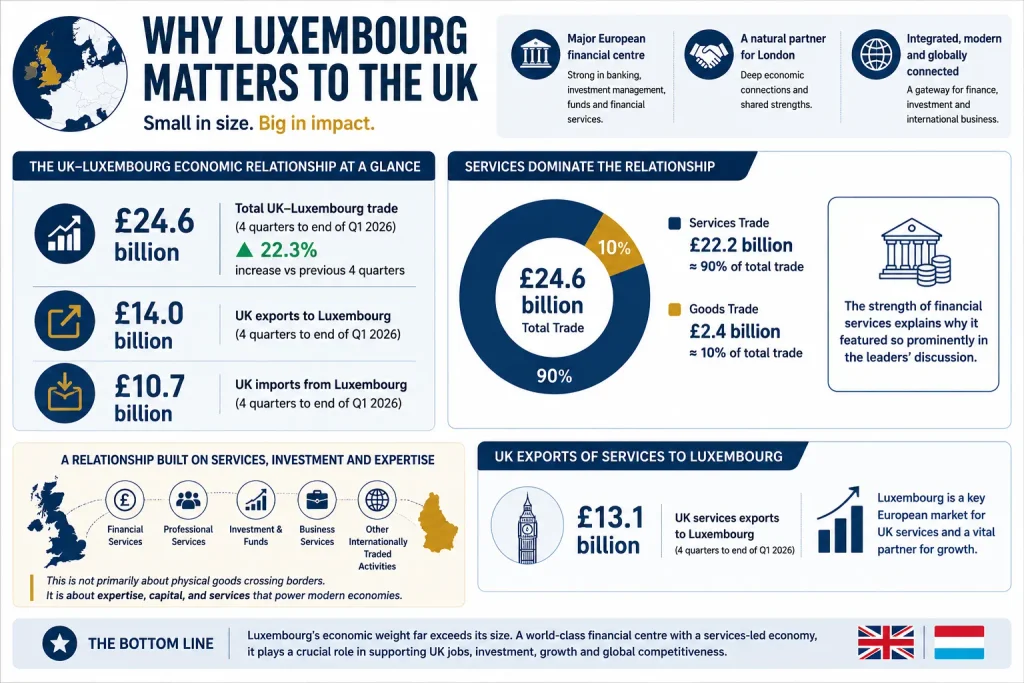
Luxembourg is small geographically, but its economic importance is much larger than its size suggests.
It is one of Europe’s major financial centres and has developed deep connections with international banking, investment management, funds and financial services.
That makes Luxembourg a natural partner for London.
The latest UK Department for Business and Trade figures show just how significant the economic relationship has become.
In the four quarters to the end of the first quarter of 2026, total UK-Luxembourg trade reached £24.6 billion, an increase of 22.3% compared with the previous four-quarter period.
UK exports to Luxembourg were worth £14.0 billion, while imports were £10.7 billion.
Services dominate the relationship. Of the £24.6 billion in total trade, around £22.2 billion was services trade, representing approximately 90% of the bilateral total.
That statistic explains why financial services featured so prominently in the leaders’ discussion.
This is not primarily a relationship built around containers of manufactured goods crossing borders. It is heavily connected to finance, professional services, investment, business services and other internationally traded activities.
The latest government trade data also show that UK exports of services to Luxembourg reached approximately £13.1 billion in the four quarters to the end of Q1 2026.
For Britain, that makes Luxembourg an important European services market.
Financial services are at the heart of the relationship
The financial connection between London and Luxembourg has developed over many years.
The two financial centres have different strengths, but they also complement one another.
London is one of the world’s largest financial centres, with extensive capabilities across banking, insurance, capital markets, investment management, foreign exchange and professional services.
Luxembourg has built a particularly strong position in areas such as investment funds and cross-border financial activity.
This creates room for cooperation rather than simply competition.
Official UK trade information shows that financial services are one of the most important components of British services exports to Luxembourg. UK exports of explicitly charged and other financial services to Luxembourg were worth around £6.1 billion in the latest published service-type data. Professional and management consulting services were another major category.
That matters because financial services are not isolated from the rest of the economy.
When investment funds have access to capital, businesses can expand.
When financial markets work efficiently, infrastructure projects can obtain funding.
When companies can access insurance and risk-management products, they can operate internationally with greater confidence.
And when financial institutions cooperate across borders, capital can move towards projects that governments consider strategically important.
This is increasingly relevant to defence.
From finance to defence: why the conversation is changing
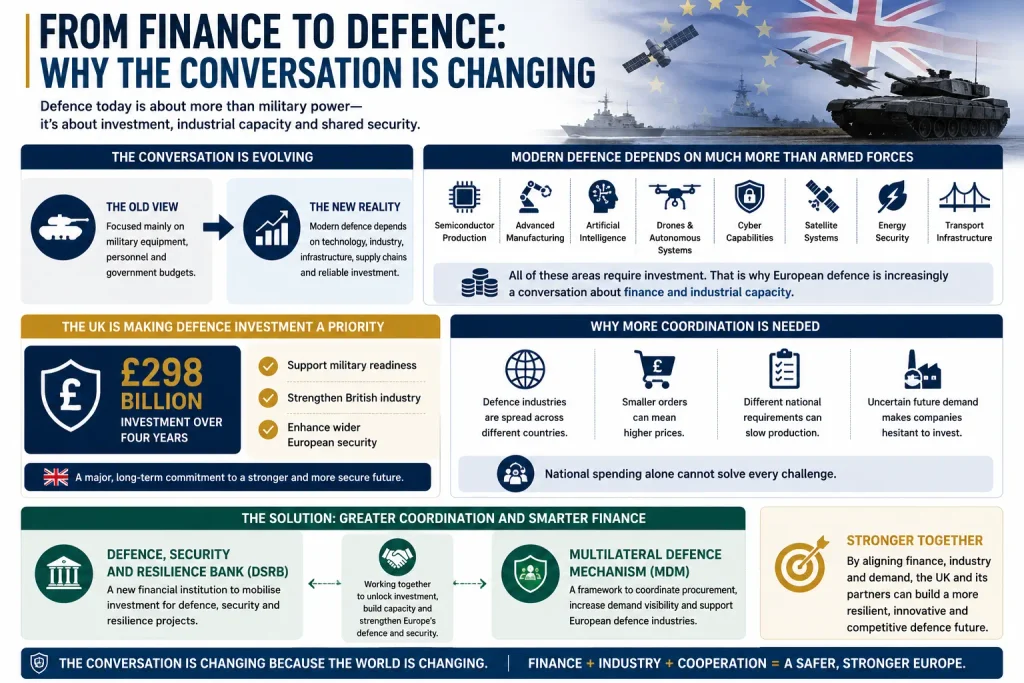
For decades, defence policy was often discussed mainly in terms of military equipment, personnel and government budgets.
That approach is changing.
Modern defence depends on much more than armed forces.
It requires semiconductor production, advanced manufacturing, artificial intelligence, drones, cyber capabilities, satellite systems, energy security, transport infrastructure, specialist engineering and reliable access to raw materials.
All of these areas require investment.
That is why the conversation about European defence is increasingly becoming a conversation about finance and industrial capacity.
The UK government has already made defence investment a major priority.
Its Defence Investment Plan is backed by £298 billion of investment over four years and is intended to support military readiness, British industry and wider European security.
But national spending alone cannot solve every problem.
European defence industries remain spread across different countries and procurement systems. Smaller orders can mean higher prices. Separate national requirements can slow production. Companies may hesitate to invest heavily in manufacturing capacity if future demand is uncertain.
The answer being explored by the UK and its partners is greater coordination.
That is where the Defence, Security and Resilience Bank and the Multilateral Defence Mechanism become important.
What is the Multilateral Defence Mechanism?
The Multilateral Defence Mechanism is designed as a new approach to financing defence investment.
The UK, Netherlands, Finland and Poland have been developing the initiative, with the objective of creating a mechanism that can accelerate defence investment and joint procurement.
The idea is to aggregate demand.
In simple terms, countries that need similar defence capabilities can work together rather than acting entirely separately.
That could make it easier to place larger orders, provide companies with greater certainty and encourage manufacturers to increase production.
The governments involved have said they aim to establish the mechanism by 2027. They have also said the mechanism could expand into a broader coalition of participating countries.
This is important for another reason.
Defence production cannot be switched on overnight.
If Europe suddenly needs more drones, missiles, air-defence systems or other capabilities, manufacturers need factories, machinery, skilled workers and long-term contracts.
Investment therefore needs to begin before a crisis becomes even more severe.
That is the central logic behind new defence financing models.
What is the Defence, Security and Resilience Bank?
The Defence, Security and Resilience Bank is another proposed mechanism aimed at supporting investment in strategic capabilities.
Its broader purpose is to make it easier to mobilise capital for defence, security and resilience-related projects.
The concept is particularly relevant to the financial relationship between Britain and Luxembourg.
London and Luxembourg both understand how financial markets can mobilise private capital.
The question is whether similar principles can be used to support areas that have traditionally depended heavily on government budgets.
The UK and Canada have already discussed the relationship between the DSRB and MDM. In July 2026, the two governments agreed to step up work between the initiatives to improve defence investment throughout supply chains.
The UK and Canada also described the two approaches as complementary.
That point is important.
The objective is not necessarily to create competing institutions.
Instead, different mechanisms could potentially operate alongside one another, helping direct capital into different parts of the defence ecosystem.
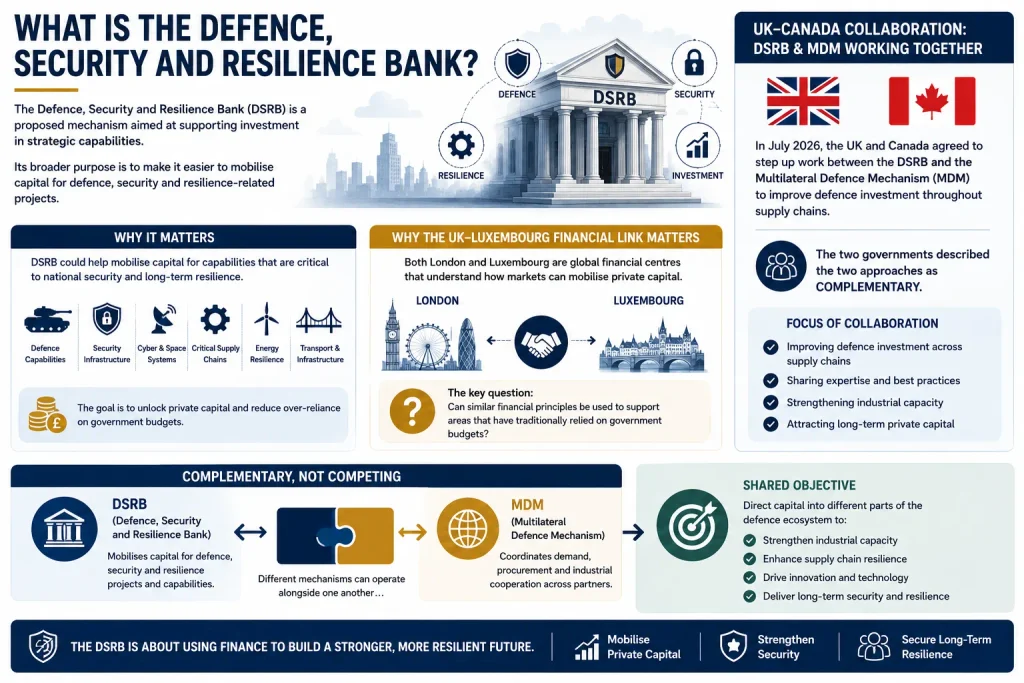
Why the two defence financing schemes could complement each other
The biggest problem facing defence investment is not always a lack of money.
Sometimes it is the way money is organised.
Governments may have budgets, but companies still need predictable demand before investing in new factories.
Banks and institutional investors may have capital, but defence projects can involve political, regulatory and long-term procurement risks.
Manufacturers may have technology, but not enough guaranteed orders to expand production.
A coordinated financing structure can potentially connect these different pieces.
The Multilateral Defence Mechanism is focused heavily on aggregating demand and encouraging joint procurement.
The Defence, Security and Resilience Bank is intended to help mobilise investment and strengthen resilience.
If designed effectively, these approaches could reinforce one another.
One could help establish demand.
The other could help mobilise capital.
Together, they could create a stronger investment environment for defence companies and suppliers.
That is the strategic opportunity the UK and Luxembourg were discussing.
What could this mean for European defence industries?
The impact could be significant if the initiatives move from policy discussions into practical financing.
1. More predictable demand
Defence manufacturers need confidence that orders will continue.
Long-term procurement arrangements can encourage companies to expand production capacity.
2. Faster investment
If financing becomes easier to access, companies may be able to invest more quickly in factories, technology and equipment.
3. Stronger supply chains
Modern defence systems often depend on thousands of suppliers.
A disruption at one level can affect the entire production process.
More investment in critical suppliers could make those chains more resilient.
4. Lower procurement costs
Joint purchasing can potentially create economies of scale.
If several countries purchase the same system together, manufacturers can produce larger quantities and spread fixed costs across more units.
5. Greater interoperability
Common procurement can also mean that allied forces use compatible equipment.
That matters enormously during multinational operations.
6. Support for innovation
Defence technology increasingly overlaps with civilian technology.
Artificial intelligence, robotics, advanced computing, communications and autonomous systems all have dual-use applications.
Better access to investment could help European companies scale promising technologies.
Why the UK wants closer ties with the European Union
The meeting with Luc Frieden also needs to be understood within the wider UK strategy towards Europe.
Since Brexit, Britain and the EU have remained major economic and security partners, but the relationship has faced additional barriers.
The current UK government has increasingly argued that closer practical cooperation can benefit both sides without reversing Brexit.
The focus is on areas where cooperation delivers tangible benefits.
These include:
- defence and security;
- energy;
- trade;
- technology;
- financial services;
- education;
- research;
- youth opportunities;
- supply-chain resilience; and
- support for Ukraine.
The government has repeatedly described closer UK-EU cooperation as important for European security and prosperity.
In July 2026, the UK also reached an agreement with the EU allowing British defence companies to bid for procurement contracts funded through the EU’s €90 billion Ukraine Support Loan initiative.
The government said this could unlock investment for British defence companies, support skilled jobs and strengthen the UK’s defence industrial base.
This is an important example of what closer practical cooperation can look like.
It is not simply about political statements.
It is about allowing businesses, investors and institutions on both sides to participate in strategic economic activity.
Why Luxembourg supports a stronger European partnership
Prime Minister Luc Frieden has also consistently emphasised the importance of European cooperation.
In his 2026 State of the Nation address, Frieden argued that Luxembourg’s future is closely connected with Europe’s future and stressed the importance of strengthening European capacity in areas such as energy, security, technology and food production.
He also highlighted the changing international environment, including war in Europe, economic fragmentation and growing pressure on the international rules-based system.
This makes Luxembourg an interesting partner for Britain.
The UK is outside the EU but remains deeply connected to European security.
Luxembourg is inside the EU and NATO and is also a highly international financial centre.
Both countries therefore have reasons to build practical bridges.
Education and culture: an important part of the conversation
The defence and financial aspects of the meeting may attract the most attention, but another part of the discussion should not be overlooked.
The two leaders spoke about cultural and educational links between the UK and Europe.
That matters because international relationships are not built only through governments.
They are also built through students, universities, researchers, businesses, workers and young people.
Education creates connections that can last decades.
A student who studies abroad can later become a researcher, entrepreneur, policymaker or business leader with professional relationships across borders.
That is why the future of UK-Europe relations cannot be measured only in trade figures.
Mobility and education are part of the long-term relationship.
The UK government has already identified youth and educational cooperation as an area where closer UK-EU ties could create opportunities for younger generations.
For British and European students, this could eventually mean more opportunities to study, work, research and build professional networks across Europe.
The employment question
Another theme from the meeting was domestic employment.
That may appear separate from defence finance or European relations, but the issues are connected.
Investment creates jobs.
Industrial investment can support engineers, technicians, software developers, researchers, logistics workers and skilled manufacturers.
Financial services create another large employment ecosystem, including banking, law, accounting, consulting, insurance and technology.
The UK-Luxembourg relationship therefore has the potential to support employment through several channels.
The latest UK trade figures show that services dominate bilateral trade, while Luxembourg is also a significant destination for UK investment. At the end of 2024, UK outward foreign direct investment stock in Luxembourg stood at £129.9 billion, while Luxembourg’s inward FDI stock in the UK was £134.2 billion.
Those figures demonstrate the depth of the economic relationship.
Ukraine is becoming a central part of European economic strategy
The fact that the conversation took place on the way to Kyiv is also significant.
Ukraine is no longer viewed only through the narrow lens of military assistance.
Its future is increasingly connected to Europe’s defence industry, reconstruction, energy security, infrastructure and investment.
The UK has committed substantial financial and military support to Ukraine and continues to work with European and international partners on its security and reconstruction.
The UK’s participation in the EU’s Ukraine Support Loan is another example of this growing connection between economic policy and security policy.
For European governments, supporting Ukraine has two dimensions.
The immediate objective is helping Ukraine resist Russian aggression.
The longer-term objective is building a more secure European continent.
That requires money, industrial capacity, infrastructure and long-term investment.
This is precisely where defence financing mechanisms can become important.
What happens next?
The most important question now is implementation.
A diplomatic meeting can establish political support.
But institutions such as the Multilateral Defence Mechanism and Defence, Security and Resilience Bank will ultimately be judged by what they deliver.
Several areas will need attention.
1. Building the financing architecture
Governments will need to decide how capital is raised, who can participate, how projects are selected and how risk is shared.
2. Bringing more countries into the system
The MDM is intended to become a broader coalition.
More participating countries could mean greater purchasing power and a larger defence industrial market.
3. Connecting private investors
Government money alone is unlikely to meet the scale of Europe’s long-term investment requirements.
Private capital will therefore be important.
4. Supporting smaller suppliers
Large defence companies attract much of the attention, but critical technologies often come from smaller companies.
Financing mechanisms need to ensure that smaller suppliers can participate.
5. Avoiding duplication
The DSRB, MDM, NATO initiatives and EU financing instruments need to work together rather than create unnecessary layers of bureaucracy.
The UK government has already stressed the importance of complementarity between emerging defence financing approaches.
6. Measuring results
Success should ultimately be visible in practical outcomes:
- more production capacity;
- faster procurement;
- stronger supply chains;
- more interoperable equipment;
- greater investment;
- more skilled jobs; and
- improved European defence readiness.
What does this mean for businesses?
Businesses should pay attention to the direction of travel.
The European defence market is becoming more closely connected.
Companies operating in aerospace, cyber security, artificial intelligence, robotics, electronics, advanced manufacturing, communications, energy and logistics could increasingly find opportunities through defence-related investment.
The effect may also extend beyond traditional defence contractors.
A company producing a critical component for drones, satellites or communications systems may become strategically important even if defence is not its primary market.
The UK’s recent agreement allowing British companies to access contracts funded by the EU’s Ukraine Support Loan demonstrates how defence cooperation can also become an industrial opportunity.
For businesses, the future may therefore involve more cross-border partnerships between British and European companies.
What does this mean for students and young people?
For students, the most interesting part of the meeting may not be defence finance.
It may be the emphasis on education and cultural links.
A closer UK-Europe relationship could gradually create more opportunities for young people to move between Britain and European countries for education, research, internships and professional experience.
That does not automatically mean unrestricted movement.
Future arrangements will depend on negotiations and specific agreements.
But politically, the direction is clear: the UK government wants to strengthen practical links with Europe, particularly where those links can create opportunities for younger generations.
For international students, researchers and professionals watching UK policy, this is an area worth monitoring closely.
A relationship bigger than one meeting
It would be easy to describe the Burnham-Frieden conversation simply as another diplomatic meeting.
That would miss the bigger picture.
The UK and Luxembourg already have substantial economic links.
Their bilateral trade is worth tens of billions of pounds. Their financial sectors are deeply connected. Investment flows in both directions. Both countries are members of NATO. Both have an interest in European stability.
Now the relationship is being discussed in a broader context.
Financial markets are being connected with defence investment.
Economic resilience is being connected with national security.
Education is being connected with long-term European relationships.
And Ukraine is increasingly becoming a test of whether European countries can translate political cooperation into practical capability.
That is why this meeting matters.
The future of UK–Luxembourg cooperation
The next phase of the relationship could develop around four broad pillars.
Economic cooperation
Financial services, investment and professional services will remain fundamental.
With bilateral trade reaching £24.6 billion in the latest four-quarter period, the economic relationship already has a strong foundation.
European cooperation
The UK is seeking a closer practical relationship with the EU.
Luxembourg, as an EU member, can be an important voice and partner within that wider European framework.
Defence and security
The DSRB and MDM discussions indicate a move towards innovative approaches to defence financing.
The objective is not simply to spend more, but to spend more effectively and create sustainable industrial capacity.
People-to-people connections
Education, culture and youth opportunities provide the human foundation for the relationship.
Governments can sign agreements, but people ultimately make international relationships durable.
Final thoughts
The UK–Luxembourg meeting on the journey to Kyiv was short, but the subjects discussed were anything but small.
Financial services point towards economic cooperation.
Employment points towards domestic prosperity.
Education and culture point towards the next generation.
Defence financing points towards Europe’s changing security environment.
And Kyiv provides the wider backdrop: a continent confronting a long-term security challenge that cannot be solved by military spending alone.
The real lesson is that Europe’s future is increasingly being shaped by the connection between security, finance, industry, technology and economic growth.
The UK is trying to position itself closer to European partners while remaining a global power. Luxembourg brings something different but valuable to that effort: a highly international economy, a major financial centre, strong European integration and a commitment to collective European security.
The challenge now is turning political conversations into practical results.
If the Defence, Security and Resilience Bank and Multilateral Defence Mechanism develop successfully, they could help change how European countries finance defence.
If UK-EU cooperation continues to deepen, British businesses, universities and young people could gain new opportunities to reconnect with European markets and institutions.
And if Britain and Luxembourg can use their financial relationship to support wider investment, their partnership could become more strategically important than its size might suggest.
The meeting in Kyiv should therefore be viewed not as an isolated diplomatic conversation, but as part of a much larger shift.
The future relationship between Britain and Europe is likely to be built less around old political arguments and more around practical questions: How can countries invest together? How can they protect their economies? How can they strengthen defence? How can they create opportunities for young people? And how can they build resilience in an increasingly uncertain world?
Those questions will shape the next chapter of UK–Luxembourg relations — and, more broadly, the UK’s place in Europe.
Key takeaways
- Prime Minister Andy Burnham spoke with Luxembourg Prime Minister Luc Frieden on 23 August 2026 while travelling to Kyiv.
- Financial services were a major part of the discussion.
- UK-Luxembourg trade reached £24.6 billion in the four quarters to the end of Q1 2026.
- Services accounted for around 90% of bilateral trade during that period.
- The leaders discussed closer UK-EU relations and the importance of education and cultural links.
- They also discussed the Defence, Security and Resilience Bank and the Multilateral Defence Mechanism.
- The MDM is intended to accelerate defence investment, support joint procurement and aggregate demand among participating countries.
- The UK and Canada have also identified potential complementarity between the DSRB and MDM.
- The UK’s wider European strategy increasingly links economic growth, defence, technology and resilience.
- The future impact will depend on implementation, investment, participation by allies and the ability to translate cooperation into practical projects.
- For businesses and young people, closer UK-Europe cooperation could create new opportunities in trade, investment, education, technology and defence-related industries.
Official sources and further reading
UK Government — PM meeting with Prime Minister Frieden of Luxembourg
UK Government — Luxembourg Trade and Investment Factsheet
UK Government — Multilateral Defence Mechanism
UK Government — UK and Canada defence financing cooperation
UK Government — Defence Investment Plan
Luxembourg Government — Address on the State of the Nation 2026 by Luc Frieden
Leave feedback about this