
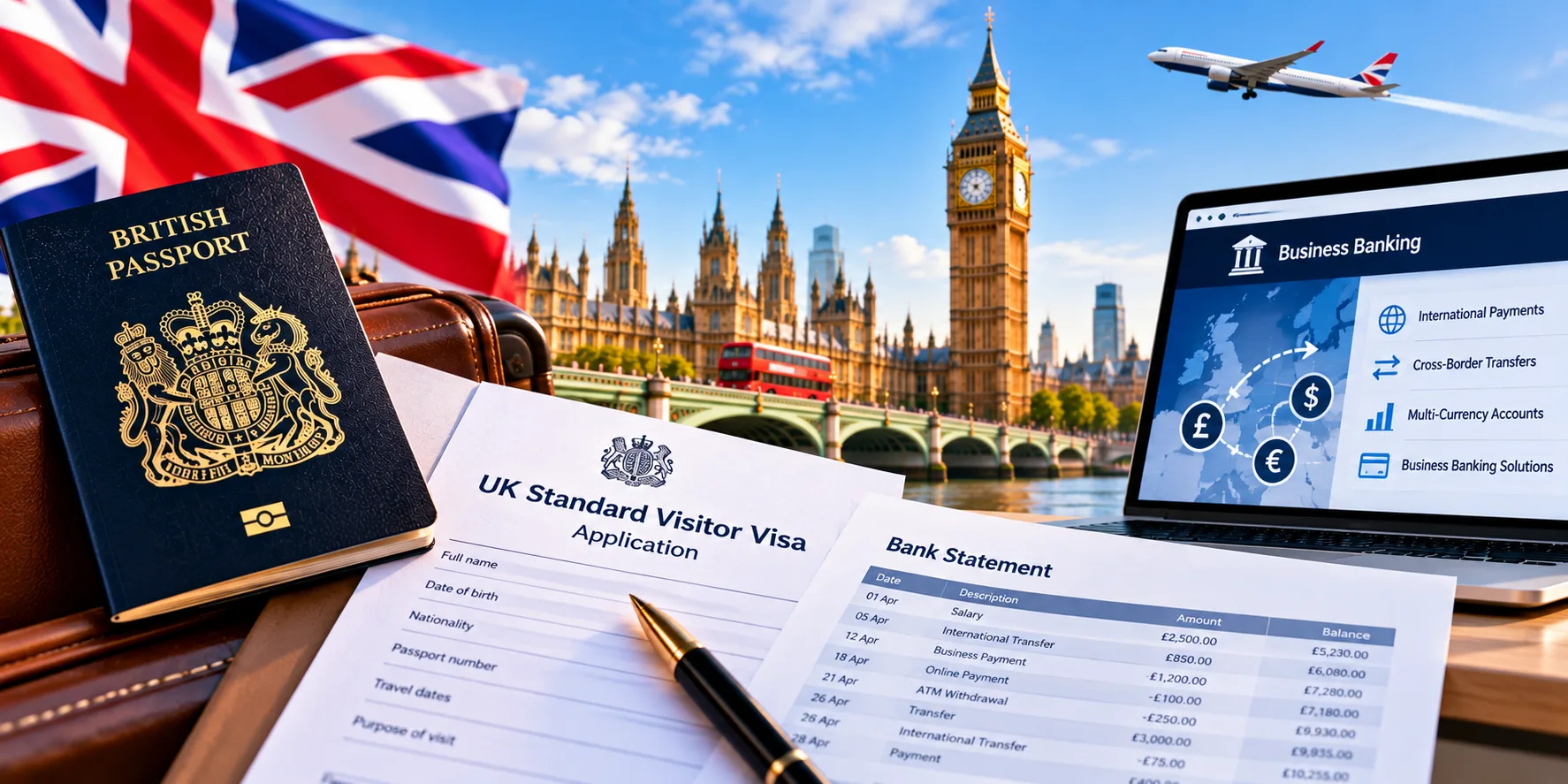
Applying for a UK Standard Visitor visa involves more than completing an online form and booking a trip. You also need to demonstrate that your visit is genuine, that you can afford the costs and that you intend to leave the UK at the end of your stay.
For employees, business owners, freelancers and self-employed applicants, financial evidence can require extra planning. Your income may arrive from several sources, your clients may pay in different currencies, or you may use a digital business account to receive international payments. In these circumstances, presenting bank statements without explaining the transactions can make your finances harder to understand.
One question applicants frequently ask is: Does GOV.UK require six months of bank statements for a UK Standard Visitor visa?
Another question matters to people who run international businesses: which business banking brands are useful for managing cross-border payments, and how can these accounts help keep financial records organised?
This guide explains the official visitor visa requirements, how to prepare financial evidence, what to do if you use international business accounts and how to plan your application.
Important: Banking products and immigration requirements serve different purposes. Choosing a business banking provider does not improve your visa eligibility by itself. Your application must meet the relevant immigration rules, and all financial evidence must be genuine and consistent.
1. Latest UK Standard Visitor visa update: What applicants need to know
The UK Standard Visitor route allows eligible people to visit for tourism, family visits, certain business activities, short courses and other permitted purposes. A visitor can usually stay for up to six months, subject to the conditions of their permission.
According to the official GOV.UK guidance, applicants must demonstrate that they will leave the UK at the end of the visit, can support themselves and any dependants during the trip, and can pay for their return or onward journey. Financial support may also come from another person or organisation where the arrangements meet the relevant requirements.
Official guidance: Visit the UK as a Standard Visitor.
What is the latest position on bank statements?
The central point is that there is no universal rule requiring every Standard Visitor visa applicant to submit exactly six months of bank statements.
The Home Office assesses applications according to the person’s circumstances and the evidence provided. Bank statements can help demonstrate available funds, income and financial circumstances, but the right evidence depends on the applicant’s situation.
For example:
- An employee may provide salary credits and evidence of employment.
- A self-employed applicant may need to explain business income and personal withdrawals.
- A business owner may use company accounts to show business activity, alongside evidence of how their personal travel costs will be paid.
- A sponsored visitor may need evidence of the sponsor’s financial ability and the arrangements for supporting the trip.
- Someone receiving money from overseas may need to explain the source and purpose of significant international transfers.
The aim is to provide a credible financial picture rather than simply submit a fixed number of pages.
Does the six-month rule still apply?
Six months of statements can be a useful preparation strategy because they may show a pattern of income, spending and savings. However, it should not be presented as a mandatory requirement for every applicant unless the relevant official instructions for that particular case say otherwise.
Applicants should check the latest GOV.UK Standard Visitor visa application guidance and the official guide to supporting documents for visitors.
The practical question is not simply, “Have I provided six months of statements?” It is, “Do my documents clearly demonstrate how I will fund this trip and why my financial circumstances make sense?”
2. What bank statements are used for in a UK visitor visa application
A bank statement is evidence, not a guarantee of approval. It helps the decision-maker understand whether the applicant’s financial circumstances support the proposed visit.
A useful statement may show:
- The account holder’s name.
- The bank or financial institution.
- The relevant account details.
- The statement period.
- Opening and closing balances.
- Income and outgoing transactions.
- Salary, business receipts or other identifiable credits.
- Whether the available balance appears consistent with the proposed travel costs.
The document should be genuine and readable. If you download a digital statement, retain the original PDF from your bank or provider. Avoid editing transaction descriptions, changing balances or altering dates.
Why the transaction history matters
Imagine that an applicant plans to visit London for ten days. Their bank statement shows a balance sufficient to pay for flights, accommodation, food and local travel. That is useful, but the balance is only one part of the picture.
If the account also shows regular salary payments and ordinary household spending, the applicant may be able to explain their finances more easily.
Now imagine that the same account received a large transfer shortly before the application, with no explanation of its source. The money may be legitimate, but the applicant should consider whether supporting evidence is needed to explain it.
This is why financial documents should be reviewed as a complete picture. A high balance alone does not automatically establish that the applicant’s circumstances are credible.
3. How many months of bank statements should you provide?
There is no single statement period that is right for every visitor. Choose evidence that is sufficient to explain your income, savings and proposed travel expenses.
The following table is a practical planning guide, not a list of mandatory Home Office statement periods.
| Applicant’s circumstances | Evidence to consider |
|---|---|
| Salaried employee | Recent personal bank statements showing salary credits, plus an employer letter or other employment evidence |
| Self-employed professional | Personal statements, relevant business statements, invoices and evidence of business activity |
| Company director | Personal financial evidence, relevant company records and an explanation of who will pay for the trip |
| Freelancer with overseas clients | Statements showing client payments, invoices or contracts, and evidence explaining currency conversions where relevant |
| Applicant supported by family | Evidence of the sponsor’s funds, relationship and the support being offered |
| Applicant with substantial recent deposits | Evidence explaining the source, ownership and purpose of the money |
| Applicant with several bank accounts | Statements from the accounts relevant to the trip and a clear explanation of how the funds will be used |
Is providing six months of statements a good idea?
It can be helpful where a six-month history makes your circumstances easier to understand. For example, it may demonstrate recurring salary payments, regular business receipts or a savings pattern.
However, more documents are not always better. Submitting many unrelated statements can make an application harder to follow. Select relevant, genuine records and ensure that the evidence is consistent with the information entered on the application form.
If your financial circumstances changed recently, explain the change rather than relying on a longer statement history to speak for itself.
4. What if you recently deposited a large amount of money?
A recent deposit is not automatically a reason for refusal. The important questions are where the money came from, whether it belongs to you or is genuinely available for your trip, and whether the explanation is supported by evidence.
Possible sources include:
- A salary bonus.
- Payment for completed freelance work.
- Proceeds from the sale of an asset.
- A transfer between your own accounts.
- A family gift.
- A business distribution or dividend.
- Repayment of a loan.
The supporting documents will depend on the source. For example, an invoice and payment receipt may help explain a client payment, while a transfer confirmation and statements from both accounts may explain money moved between your own accounts.
If a family member is funding the visit, do not simply present their money as if it were your own. Explain the sponsorship arrangement and provide relevant evidence of the person’s identity, financial ability and intended support.
Never borrow money temporarily or misrepresent the source of funds to create a misleading impression of financial strength.
5. What documents should accompany bank statements?
Bank statements are only one part of a potential visitor visa evidence package. Your documents should tell a consistent story about the purpose, duration and funding of your visit.
Identity and travel plans
Consider preparing:
- A valid passport or travel document.
- Proposed travel dates.
- Details of where you plan to stay.
- An outline of your itinerary, where useful.
- Evidence of the expected cost of the visit.
You should provide information that reflects your genuine plans. Do not invent bookings, employment details or travel arrangements simply to make the application look stronger.
Employment and income evidence
Depending on your circumstances, useful documents may include:
- An employer letter confirming your role and employment.
- Payslips that correspond with the bank credits.
- Evidence of approved leave, where relevant.
- Business registration or self-employment records.
- Client contracts, invoices or payment receipts.
- Relevant tax or accounting records.
No single document automatically guarantees a successful outcome. The purpose is to explain your real financial circumstances clearly.
Evidence of who is paying
If another person or organisation will pay for some or all of your trip, explain the arrangement.
Depending on the circumstances, evidence could include:
- A letter from the person or organisation providing support.
- Evidence of the relationship between the applicant and sponsor.
- The sponsor’s relevant financial documents.
- An explanation of which costs will be covered.
- Evidence of accommodation arrangements, where applicable.
A sponsor’s promise should match the evidence. For example, if an employer says it will pay for flights and accommodation, the supporting documents should make that arrangement clear.
Documents not in English or Welsh
GOV.UK says documents that are not in English or Welsh must be accompanied by certified translations. Applicants should follow the current official instructions for the required translation details.
Read the official Standard Visitor application guidance before submitting documents.
6. Best business banking brands in the UK for cross-border payments
Business owners and freelancers who receive international payments may use a traditional bank, a digital business account or a specialist international payment provider. The right choice depends on where the business operates, which currencies it uses, its transaction volume and the level of support it needs.
The following providers are examples to compare, not an official ranking or an endorsement. Product availability, eligibility, account features and pricing can change.
Wise Business
Wise Business is worth comparing if a company or freelancer regularly receives and sends payments in multiple currencies.
Its published UK pricing describes international transfers with fees that vary by currency, with transfer fees advertised from 0.24%. It also lists account details for receiving money in multiple currencies and a one-off setup fee for certain features. Check the provider’s current pricing and eligibility before opening an account.
Official source: Wise Business pricing.
Potential advantages to assess:
- Clear visibility of transfer and conversion fees.
- Support for receiving and holding multiple currencies, subject to the product terms.
- Useful transaction records for international client payments.
- A digital workflow for businesses that work across borders.
What to check: Confirm that the currencies and receiving methods you need are supported. Review conversion charges, transfer limits, account eligibility and whether the service suits your company’s structure and location.
Revolut Business
Revolut Business offers business account plans with payment allowances that vary by subscription. Its published fee information lists charges for international transfers outside the relevant plan allowance and notes that additional fees may apply to some payment routes.
Official sources: Revolut Business fees and Revolut Business account comparison.
Potential advantages to assess:
- Digital account management.
- Business payment and card features.
- Plan-based allowances for certain transfers.
- Features for teams that need to manage business spending.
What to check: Compare the monthly subscription with the number and value of transfers you expect to make. Check foreign-exchange allowances, weekend or out-of-plan charges where applicable, intermediary bank costs and the availability of the service for your business.
Starling Bank
Starling may be worth considering for businesses that want a UK business banking relationship and need to review options for foreign-currency payments. Its Euro account has separate terms and charges, and the bank explains that recipient banks may apply fees in some circumstances.
Official source: Starling Bank Euro account fees.
Potential advantages to assess:
- A UK business account environment.
- A dedicated euro-account option, subject to eligibility.
- Published information about currency conversion and payment charges.
What to check: Confirm account eligibility, supported payment routes, account fees and whether the provider offers the currencies and services your business requires.
Traditional UK banks
Established banks such as HSBC UK, Barclays and Lloyds Bank may also be relevant to businesses that need a broader banking relationship, lending, relationship support or international payment services.
Features and fees vary by bank, account type and customer eligibility. Compare their official business banking and international payment terms directly rather than assuming that a familiar brand will always be cheaper or more suitable.
How should you compare providers?
| Factor | What to examine |
|---|---|
| Transfer fees | Fixed charges and percentage-based charges |
| Exchange rates | The rate offered and any markup |
| Supported currencies | Whether your business’s main currencies are available |
| Receiving payments | Local account details, SWIFT and other supported methods |
| Transfer speed | Estimated processing times and cut-off rules |
| Payment limits | Daily, monthly or transaction-specific limits |
| Account fees | Setup costs, subscriptions and other charges |
| Business eligibility | Supported country, company type and ownership structure |
| Records and statements | Whether downloadable statements and transaction references meet your accounting needs |
| Customer support | Access to help when a transfer is delayed or flagged |
The cheapest provider for one business may not be the cheapest for another. A company making a few large transfers could have different needs from a freelancer receiving many small payments.
7. Can a business banking account help with a UK visitor visa application?
A business banking account can help document genuine business transactions. However, having an account with a recognised banking brand does not itself improve your chances of getting a UK Standard Visitor visa.
The relevant issue is whether your evidence establishes the source and availability of the money you intend to use for your visit.
For example, a freelancer may receive payments from clients in euros or US dollars. Those payments might first appear in a business account before the freelancer transfers money to a personal account.
A clear evidence package could include:
- A business statement showing the client payment.
- An invoice or contract that identifies the payment’s purpose.
- A transfer record showing money moving from the business account to the personal account.
- A personal statement showing the funds available for the trip.
- A brief explanation of the arrangement, if it is not obvious from the documents.
This can help the reader understand the relationship between the business income and the money available for personal travel.
Business money is not always personal money
A company account balance should not automatically be treated as the director’s personal savings. The applicant should explain whether the business is paying the trip expenses directly, whether the business has authorised the expenditure, or whether the applicant will use personal funds.
If the business is sponsoring a work-related visit, the supporting evidence should accurately reflect that arrangement. It should not suggest that company funds are personally owned when that is not the case.
This distinction is especially important for limited-company directors, founders and self-employed professionals.
8. Cross-border payments: What evidence should you keep?
International payments can make a financial history harder to interpret if references are unclear or money moves through several accounts. Good record-keeping helps with accounting and can also make it easier to prepare supporting documents for a visa application.
Keep relevant records such as:
- Client invoices and payment confirmations.
- Statements from the account that received the money.
- Exchange-rate or conversion records where relevant.
- Transfer confirmations between business and personal accounts.
- Records explaining refunds, loans, dividends or other unusual transactions.
- Accounting records that correspond with the bank statements.
If a payment provider uses a reference that does not clearly identify the client, an invoice or contract may help explain it. If the same money appears in several accounts, show the transfer trail where it is relevant.
Do not submit a large collection of unrelated business records merely because they exist. Choose the documents that help explain the funds and the proposed visit.
9. Common mistakes when submitting bank statements
Mistake 1: Assuming six months is always compulsory
Applicants sometimes focus on a fixed number of months instead of the quality of their evidence. Review the official guidance and choose a statement history that explains your circumstances.
Mistake 2: Showing a balance without explaining its source
A high balance may not tell the full story if there are recent, unexplained deposits. Provide supporting evidence where necessary.
Mistake 3: Confusing business revenue with personal income
Company revenue may be needed for operating expenses, salaries, taxes or other obligations. Explain which funds are genuinely available to pay for your trip.
Mistake 4: Using inconsistent figures
If the application states that the trip will cost £2,000 but the financial documents suggest a different budget, explain the difference. Your travel plans, income, available funds and sponsorship arrangements should be consistent.
Mistake 5: Ignoring currency conversions
Where income or savings are held in a foreign currency, make the currency clear. If useful, explain the approximate value in pounds sterling and provide relevant transaction or conversion evidence.
Mistake 6: Providing altered or misleading documents
Never edit bank statements to conceal transactions or change balances. False or misleading evidence can seriously damage an application and may have consequences beyond the immediate refusal.
Mistake 7: Assuming a business account guarantees credibility
A familiar bank or payment provider is not a substitute for evidence. The source, ownership and availability of funds remain important.
Mistake 8: Forgetting the purpose of the visit
Financial documents should support the actual purpose of the trip. If you are travelling for meetings, conferences or another permitted business activity, explain the arrangements accurately and check that the proposed activities are allowed under the Standard Visitor route.
10. Planning your application: A practical checklist
Use this checklist before submitting your application.
Step 1: Confirm the correct immigration route. Check that your planned activities are permitted under the Standard Visitor route and that you know whether you need a visa or an Electronic Travel Authorisation.
Step 2: Set a realistic travel budget. Estimate flights, accommodation, food, local transport and other expected expenses. Make sure the budget matches your itinerary.
Step 3: Identify who will pay. Decide whether the trip will be funded by personal savings, employment income, a business or another sponsor. Document the arrangement accurately.
Step 4: Select the relevant financial records. Prepare suitable statements and supporting documents. Consider whether six months of history would help explain your income and savings, without treating it as a universal legal requirement.
Step 5: Explain unusual transactions. Gather invoices, transfer records, sale documents or other evidence for significant deposits that need clarification.
Step 6: Check consistency. Compare your application form, travel plans, income evidence and funding explanation. Correct genuine errors before submitting the application.
Step 7: Check translations. Arrange certified translations for documents that are not in English or Welsh, following current official guidance.
Step 8: Review the official requirements again. Immigration guidance and financial provider terms can change. Use GOV.UK as the primary source for visa requirements and the provider’s official website for banking fees.
Step 9: Keep copies of the submitted documents. Retain the application, supporting evidence and payment records for your own reference.
11. What are the UK Standard Visitor visa fees and processing times?
As published on GOV.UK in October 2026, the application fees are:
| Visitor visa type | Published fee |
|---|---|
| Standard Visitor visa, up to 6 months | £135 |
| Long-term Standard Visitor visa, 2 years | £506 |
| Long-term Standard Visitor visa, 5 years | £903 |
| Long-term Standard Visitor visa, 10 years | £1,128 |
A long-term visitor visa does not allow someone to stay continuously in the UK for the full visa validity. Each visit is generally limited to six months, and applicants must continue to meet the visitor requirements.
The official application guidance states that a decision is usually made within three weeks after the applicant has applied, proved their identity and provided the required documents. Actual times can vary, so check current processing information before making non-refundable travel arrangements.
Official source: Apply for a Standard Visitor visa.
12. What could change in the future?
Applicants should not rely on old checklists or unofficial claims about mandatory bank statement periods. The safest approach is to check current Home Office guidance when preparing each application.
For business owners and international freelancers, financial record-keeping is likely to remain useful beyond immigration. Businesses that maintain clear invoices, consistent payment references and well-organised statements can find it easier to reconcile accounts, explain income and prepare evidence for different purposes.
When choosing a cross-border payment provider, review the total cost of the service rather than just the advertised transfer fee. Exchange-rate markups, subscription charges, receiving fees and intermediary bank deductions can all affect the amount received.
For visa planning, however, the priority remains straightforward: demonstrate your genuine purpose, credible finances, ability to meet the costs of the visit and intention to leave the UK at the end of your stay.
Frequently asked questions
1. Does GOV.UK require six months of bank statements for a UK Standard Visitor visa?
Not as a universal requirement for every applicant. Six months of statements may be useful, but the appropriate evidence depends on the applicant’s circumstances and the current official guidance.
2. Can I apply with only three months of bank statements?
The number of months alone does not determine whether an application is sufficient. Three months may show relevant income and available funds in some circumstances, while a longer history may help explain other cases. Check the official guidance and provide evidence that supports your circumstances.
3. Will my UK visitor visa be refused if I have a large deposit?
Not automatically. You should be prepared to explain a significant deposit if its source or purpose is not clear. Relevant invoices, transfer records or other genuine supporting documents may help.
4. Can I use a business bank statement for a visitor visa application?
It may be relevant if it helps demonstrate business income or explains how a business will pay for the visit. You should distinguish company money from personal funds and provide evidence that matches the actual funding arrangement.
5. Are Wise Business and Revolut Business suitable for international payments?
They are providers worth comparing, but suitability depends on the business’s country, currencies, transfer patterns, fees and account eligibility. Review each provider’s official terms and pricing before deciding.
6. Does using a recognised banking brand make a visa application stronger?
No. The brand alone does not establish eligibility. The important issues are the authenticity of the documents, the source and availability of the funds, and whether the overall application satisfies the visitor requirements.
7. Do I need to translate bank statements that are not in English?
GOV.UK says documents not in English or Welsh must be accompanied by certified translations. Follow the current official instructions for the translation requirements.
8. How much money must I show for a UK Standard Visitor visa?
There is no single fixed minimum balance that applies to every visitor. The amount needed depends on the expected cost of the trip, the applicant’s circumstances and whether another person or organisation will provide support.
9. Can a family member pay for my UK visit?
A third party may provide financial support where the relevant requirements are met. Explain the arrangement and provide suitable evidence of the support offered and the sponsor’s ability to provide it.
10. Where can I find the latest official visitor visa requirements?
Start with the GOV.UK Standard Visitor overview, then review the application guidance and the official visitor supporting-documents guide.
Conclusion
Preparing a strong UK Standard Visitor visa application is about more than meeting a supposed six-month bank statement rule. It is about presenting a clear, credible picture of your travel plans, income, savings and funding arrangements.
If you are an employee, freelancer or business owner receiving international payments, keep your financial records organised and explain any transactions that may otherwise be unclear. Compare business banking brands on their actual features and total costs, but do not confuse a banking product with immigration eligibility.
For the most reliable guidance, check the current GOV.UK requirements before applying. Where your circumstances involve complex business income, third-party funding, unexplained deposits or previous immigration issues, consider obtaining advice from a suitably qualified UK immigration professional before submitting your application.
Official sources
- GOV.UK — Visit the UK as a Standard Visitor
- GOV.UK — Apply for a Standard Visitor visa
- GOV.UK — Guide to supporting documents for visitors
- Wise Business — UK pricing
- Revolut Business — Current fees
- Starling Bank — Euro account fees
This article is general information, not a guarantee of a visa decision or personalised immigration or financial advice. Always verify the current official requirements and provider terms before acting.